

There is a particular kind of confidence that comes from a market discovering its own taste. For decades, Indian spirits took their cues from elsewhere. Whisky borrowed its language from Scotland. Vodka arrived, quite literally, from the cold. Gin came dressed in botanicals from English hedgerows and Mediterranean coastlines. We drank the world’s flavours because, for a long time, that was the only vocabulary the category offered.
That is changing.
Vodka remains under-indexed in India compared with every developed spirits market. It is a category with enormous headroom to grow. Within that opportunity, flavoured vodka is likely to drive an outsized share of growth because it offers the easiest on-ramp for consumers new to the category, or even to spirits altogether. Flavour has become the primary engine of innovation. India’s long summers, a thriving mixology culture, and increasingly sophisticated food pairings are creating demand for drinks that are lighter, more refreshing, and more experimental. Flavour is no longer a finishing touch. It is increasingly the reason someone reaches for the bottle.
What is interesting is where that flavour is coming from. For years, innovation meant adapting global preferences for Indian shelves: citrus, berry, apple. Familiar to the world, but not necessarily to the Indian palate. Today, brands are looking inward, drawing inspiration from flavours that have always existed in Indian kitchens, summers and family traditions, and asking whether they belong in a bottle.
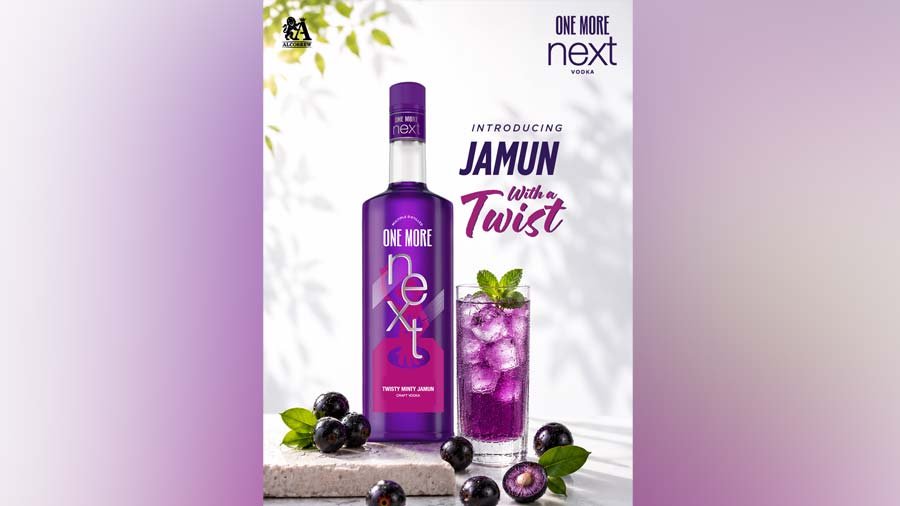
We explored that idea earlier this month with the launch of One More Next Twisty Minty Jamun, the newest variant in our One More Next vodka range. Jamun is hardly a novel flavour. It is a fruit most Indians have known since childhood, sold on handcarts in peak summer, tied to memory and seasonality. Most flavour launches chase novelty. We chased familiarity instead, because familiarity earns the first sip, while taste earns the second.
Pairing jamun’s tart, earthy character with a cooling note of mint created something that felt both recognisable and genuinely new. It requires very little in the way of mixers and works comfortably neat, an advantage in a market where convenience increasingly matters as much as taste. Following the success of our Cranberry variant, it also prompted a larger question: could an indigenous flavour become more than another variant on the shelf? Could it become a flavour code consumers associate specifically with us?
That question extends well beyond one product or one company. It reflects a broader shift across Indian spirits, and arguably across Indian consumer goods. For much of the last century, “premium” and “global” were treated as synonyms. Today’s consumers, particularly younger urban drinkers, no longer need that reassurance. They are not rejecting global categories; they simply want those categories to speak in a language they already understand. A whisky can still be a whisky. A vodka can still be a vodka. But the flavour it carries can be unmistakably Indian.
This is not just a cultural shift; it has real economic significance. India’s spirits industry has long pursued growth through pricing and distribution. Indigenous flavours offer something different: differentiation without discounting, and an opportunity to build brand identity around culture. A flavour such as jamun, kokum or imli is easy enough to replicate in formulation, but far harder to replicate in meaning. The associations they carry—summer, regional identity, childhood memories, street food—cannot be manufactured overnight. They have to be earned through consistency and time.
There is also a quieter implication. When an industry builds its innovation pipeline around domestic flavours, it signals confidence in where future value will be created. It reflects the belief that the Indian consumer’s idea of premium has matured. The confidence to draw from one’s own culture is often the clearest sign that an industry has stopped trying to prove itself and started expressing itself instead.
Jamun will not be the last indigenous flavour to make this journey from memory to market. Kokum, imli, aam panna and paan each carry their own regional identity and emotional resonance, waiting for categories confident enough to embrace them. What we are attempting with Twisty Minty Jamun is one early chapter in a much larger rewriting of what Indian spirits are allowed to taste like.
The category has begun speaking its own language, and this is only the beginning.



Leave a Reply