

For decades, whisky’s finest stories came from elsewhere.
Now, India is telling its own with Indian Single Malt.
For several years, I travelled to Scotland not as a businessman, but as a father. My daughter was studying there, and what began as visits soon became something closer to an education for me too. I would visit distilleries around Speyside, sit in their tasting rooms, and listen to distillers speak about their craft with a reverence usually reserved for something sacred. What struck me wasn’t the whisky itself, fine as it was, but the certainty in the room — an unspoken assumption that single malt belonged to Scotland, and to no one else.
I remember one such evening, glass in hand, thinking: why not us? India has barley, water, climate, and a distilling tradition older than most realise.
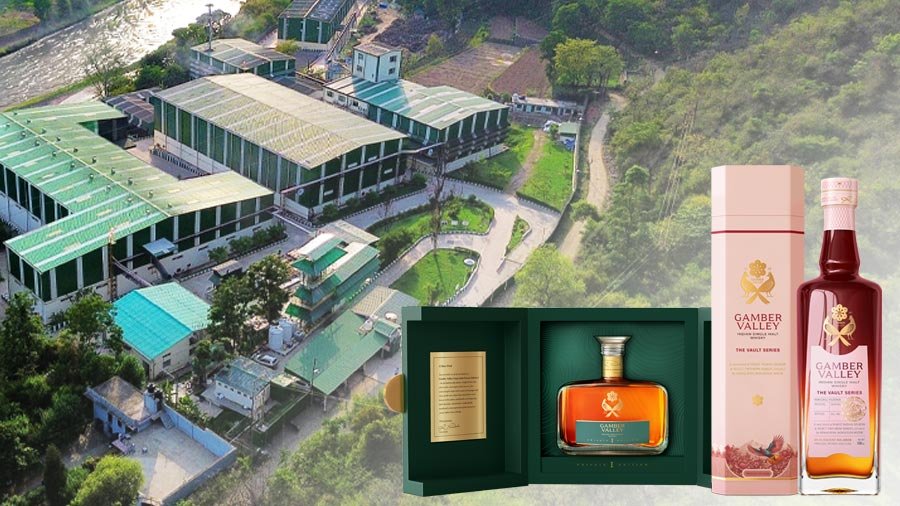
That question stayed with me long after those visits ended, and it eventually became the seed for our recently launched Gamber Valley Indian Single Malt. Alcobrew’s first Indian Single Malt Whisky. In truth, the seeds were planted years before we announced the brand. When we set up our facility in Solan, in the Himachal highlands, we were thinking of it as a long-term wager on geography itself.
The altitude, the Himalayan air, the temperature swings between day and night — these were never incidental to us. We recognised early that these conditions were extraordinary for maturation, the way a winemaker recognises a slope or a soil. But patience in this business is mandatory. You cannot rush a single malt. So we waited, we observed, we refined. What exists today as Gamber Valley is the result of years of quiet conviction.
If we were to compare Scotch with the Indian Single Malt Whisky, with the deepest respect for Scotland — and Scotland deserves every ounce of it — I find the comparison more interesting as a contrast than as a benchmark. Scottish whisky is defined by centuries of unhurried tradition, a slow and gentle climate that rewards waiting in a linear way. Indian climate offers something else: a dynamic environment, where the swing between day and night is dramatic, and where the conversation between spirit and cask is intensified rather than just prolonged. The Angel’s Share, as we have observed it, is meaningfully higher than in a temperate climate. We lose more liquid to the air — but in exchange, we concentrate flavour and complexity into a shorter span of years, often rivalling far older expressions from slower climates.
This is also why Indian Single Malt Whiskies choose not to lean on an age statement. The liquid speaks, the climate explains it, and the consumer experiences it. A whisky matured in India does not need to borrow the vocabulary of a fifteen-year-old Speyside malt. It has earned its own — built on warmth, texture, and a natural orientation toward spice that comes from the mountain rather than the calendar.
If we talk of the sales data, the numbers today vindicate that instinct more than I expected. In 2024, Indian single malts crossed fifty-three per cent of total single malt case sales within India, surpassing imported Scotch in volume for the first time. It is a structural shift in how a nation thinks about what belongs in its glass. India’s whisky market is valued in the range of sixteen hundred billion rupees, and within that, the single malt segment alone is expected to nearly triple by the turn of the decade. We are already the largest whisky-consuming nation on earth by volume. What has lagged, until recently, is our share of the global conversation around premium and luxury single malt — a gap now closing with real momentum.
What is happening, in other words, is not a fad. It is the maturing of an industry that spent two decades quietly building distilling expertise before the world thought to notice. The consumer driving this shift is not the consumer of a decade ago. Today’s single malt drinker in India is younger, often well-travelled, and has largely shed any residual deference to imported labels simply because they are imported. We are also seeing a meaningful rise in women choosing to participate in this category, reshaping not just who buys the bottle but how it is designed and spoken about. The question this consumer asks is no longer whether something is worth its price. It is whether it carries a story worth being part of.
For Gamber Valley Indian Single Malt Whisky, our ambition was to converse with Scotch — acknowledging centuries of craft while insisting that whisky, like wine, can carry the unmistakable signature of where it was made. Every stage, from distillation to maturation to bottling, happens under one roof at Solan, which means there are no gaps in the chain of custody from grain to glass — a transparency that today’s discerning consumer treats not as a marketing flourish, but as a baseline expectation.
What I learned outside Edinburgh’s tasting rooms, somewhat unexpectedly, was simple: legacy is earned, not borrowed. Every generation gets a narrow window to build something that outlasts it, and in this business that window is defined by the purity of the liquid you produce, the geography you root yourself in, and the patience you bring to both. India is finally earning its own legacy in spirits — not by claiming a seat at a table set by someone else, but by setting an entirely new one, on its own terms.



Leave a Reply