

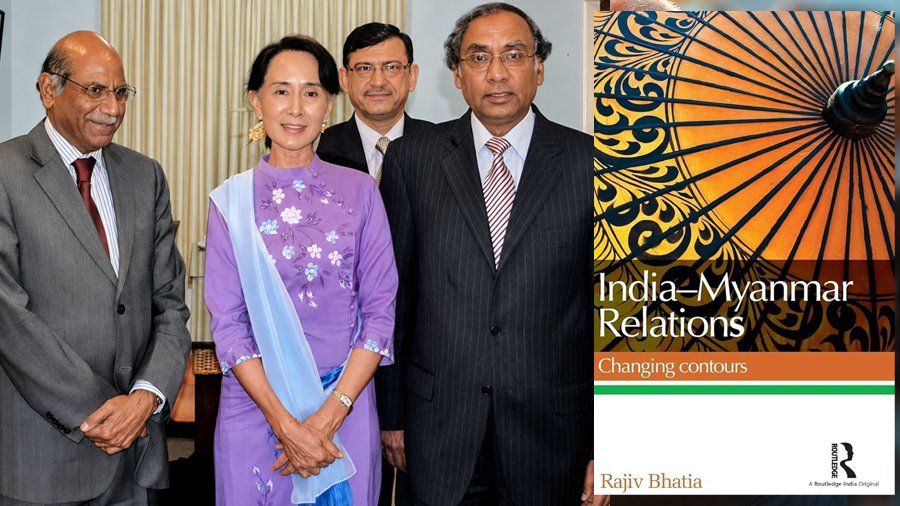
Diplomacy, language, and literature are all interconnected. A diplomat chooses words carefully to communicate, is a witness to, or at times even an architect of, history, and writes memoirs, thus contributing to the body of literature. They also write treatises on various facets of diplomacy and international relations, offering perspectives that are useful to academics.
I was persuaded to author a book on India-Myanmar relations by a former Malaysian diplomat who headed a prestigious think tank in Singapore. “There is a book inside you,” he announced on hearing my presentation at a seminar in Yangon the previous day. I was surprised and assailed by self-doubt for a while, but I wanted to believe him. The Routledge publication, which appeared in 2016, proved him right.
I authored this book for three reasons. One, people in India, even the informed ones, seemed to know very little about a vital neighbour such as Myanmar. It is a country bordering four northeastern states of India. A Mexican ambassador told me about his travail. While at the Delhi airport, he wanted to buy a SIM card that would work in Myanmar, but the salesperson had never heard of ‘Myanmar’ or its former name, ‘Burma’. I thought I had to contribute to the education of our younger generation.
Two, the challenge of turning a diplomat into a scholar excited me. Did I have the strength and the skill to do it? The book itself was the answer. Three, I strongly felt that I owed it to the people of my country and of Myanmar to craft a comprehensive story of the relations between our two nations. It had to be based on deep research and a careful grasp of history, but it must also reflect what I saw, heard, and experienced as India’s ambassador to Myanmar for over three years. Did I succeed? Ask my reviewers and readers.
My book featured important personalities from both countries. Among them was a historic figure, Aung San Suu Kyi, the famous daughter of Myanmar’s Independence hero, General Aung San. She is widely referred to as ‘the democracy icon’, a phrase she dislikes very much. “I always object to the word ‘icon’ because it’s very static; it stands there, and I happen to work very, very hard,” she once remarked.
As I write this, Daw Suu Kyi turns 81 today – 19 June 2026. She figured four times in my book: my first meeting with her on 30th January 2003, when she was under house arrest; my interaction with her in Delhi during her visit to India in November 2012; and our ICWA delegation meeting with her in Naypyitaw in March 2013.
Between 1989 and 2010, and from 2021–26, she spent over two decades in detention, whether in prison or under house arrest. Once again, her birthday has arrived, but not her freedom. “But,” as the BBC put it, “her long struggle against military rule has made her synonymous with hopes of a freer, more democratic future” for her nation.
When, on 14 November 2012, she concluded her Nehru Memorial Lecture at Vigyan Bhavan in New Delhi, I vividly remember her additional remarks:
I was saddened to see that we had drawn away from India, or rather that India had drawn away from us during our very difficult days. Still, I always had faith in the enduring friendship between our two countries, rooted in the enduring friendship between our two peoples… Governments come and go, and this is what democracy is all about, but people remain… Burma has still not reached the goal of democracy, and in this last, I hope, and most difficult phase, India will stand by us and walk by us as we proceed on the path that they were able to proceed upon many years before us.
Over 13 years later, these words remain relevant; in fact, they have become even more so.
Ask Kim Aris, her son, who has been campaigning for her release.
Daw Suu Kyi once said, “Please use your liberty to promote ours.”
Is the world listening?


Leave a Reply