

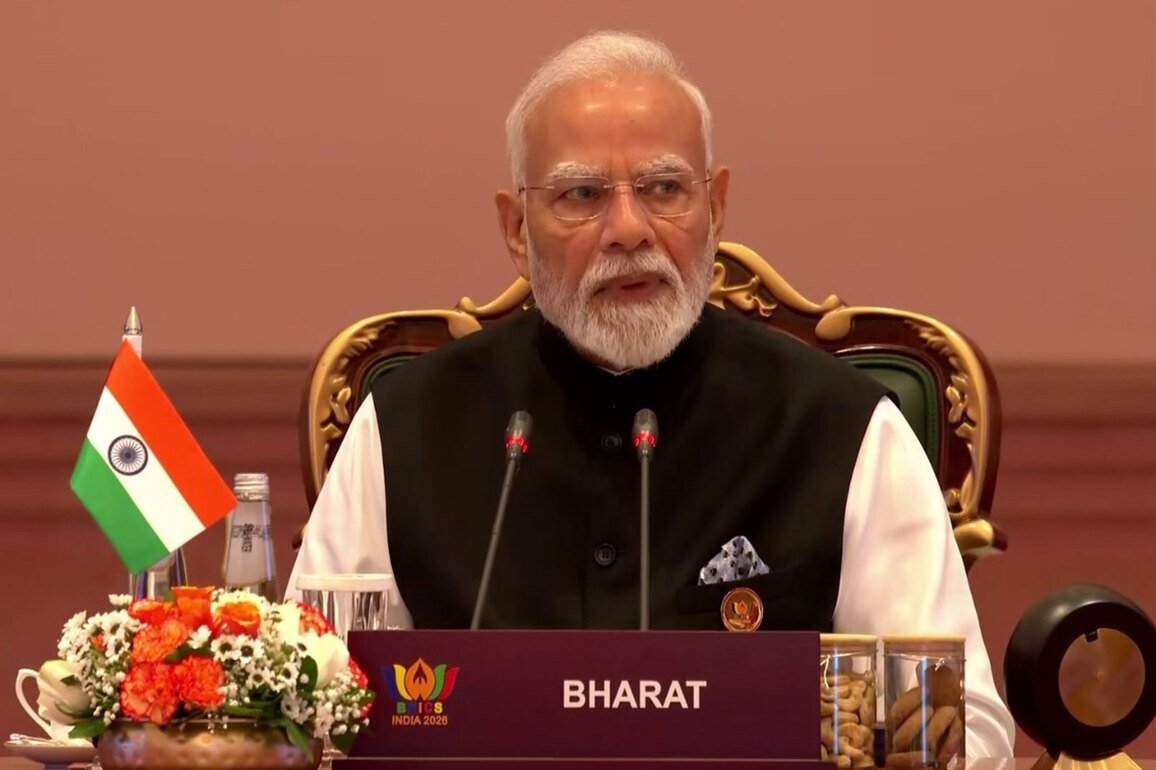
The BRICS Summit 2026 was held in New Delhi on September 12-13. The theme of the Summit was “Building for Resilience, Innovation, Cooperation and Sustainability”. The Summit received attention for more than one reason. The presence of Chinese President Xi Jinping and Russian President Vladimir Putin was significant, and equally important was the presence of Iranian President Masoud Pezeshkian – amidst the West Asia conflict. One of the notable achievements of the Summit was the fact that members were able to evolve a consensus and unanimously adopted a joint declaration over the West Asia conflict.
There were doubts over the same given the fact that during the BRICS Foreign Ministers’ meeting held in May 2026, the acrimony between Foreign Minister Abbas Araghchi and UAE Minister of State for Foreign Affairs Khalifa Shaheen Al Marar was clearly visible. During this meeting, members were unable to reach a consensus, due to which a joint statement remained elusive. In this context, the adoption of a joint statement was a clear diplomatic achievement for India.
Iranian President Masoud Pezeshkian also met with the Crown Prince of Abu Dhabi, Sheikh Khaled bin Mohamed bin Zayed Al Nahyan (UAE), on the sidelines of the Summit. In the aftermath of the West Asia conflict, the highest-level contact between the two countries was significant, since no major talks had been held between the two countries.
The New Delhi declaration expressed concern over unilateral tariffs, protectionism and sanctions. The declaration also reiterated the importance of the Global South and the role of BRICS in articulating concerns of the Global South. Said the declaration:
“….BRICS countries will continue playing a pivotal role in voicing the concerns and priorities of the Global South, as well as promoting a more just, sustainable, inclusive, representative and stable international order based on international law”.
New Delhi declaration and trade in local currencies
On the issue of trade in local currencies, the declaration, while encouraging trade in local currencies, adopted a pragmatic approach. Said the New Delhi Declaration:
“We acknowledge the work done to study the cross-border interoperability of payment and messaging channels, and the discussions on promoting trade settlements and investments using Brics local currencies, while respecting national priorities and acknowledging that there is no one-size-fits-all approach”
During BRICS meetings, the issue of linking Central Bank Digital Currencies (CBDC’s) was discussed, but India had reiterated its stance of opposing a BRICS Currency. Right at the beginning of India’s presidency of BRICS, earlier this year, the Reserve Bank of India (RBI) had recommended that linking CBDCs should be on the BRICS agenda.
India’s measured stance on trade in local currencies
India has taken a nuanced position on the issue of trade in local currencies. It distanced itself from a common BRICS currency due to concerns about China’s dominance in the same. Senior officials, including Commerce and Industry Minister Piyush Goyal, reiterated this point during BRICS meetings. While talking to the media, Secretary Economic Relations in the MEA, Sudhakar Dalela, said:
“… I would like to say that there is no proposal in the BRICS for a BRICS currency as of now.”
Here it would be pertinent to point out that India has also categorically stated that while reducing its dependence upon the dollar and giving precedence to its economic interests, it does not seek to undermine the US dollar in any way.
India’s trade in local currencies: Opportunities
India currently settles about 2 percent of its exports and 8 percent of its imports in INR. The share of imports is higher in local currency, as 96 percent of India–Russia trade is conducted in local currency, and India is a heavy importer of oil from Russia. India uses two primary mechanisms to execute trade in Indian rupees: formal Local Currency Settlement Systems (LCSS) and the broader Special Rupee Vostro Account (SRVA) network. India deals in local currency with several bilateral partners, including Indonesia, UAE, Bangladesh, Sri Lanka and Germany. However, the volume of transactions with these partners is nominal. India is also in the process of giving a push to local trade with partner countries of BRICS, including Malaysia and Vietnam. On the sidelines of the BRICS Summit, India held talks with Malaysia, Thailand and Vietnam for linking CBDCs.
It would be important to point out here that India’s trade in local currencies with BRICS+ — which includes members and partner countries – could reach 40%.
De-dollarisation Target of NDB
The New Delhi declaration did make a clear reference to the fact that the New Development Bank (established by BRICS) is shifting development finance away from the US dollar by scaling up lending in national currencies. Said the declaration:
“We encourage further efforts by the Bank to expand steadily its capacity to mobilise resources, foster innovation, expand local currency financing, diversify funding sources”
The NDB President Dilma Rousseff highlighted the point that a significant percentage of NDB’s lending in 2025 was in local currencies. NDB’s lending in local currencies has been steadily rising. In 2024, this increased to 24.2% and drastically improved to 45.9% in 2025 — for annual approvals.
In 2025, NDB approved its first-ever rupee-denominated loan and its second rupee-denominated equity investment last year.
Iran has applied for membership of the NDB. During his address, the Iranian President Masoud Pezeshkian pitched for turning the New Development Bank (NDB) into the primary funding source for infrastructure and energy projects via local-currency lending and credit lines.
Conclusion
While there is a strong consensus amongst BRICS countries that the dependency upon the US Dollar needs to be reduced in a changing economic architecture, some countries do not view this from a zero-sum geopolitical lens but from a purely economic perspective. Russia and China, for instance, have been speaking about the weaponisation of the US Dollar for a long time, while India has distanced itself from the idea of a “Common BRICS currency” and the idea of “undermining” the US Dollar in any way.
Apart from this, India has repeatedly stated that while BRICS should articulate the concerns of the Global South, it is not against anyone and is pushing the argument that BRICS is a “non-western” organisation but not “anti-west”. While BRICS and NDB can be a forum against the hegemony of the greenback, there is no immediate threat of de-dollarisation from BRICS.




Leave a Reply