

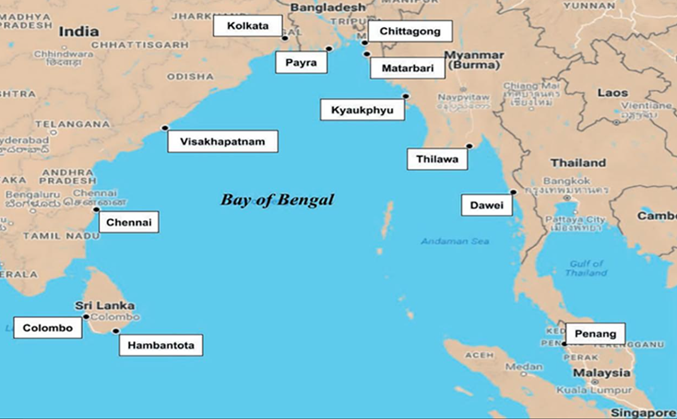
For centuries, the Bay of Bengal served primarily as a maritime bridge connecting South Asia with Southeast Asia. Today, however, it is rapidly evolving into one of the world’s most consequential geopolitical spaces. Located at the intersection of the Indian and Pacific Oceans, the Bay has become a focal point of strategic competition, economic connectivity, maritime security and regional diplomacy. As the Indo-Pacific emerges as the principal theatre of global geopolitics, the Bay of Bengal is increasingly viewed not as a peripheral water body but as a strategic frontier shaping the future balance of power in Asia (David Brewster, India’s Ocean: The Story of India’s Bid for Regional Leadership, Routledge, https://www.routledge.com/Indias-Ocean-The-Story-of-Indias-Bid-for-Regional-Leadership/Brewster/p/book/9780415830157).
The growing importance of the Bay stems from its geography. Bordered by India, Bangladesh, Myanmar, Thailand, Sri Lanka and Indonesia, it connects the Indian Ocean to the Strait of Malacca, one of the world’s busiest maritime chokepoints. A substantial portion of global trade and energy shipments passes through these waters, making the region critical for both economic prosperity and strategic stability (United Nations Conference on Trade and Development, Review of Maritime Transport, https://unctad.org/publications-search?series=1423). Consequently, major powers and regional actors alike are intensifying their engagement in the Bay, transforming it into a key arena of twenty-first-century geopolitics.
Geography Meets Strategy
The strategic significance of the Bay of Bengal lies in its location. The Bay serves as a gateway between South Asia and Southeast Asia while linking the Indian Ocean with the wider Indo-Pacific. Maritime routes traversing the Bay facilitate trade between Europe, the Middle East and East Asia. Any disruption in these sea lanes could have profound implications for global commerce and energy security (UNCTAD, Review of Maritime Transport, https://unctad.org/publications-search?series=1423).
For India, the Bay occupies a central place in its maritime strategy. India’s eastern coastline, the Andaman and Nicobar Islands, and its Act East Policy collectively position the country as a natural stakeholder in the region’s stability (Ministry of External Affairs, Government of India, Act East Policy, https://www.mea.gov.in/Portal/ForeignRelation/Act_East_Policy.pdf). The Andaman and Nicobar archipelago, situated close to the Strait of Malacca, provides India with a strategic vantage point to monitor maritime activity and safeguard critical sea lanes.
At the same time, the Bay has attracted increasing attention from external powers. The United States, Japan, Australia and several European countries have expanded their engagement in the Indo-Pacific, viewing the region as vital to maintaining a free, open and rules-based maritime order (International Institute for Strategic Studies, https://www.iiss.org).
The China Factor
No discussion of the Bay of Bengal’s strategic transformation can ignore China’s growing presence. Through the Belt and Road Initiative (BRI), Beijing has invested heavily in infrastructure and connectivity projects across the region. Ports, industrial zones and transport corridors in countries surrounding the Bay have expanded China’s economic and strategic footprint (Observer Research Foundation, https://www.orfonline.org).
The development of the Kyaukphyu deep-sea port in Myanmar exemplifies this trend. The project provides China with access to the Indian Ocean while reducing its dependence on the Strait of Malacca for energy imports. Similar investments across South Asia have generated concerns regarding debt dependency, strategic leverage and the long-term implications of Chinese maritime expansion (Observer Research Foundation, https://www.orfonline.org).
For India, China’s growing influence in the Bay presents both strategic and diplomatic challenges. New Delhi seeks to preserve regional stability while preventing the emergence of a security environment dominated by any single power. This dynamic has added a competitive dimension to the Bay’s geopolitical landscape, making it an important arena of great-power interaction.
BIMSTEC and Regional Cooperation
Amid growing geopolitical competition, regional cooperation mechanisms have acquired renewed significance. The Bay of Bengal Initiative for Multi-Sectoral Technical and Economic Cooperation (BIMSTEC) has emerged as a particularly important platform (BIMSTEC Official Website, https://bimstec.org).
Comprising Bangladesh, Bhutan, India, Myanmar, Nepal, Sri Lanka and Thailand, BIMSTEC connects South Asia with Southeast Asia and reflects the strategic centrality of the Bay. In recent years, member states have expanded cooperation in areas such as connectivity, trade, disaster management, maritime security and counter-terrorism (BIMSTEC Official Website, https://bimstec.org).
The organisation has gained prominence as India seeks to strengthen regional partnerships and reduce dependence on larger regional institutions that have often been constrained by political disagreements. Enhanced BIMSTEC cooperation offers the possibility of creating a more integrated Bay of Bengal region capable of addressing shared challenges while promoting economic growth.
Maritime Security Challenges
Despite its economic potential, the Bay of Bengal faces a range of security challenges. Illegal fishing, maritime trafficking, piracy, environmental degradation and natural disasters continue to threaten regional stability. Climate change has further intensified vulnerabilities, particularly for coastal communities and low-lying areas (Observer Research Foundation, https://www.orfonline.org).
The political instability in Myanmar has added another layer of complexity. Ongoing conflict has implications for border security, refugee flows and regional connectivity initiatives. The instability also affects maritime governance and complicates efforts to enhance economic integration across the Bay.
Recognising these challenges, regional states have increased naval cooperation, maritime domain awareness initiatives and joint exercises. Such efforts are essential for ensuring that the Bay remains a secure and reliable maritime space.
Economic Corridors and Connectivity
The Bay of Bengal is not merely a security theatre; it is also an emerging hub of economic connectivity. Infrastructure projects linking ports, highways, railways and energy networks are reshaping regional economic geography.
India’s efforts to enhance connectivity with Southeast Asia through projects such as the India-Myanmar-Thailand Trilateral Highway complement broader regional initiatives aimed at improving trade and investment flows (Ministry of External Affairs, Government of India, Act East Policy, https://www.mea.gov.in/Portal/ForeignRelation/Act_East_Policy.pdf). Port modernisation projects in Bangladesh and Sri Lanka are similarly strengthening the region’s role in global supply chains (UNCTAD, Review of Maritime Transport, https://unctad.org/publications-search?series=1423).
As companies seek to diversify production networks and reduce supply-chain vulnerabilities, the Bay of Bengal could become an important centre of manufacturing, logistics and maritime commerce. Improved connectivity has the potential to generate economic opportunities for millions while fostering greater regional integration.
Conclusion
The Bay of Bengal is undergoing a profound strategic transformation. Once regarded primarily as a regional waterway, it is now emerging as a critical geopolitical frontier at the heart of the Indo-Pacific. The convergence of maritime trade, strategic competition, infrastructure development and regional cooperation has elevated the Bay’s importance in global affairs (Brewster, 2014; International Institute for Strategic Studies, https://www.iiss.org).
For India and its regional partners, the challenge lies in ensuring that the Bay remains a zone of cooperation rather than confrontation. Achieving this objective will require stronger institutions, enhanced connectivity, effective maritime governance and sustained diplomatic engagement. As geopolitical competition intensifies across the Indo-Pacific, the future of the Bay of Bengal will play a significant role in shaping the strategic landscape of Asia and beyond.



Leave a Reply