

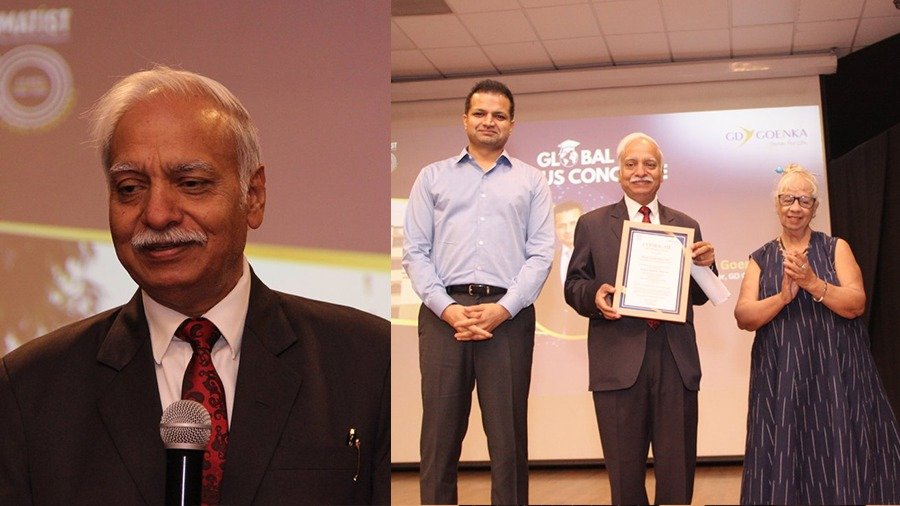
At the Global Campus Conclave, Prof. R. M. Joshi, Vice Chancellor of the Indian Institute of Foreign Trade, reflected on India’s demographic strength, multilingualism, entrepreneurial spirit and growing role in the internationalisation of education.
India is no longer simply a country from which students leave to pursue international education. It is increasingly becoming a country that the world is looking towards, for students, talent, knowledge, entrepreneurship and educational partnerships.
That was one of the central messages of Prof. R. M. Joshi, Vice Chancellor of the Indian Institute of Foreign Trade (IIFT), in his address at the Global Campus Conclave, organised jointly by Diplomatist@30 and GD Goenka Group on 18 August at GD Goenka The Flagship School, New Delhi.
Prof. Joshi described the theme of the conclave as particularly relevant to the changing landscape of education. For him, the idea of a “global campus” is not simply about students crossing borders. It is about understanding cultures, markets, languages and societies and developing the ability to operate confidently in an interconnected world.
India’s greatest strength: its people
Prof. Joshi placed India’s enormous student population and demographic profile at the centre of his argument.
India has one of the world’s largest education systems, with approximately 240 million students enrolled in school education in 2023–24, according to recent data.
For Prof. Joshi, the scale itself represents an extraordinary opportunity. But numbers are only one part of India’s advantage. The other is its young population.
India remains among the world’s youngest large economies, with a median age of roughly 29 years. Recent Indian government and policy sources continue to identify this young population as a major potential demographic dividend.
“India is the youngest big economy on the earth,” Prof. Joshi told the audience, contrasting India’s demographic profile with ageing populations in several major economies.
For an education system, this youthfulness is both an opportunity and a responsibility.
A large young population can become an enormous source of innovation, entrepreneurship and economic growth but only when education equips it with the knowledge and skills required to participate meaningfully in the global economy.
India’s multilingual advantage
One of the more distinctive themes of Prof. Joshi’s address was India’s linguistic diversity.
He argued that India’s multilingual environment is not merely a cultural characteristic; it can also become an educational advantage.
“On an average a person knows three languages. In South India, people know four languages.”
India’s multilingualism, he suggested, encourages young people to move between linguistic and cultural contexts from an early age. Hindi, English and regional languages often coexist within the educational and social experience of Indian students.
This creates a form of adaptability that becomes increasingly valuable in an international environment.
The global campus, in his formulation, therefore requires more than English-language proficiency. It requires the ability to understand different ways of communicating, thinking and interpreting the world.
From international education to international understanding
Prof. Joshi also brought his own experience in international marketing and global engagement into the conversation.
Having worked across numerous countries, including extensively in Africa, he emphasised that internationalisation cannot be reduced to a generic understanding of “foreign countries”.
“You need to understand the nuances and the differences between the countries and between the cultures.”
That observation is particularly relevant to the changing nature of international education.
A student who studies abroad or an international student who comes to India, does not simply enter another academic system. They enter another cultural environment, with different social codes, expectations and ways of communicating.
Prof. Joshi highlighted the concept of high-context cultures, where meaning may be conveyed through context, relationships and what remains unsaid as much as through explicit words. India, Japan and Korea, he noted, offer examples of societies where contextual communication can be particularly important.
For young people preparing to work across borders, cultural intelligence can therefore be as important as academic knowledge.
The global citizen
Prof. Joshi’s intervention also connected directly with the larger idea of global citizenship education.
He recalled his involvement in the development of India’s National Education Policy and specifically his role in a committee dealing with global citizenship education.
“Global citizenship is, you need to understand the nuances of the international markets.”
That understanding is increasingly essential.
Students entering today’s workforce are likely to work with multinational teams, serve international markets, interact with people from different cultural backgrounds and navigate economic and geopolitical shifts that originate far beyond their own borders.
The global citizen, therefore, is not simply someone who has travelled.
It is someone who can understand difference without being intimidated by it.
Preparing students for uncertainty
Another strong thread running through Prof. Joshi’s address was the changing nature of the global environment.
He referred to the familiar VUCA framework—volatility, uncertainty, complexity and ambiguity, and then offered his own memorable formulation:
“Something which has become very certain now is uncertainty. Something which is not going to change is change. And something which is going to be very predictable in the time is unpredictability.”
For students, this has an important implication.
Education cannot prepare them for one fixed version of the future because the future itself will continue to change. Instead, education must develop the capacity to learn, unlearn and relearn.
That means moving beyond the question, “What job will you get after graduation?” towards a broader question: “How capable are you of adapting when the nature of that job changes?”
Intelligence in the age of artificial intelligence
Prof. Joshi also addressed one of the defining questions confronting education today: artificial intelligence.
His observation was deliberately provocative: “You are using your intelligence, they are using artificial intelligence. Even intelligence has become artificial.”
Rather than viewing technology simply as a threat, however, he positioned it within a larger question of human capability.
His warning was succinct: “Science and technology is a good servant but a dead master.”
For schools and universities, this raises a fundamental challenge. If AI can increasingly retrieve information, generate text, analyse data and perform tasks that were once considered markers of intellectual ability, education must become even more focused on what remains distinctly human: judgment, creativity, curiosity, ethics, interpretation and the ability to ask the right questions.
India as both sender and destination
Prof. Joshi’s address also captured the changing nature of India’s relationship with international education.
For decades, the dominant narrative has been one of Indian students travelling overseas for higher education. That remains an important part of India’s international education story.
But the direction of movement is no longer one-way.
India is increasingly seeking to attract foreign universities, international students and educational partnerships. The National Education Policy 2020 explicitly places internationalisation and the development of India as a global study destination among its objectives.
Prof. Joshi recalled his involvement in the policy process and the opening up of possibilities for foreign higher education institutions to establish a presence in India.
This is where the concept of the Global Campus becomes especially relevant.
The future is not necessarily about choosing between “study in India” and “study abroad.”
It is increasingly about creating educational ecosystems where students can experience international perspectives without international education becoming detached from local contexts.
The India opportunity
Underlying Prof. Joshi’s address was a strong confidence in India’s ability to participate in and shape, the global education landscape.
India’s scale, young population, linguistic diversity, entrepreneurial culture and growing economic importance give it considerable potential.
But potential does not automatically translate into global leadership.
The real opportunity lies in building educational institutions capable of turning demographic scale into human capability.
As Prof. Joshi put it: “Have trust in India.”
At the Global Campus Conclave, that message carried particular resonance.
The world is increasingly coming into Indian classrooms, through international students, universities, diplomats, technology, partnerships and ideas.
At the same time, Indian students and graduates are travelling outwards, carrying Indian talent into universities, companies and institutions around the world.
The global campus, therefore, is no longer a distant concept. It is already taking shape, and India is both a participant and an increasingly important destination.


Leave a Reply