

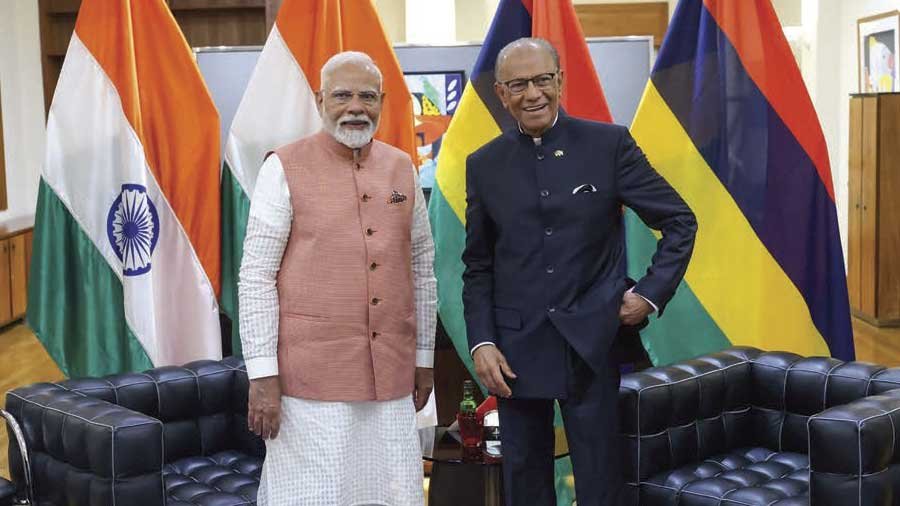
In 2015, while commissioning the offshore patrol vessel Barracuda in Mauritius, Prime Minister Narendra Modi unveiled India’s maritime policy: SAGAR – Security and Growth for All in the Region. A decade later, on the same island, PM Modi announced MAHASAGAR (Mutual and Holistic Advancement for Security and Growth Across Regions) – expanding the Indian Ocean maritime strategy to a global maritime vision, with particular focus on the Global South. Since both maritime visions were unveiled in the same island nation, it is pertinent to reflect on the country’s strategic maritime importance in shaping India’s maritime strategy.
Although Mauritius is one of the smallest countries in the world, its strategic location – east of Madagascar, linking Africa and Asia, near the critical maritime trade route – the Cape of Good Hope- enhances its geopolitical significance in the Indian Ocean. For India, along with the geographical proximity, the island shares profound cultural, civilisational, historical, and linguistic ties. With roughly 70% of its population of Indian descent, it is affectionately called “Chhota Bharat” or Mini India.[1] This deep cultural resonance has translated into one of India’s most reliable strategic partnerships over the decades, especially in the maritime domain.
Anchoring India’s Maritime Architecture
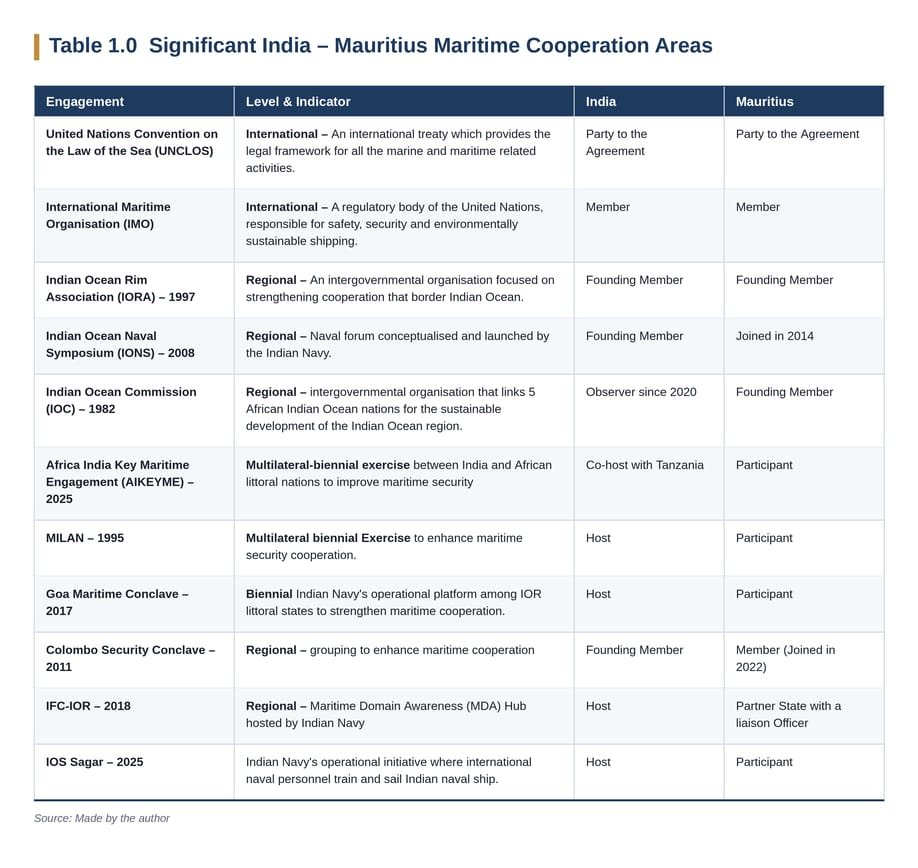
India-Mauritius maritime cooperation is grounded in India’s Neighbourhood First Policy and the MAHASAGAR Vision. What makes this partnership particularly distinctive is Mauritius’s presence across nearly every layer of India’s maritime architecture, as illustrated in Table 1.0. UNCLOS gives both the countries the legal basis for the maritime claims, and IMO supplies the operational layer for both the countries to coordinate on shipping safety, security, and pollution control.
Moreover, both the states are founding members of the Indian Ocean Rim Association (IORA); Mauritius sits in the Indian Ocean Naval Symposium (IONS) that India conceived, and its membership of the Indian Ocean Commission (IOC) helped open the door to Indian observer status in 2020. Moreover, Mauritius joined the Colombo Security Conclave in 2022 and posts a liaison officer to the Information Fusion Centre in Gurugram, India, associating directly with Indian Maritime Domain Awareness (MDA).
Beyond these institutional engagements, the maritime ties are much thicker on the bilateral end. The trust and goodwill of the cooperation run across assistance in equipment, people, and institutions.
Capacity Building to Operational Capability
India has supplied Mauritius with key assets including the offshore patrol vessel Barracuda, the patrol ships – Victory and Valiant, interceptor boats, maritime aircraft such as Dornier maritime aircraft, Chetak and Advanced Light Helicopters, surveillance radar systems, automatic identification systems, and many more. But what translates this capacity into sustained capability is the human embedding. The Indian Navy has trained hundreds of personnel from the Mauritius National Coast Guard in the last nine years.[2] Moreover, India announced in April 2026 that it would post a resident Defence Attaché in Mauritius to strengthen bilateral ties and overall security in the Indian Ocean Region (IOR).
India and Mauritian personnel actively patrol and survey Mauritius’s Exclusive Economic Zone (EEZ), which is about 2.3 million sq. kilometres. While the EEZ surveillance strengthens the bilateral and regional maritime security aspect, the joint hydrographic surveys under a memorandum first signed in 2005, and renewed in 2025, provide the economic leverage (knowledge of seabed), geopolitical advantages (countering external influence) and exclusive strategic influence (institutional access on critical trade routes) for India in the Western IOR.[3]
Infrastructure, Information Sharing and Beyond
Beyond capacity building and capability enhancement, India and Mauritius deepened their mutual trust, commitment and enduring partnership in 2024 and 2025 through a series of defining agreements.
The first was welcoming Indian-built infrastructure on Agalega Island of Mauritius. In 2024, India inaugurated an airstrip – capable of supporting P-8I operations- and a jetty able to service Indian ships at the time of crisis.[4] These facilities extend India’s geographical and operational outreach across the WIOR while enhancing Mauritius’s own surveillance and response capacity.
The second, and the one that complements the existing relationship, is India’s guiding vision – the announcement of MAHASAGAR in 2025. Although it is often viewed as a framework for economic and security development of the Global South, its practical implementation is already evident across multiple domains. For instance, the 2025 agreement to establish a National Maritime Information Sharing Centre in Mauritius to facilitate coordinated sea-lane monitoring, maritime surveillance, and developmental support across the Chagos Marine Protected Area and its expanded economic zone. [5]This further strengthens MDA, security cooperation, maritime governance, economic development, and further consolidates India’s role as a net security partner in the IOR.
Shared Prosperity: Security with Development
Maritime cooperation constitutes a foundational layer of the New Delhi – Port Louis relationship, yet the relationship rests on a deeper sense of trust that stems from India’s commitment to the island’s development and growth story.
Mauritius is India’s first African state to sign the Comprehensive Economic Cooperation and Partnership Agreement (CECPA) in 2021.[6] According to the Ministry of Commerce, bilateral trade has grown substantially over the years, increasing from approx. USD 787 million in 2021-22 to USD 887 million in 2024-25, with India maintaining a trade surplus.[7] The CECPA provides mutual preferential market access for goods and services.
And, with the elevation of the ties to an Enhanced Strategic Partnership in 2025, the cooperation and investments have diversified into energy security, financial integration through India’s UPI and RuPay networks into the Mauritian financial gateway, direct trade settlement using Indian Rupees (INR) and Mauritian Rupees and supporting high-impact infrastructure projects.[8] Few notable examples of India’s continued support in Mauritian infrastructural needs include – Metro Express project, New Supreme Court Building, hospital, housing units, educational tablets, transport services, and broader educational assistance which reflect the tangible expressions of trust and long-term commitment.
In the maritime domain as well, in 2025, both countries expressed a collective desire to cooperate in the fields of maritime priorities of Mauritius – joint surveillance, hydrographic surveys, port safety, security for the Mauritius Port Authority and other marine operations.[9] This is the practical embodiment of a security-with-development continuum.
Conclusion
In sum, Mauritius’s geographical location gives strategic weight; shared history and culture give the relationship unique depth; sustained capacity-building, investments and security ties convert proximity into long-term reliance.
In an increasingly contested Indian Ocean, the New Delhi–Port Louis partnership demonstrates how security cooperation, institutional engagement, maritime cooperation, and people-centric development can reinforce one another. Mauritius remains not merely a partner but an indispensable anchor for India’s maritime strategy – linking the western Indian Ocean to the broader Global South and embodying the principle of mutual and holistic advancement for security and growth.
References:
[1] PTI. (2018, May 3). Indira Gandhi called us “Chota Bharat”: Mauritius PM. Deccan Herald. https://www.deccanherald.com/world/indira-gandhi-called-us-chota-2411416.
[2] Raksha Samachar. (2026, April 17). Indian Navy’s maritime diplomacy in Indian Ocean! 516 Coast Guard of Mauritius trained in 9 years under MAHASAGAR Vision. https://www.rakshasamachar.com/en/indian-navy/india-mauritius-maritime-security-blue-economy-training-516-personnel/.
[3] Indian Navy. (2025, September 29). INS Sutlej arrives at Port Louis for 18th joint hydrographic survey mission in Mauritius. https://indiannavy.gov.in/content/ins-sutlej-arrives-port-louis-18th-joint-hydrographic-survey-mission-mauritius.
[4] Roy Chaudhury, D. (2024, March 1). India, Mauritius inaugurate airstrip & jetty in Agalega. The Economic Times. https://economictimes.indiatimes.com/news/india/india-mauritius-inaugurate-airstrip-jetty-in-agalega/articleshow/108117455.cms
[5] Ministry of External Affairs, Government of India. (2025, March 12). India-Mauritius joint vision for an enhanced strategic partnership. https://www.mea.gov.in/bilateral-documents?dtl/39159/IndiaMauritius+Joint+Vision+for+an+Enhanced+Strategic+Partnership+March+12+2025
[6] High Commission of India, Port Louis, Mauritius. (n.d.). Comprehensive Economic Cooperation and Partnership Agreement (CECPA). Retrieved September 7, 2026, from https://www.hcimauritius.gov.in/page/comprehensive-economic-cooperation-and-partnership-agreement-cecpa/
[7] Department of Commerce, Ministry of Commerce & Industry, Government of India. (n.d.). India-Mauritius total trade. Trade Statistics. Retrieved September 7, 2026, from https://tradestat.commerce.gov.in/eidb/country_wise_ttrade
[8] Press Information Bureau, Government of India. (2025, March 12). India-Mauritius joint vision for an enhanced strategic partnership. https://www.pib.gov.in/PressReleasePage.aspx?PRID=2110718®=48&lang=2
[9] Press Information Bureau, Government of India. (2025, March 12). India-Mauritius joint vision for an enhanced strategic partnership. https://www.pib.gov.in/PressReleasePage.aspx?PRID=2110718®=48&lang=2



Leave a Reply