

Some literary readings entertain. Others linger long after the final word has been spoken.
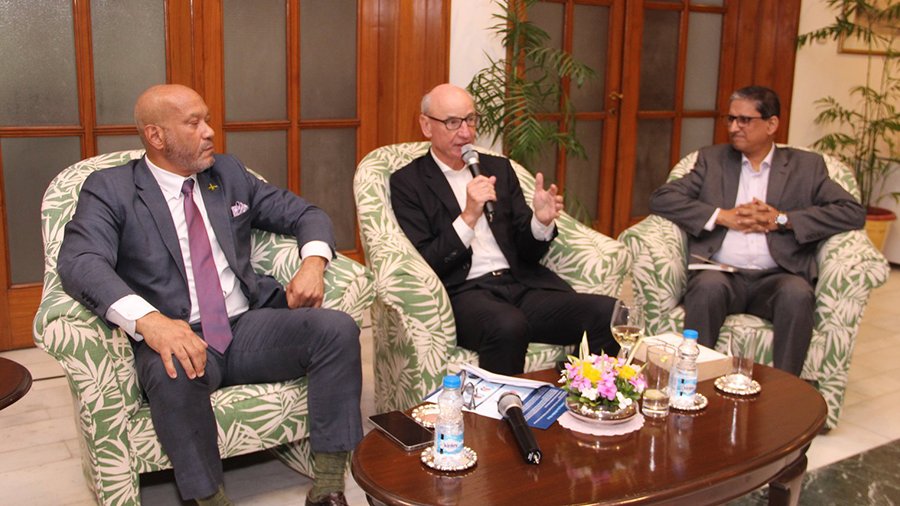
At the Literary Evening jointly organised by the Austrian Embassy and Diplomatist Magazine at the Residence of the Austrian Ambassador in New Delhi, on 25th June 2026, H.E. Dr. Robert Zischg, Ambassador of Austria to India, chose not poetry but one of the most enduring works of modern European literature, Franz Kafka’s The Trial. In doing so, he reminded the audience that literature is often at its most powerful when it refuses to provide easy answers.
Introducing his selection, Ambassador Zischg observed with characteristic wit that the English language itself has immortalised Kafka through the expression “Kafkaesque”, a word now universally used to describe situations of bewildering bureaucracy, opaque authority and seemingly endless procedures.
As a career diplomat and public servant, he admitted that Kafka’s exploration of bureaucracy held a particular fascination for him.
“People were already complaining about bureaucracy more than one hundred years ago,” he remarked with a smile. “The system was unclear, people became lost in it, and ordinary citizens often did not know who was responsible for what.”
Before beginning the reading, Ambassador Zischg transported the audience to the extraordinary cultural landscape of Vienna and Central Europe at the turn of the twentieth century. The decades between the late nineteenth century and the outbreak of the First World War, he reflected, were among the richest periods in European intellectual history, a remarkable age that produced not only Kafka but also Freud, Mahler, Klimt, Schönberg and many other towering figures who reshaped modern thought.
“If I could choose one historical period to live in,” he remarked, “it would be those years between roughly 1890 and 1914, before the First World War changed everything.”
He then read one of the most celebrated passages from The Trial—the haunting parable “Before the Law.”
In the story, a man from the countryside spends his entire life waiting before a door that supposedly leads to the Law. A solitary gatekeeper repeatedly tells him that entry is “not yet” possible. The man waits patiently for years, offering gifts, asking questions and hoping for permission that never comes. Only as death approaches does he learn the devastating truth: the entrance had been intended solely for him, and now it will be closed forever.
The passage captivated the audience through its quiet simplicity and profound symbolism.
Kafka never explains what the Law represents. Nor does he reveal why the man never walks through the open doorway. That uncertainty is precisely what has made the novel one of the defining works of twentieth-century literature.
During the conversation that followed, Chair Ajay Jain, Founder of Kunzum Bookstore, asked Ambassador Zischg why he had selected this particular passage.
The Ambassador explained that Kafka has long been one of his favourite authors because his stories exist in a space where reality itself becomes uncertain.
“I enjoy stories that are slightly detached from reality,” he reflected. “They make us question whether the reality we think we perceive is actually the real reality.”
Beyond its literary brilliance, he noted, The Trial remains astonishingly contemporary. Although written more than a century ago, its themes continue to resonate with modern societies navigating increasingly complex institutions and administrative systems.
But Ambassador Zischg broadened the discussion far beyond bureaucracy.
He suggested that Kafka’s work also captures something far more universal: the uncertainty that accompanies periods of profound historical change.
Drawing thoughtful parallels between Europe at the dawn of the twentieth century and the contemporary international order, he observed that both eras were marked by political upheaval, rapid transformation and widespread anxiety about the future.
“The world was unpredictable then,” he reflected. “Things were complicated then as well. Today we often think we are living in uniquely uncertain times, but history reminds us that previous generations experienced similar uncertainties.”
His reflections naturally turned towards history.
Recalling how the Austro-Hungarian Empire entered the First World War in 1914, believing military action would resolve political disputes, Ambassador Zischg noted that history has repeatedly demonstrated the tragic limitations of war as an instrument of policy.
Without dwelling on current geopolitical conflicts, he gently reminded the audience that many of today’s challenges continue to echo the dilemmas of the past.
“The First World War did not resolve those problems,” he observed. “Neither did the Second. History teaches us that war rarely provides lasting solutions.”
It was a reflection delivered not as a political argument but as a literary observation, one emerging naturally from Kafka’s world of uncertainty, authority and human vulnerability.
Throughout the evening, Ambassador Zischg’s reading demonstrated why Kafka continues to speak across generations.
His characters struggle to understand systems they cannot fully comprehend.
They search for meaning in institutions that offer few explanations. They confront uncertainty with persistence rather than certainty.
More than a century after The Trial was written, those questions remain strikingly relevant, not only to governments and public institutions, but to individuals navigating an increasingly complex world.
By choosing Kafka, Ambassador Robert Zischg offered the audience something far greater than a literary reading.
He offered a reminder that the finest literature does not simply describe its own age.
It quietly continues to illuminate ours.


Leave a Reply