

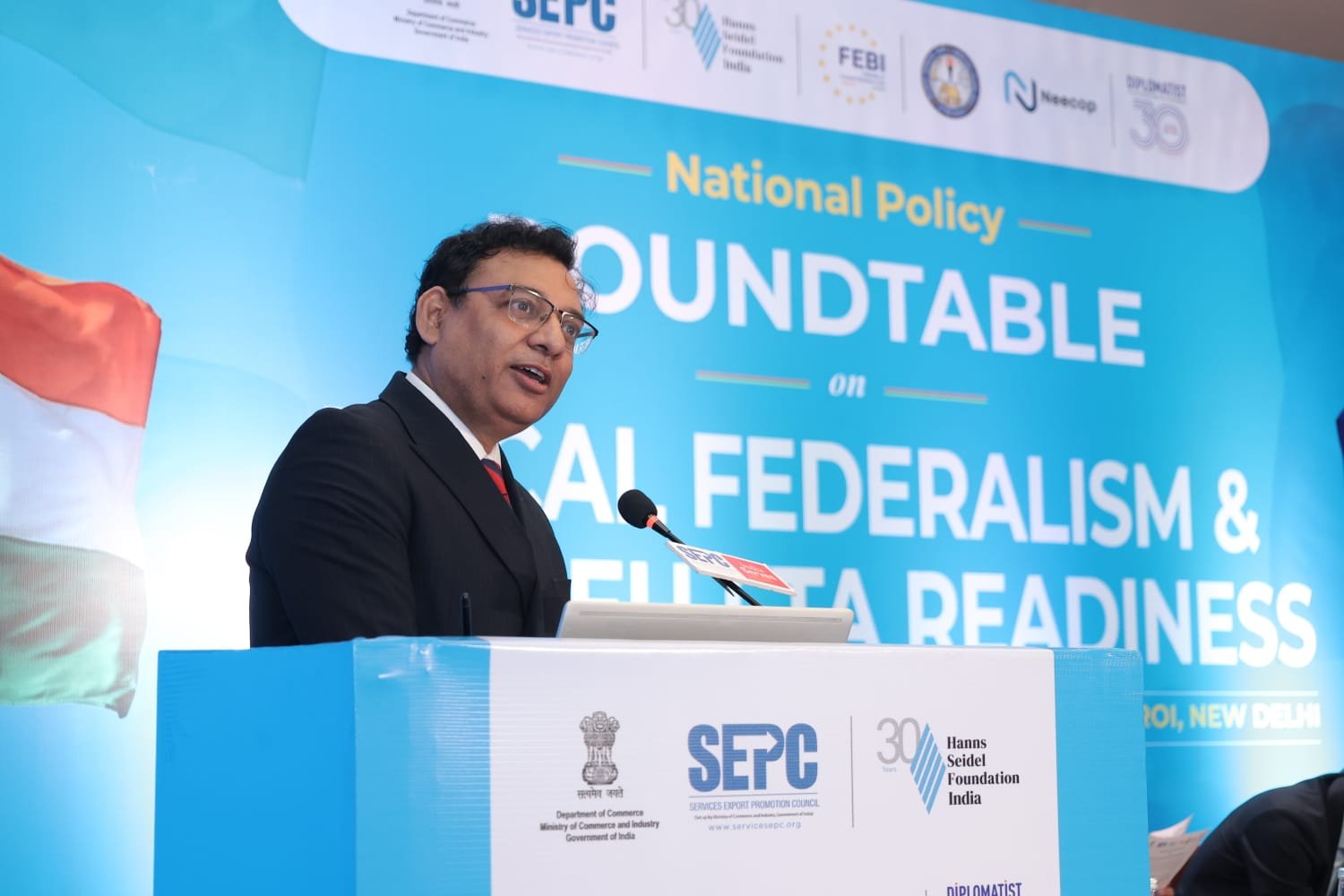
The SEPC Director General underlined the need to take India–EU FTA awareness and preparedness beyond policy circles, with states and the services sector playing a central role in implementation.
Dr Abhay Sinha, Director General, Services Export Promotion Council (SEPC), emphasised the importance of strengthening state-level preparedness and widening awareness of the India–EU Free Trade Agreement during the National Policy Roundtable on “Fiscal Federalism and India–EU FTA Readiness” on 6th October in New Delhi.
Reflecting on the day-long discussions, Sinha noted that the deliberations had raised several questions that still required attention. He invited participants to continue sharing these questions with SEPC so that the Council could work with experts to develop responses and communicate them back to stakeholders.
He emphasised the need to address the readiness of individual states. While much of the discussion around FTAs takes place at the national level, Sinha stressed that institutions such as SEPC have an important role in helping states understand and prepare for the opportunities and challenges emerging from the India–EU agreement.
“That’s where I believe organisations like us have a role to play,” he said, pointing to SEPC’s mandate to create greater awareness about the India–EU FTA, particularly from the perspective of the services sector.
Sinha also cautioned against viewing the agreement exclusively through the lens of merchandise trade. The services dimension, he argued, needs to be considered alongside goods, particularly because many sectors increasingly depend on an integrated combination of goods and services.
He highlighted a persistent challenge: the lack of sufficiently granular data on services, particularly at the state level. “We don’t have any granular data,” he observed, suggesting that the absence of detailed information makes it more difficult to assess state-level preparedness and identify where interventions are required.
For Sinha, awareness-building is therefore an essential first step. Without greater understanding among state policymakers, it would be difficult to raise preparedness levels or ensure that states are positioned to take advantage of the opportunities presented by the FTA.
He proposed a more active engagement with states, particularly those that have not yet come forward to participate in discussions around the agreement. Rather than adopting a one-size-fits-all approach, SEPC could work with individual states to understand their existing strengths and identify areas where further capacity-building is required.
“Some states are already reactive, but more so the states which have yet to come forward,” Sinha said, emphasising the need to reach out to these states and organise dedicated interactions and awareness sessions.
This approach, he suggested, should form part of a broader institutional mechanism involving SEPC, industry associations and other stakeholders. The objective would be to ensure that once state-level opportunities and constraints are identified, the necessary preparedness is already underway.
For Sinha, the next stage of the India–EU engagement therefore cannot remain confined to conference rooms. Awareness and preparedness need to extend to states, businesses, policymakers and younger generations, creating a wider ecosystem capable of translating the FTA into tangible economic opportunities.


Leave a Reply