

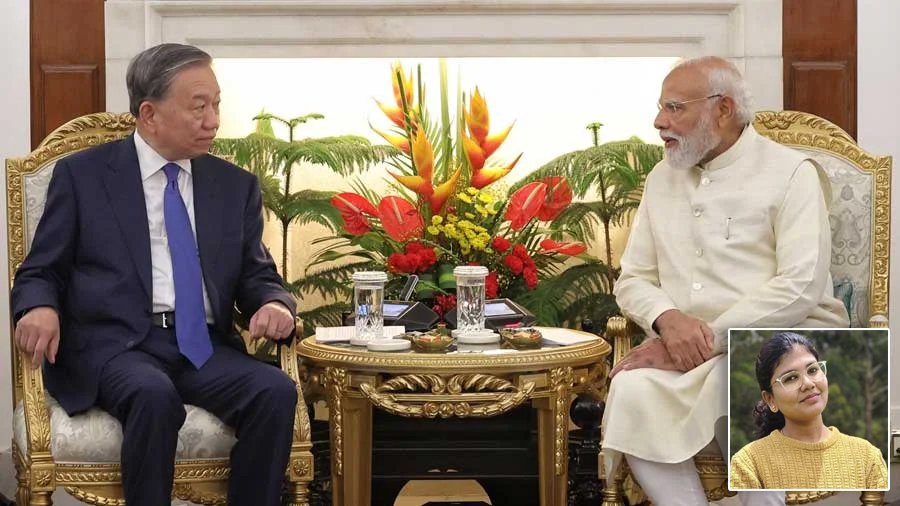
With the dynamic geopolitical framework in the 21st century, there is hardly any bilateral relationship that has grown between Vietnam and India. Since it was characterised at its inception mostly by common historical experiences of colonialism and the unity of the Cold War, the relationship has changed. Since India implemented its foreign policy in 2014, redefining its previous foreign policy as the Look East Policy into a more expansive Act East Policy, Vietnam became a pivot state in Southeast Asia. As it happens, Vietnam is at the exact crossroads of the two strategic frameworks, such as the Act East Policy and the wider Indo-Pacific Vision.
Stakeholders in the India-Vietnam relationship have a vision of the Indo-Pacific to lay the foundation of the relationship. Each of the countries promotes the following: a free, open, inclusive, and rules-based order based on respect of national sovereignty and international law, namely, the 1982 United Nations Convention on the Law of the Sea. The Indo-Pacific is a very important theatre on which the future of the global maritime trade and security is being penned. Vietnam is in the centre of this theatre with its long coastline, which serves as the eastern flank of the Indochina peninsula. The two countries have major concerns about unilateral behaviour affecting the status quo.
As India navigates its territorial dispute in the Himalayas, Vietnam addresses its maritime issue in its Exclusive Economic Zone in the South China Sea. This security environment has promoted a high level of strategic trust, which has made both sides of leaders come up clearly to endorse evolution rather than expansionism. The significance of Vietnam is also enhanced by the fact that it is a member of the Association of Southeast Asian Nations. India superimposes ASEAN centrality as the key to the Indo-Pacific framework. As a member of this bloc, Vietnam plays a crucial role in facilitating India’s political and security integration in Southeast Asia.
The solid pillar of the Comprehensive Strategic Partnership has arguably been the defence cooperation, to which the relationship was advanced in 2016. This level of engagement was codified in the Joint Vision Statement on India-Vietnam Defence Partnership towards 2030 in June 2022, which set out a comprehensive roadmap of military cooperation. India has shifted its diplomatic assistance to active capacity building of Vietnam. One pivotal point in this direction was the corvette missile INS Kirpan donated to the Vietnam People’s Navy in June 2023.
India provided more than 600 million dollars for defence Lines of credit to Vietnam, such as a 300 million dollars package signed in 2024 to promote maritime security. Operational cooperation between the two countries has been enhanced, as is evidenced by frequent military exercises in the form of a Memorandum of Agreement on submarine rescue support. This partnership enhances the maritime capacity of Vietnam, which leads to stability of South China Sea. Besides, they are strengthening their economic relationship with bilateral trade amounting to approximately $14.8 billion in the 2023-24 fiscal year, and a target of 20 billion is projected by the leadership of both parties.
The two economies are also capitalising on the globalisation of supply chains, alternatively known as the China Plus One strategy. Vietnam has already become a major force in the manufacturing industry throughout the globe, and India sees it as a major collaborator in becoming a part of the regional value chains. One of the best illustrations of this new economic dynamism is the investment by the Vietnamese electric vehicle producer, VinFast. At the beginning of 2024, VinFast started construction on a large-scale factory in Thoothukudi, Tamil Nadu, with a preliminary investment promise of 500 million dollars. As a pioneer project in high-tech industrial cooperation, this project has advanced the way out of the conventional trade of commodities.
Another important cooperation is energy security. The Indian government-owned companies, such as ONGC Videsh Limited, have a long history of involvement in oil and gas exploration ventures in the EEZ of the South China Sea of Vietnam. Their presence is symbolically important as a tool to strengthen Vietnam in its sovereign rights to its waters against external pressure. Physical and digital connectivity is a crucial tool to make the Act East Policy effective. The past few years have been marked by the growth of air connectivity, where more than 50 direct flights are now connecting the major cities of the two countries. This has led to an explosion of tourism and business travelling, which has brought the people of the two countries nearer than ever before.
The digital connectivity is viewed as a major point of international collaboration. In 2024, during a visit of the Vietnamese Prime Minister to India, both nations announced that they would connect the digital payment platforms based on the established standards, including connecting the Indian Unified Payments Interface to the Vietnamese financial systems. This project intends to minimise trade barriers and boost tourism through the establishment of a unified economic transport between the fast-developing countries. A two-thousand-year cultural relationship also enhances the relationship, as there were immense Hindu influences on the Cham civilisation in central Vietnam, and the relationship is also based on a shared spiritual bond due to Buddhism. An example of the use of soft power by India can be seen in the restoration efforts on the My Son Sanctuary, a UNESCO World Heritage site, which highlights the use of cultural diplomacy as well as the strengthening of its positive presence in the area based on cultural heritage.
In 2024, the partnership between India and Vietnam was strengthened by high-level visits, which will result in a new Plan of Action between India and Vietnam to be developed from 2024 to 2028 to promote their Comprehensive Strategic Partnership. The areas covered in this plan include defence, trade, technology, and energy transition and respond to the modern challenges such as cybersecurity and climate change. The latest efforts, such as the Army Software Park in Nha Trang or the fact that Vietnam is part of the Coalition of Disaster Resilient Infrastructure, prove this development. Since the two countries are on the same path to achieving their developmental objectives, that is, Viksit Bharat 2047 of India and 2045 of Vietnam, the collaboration is an example of stability and cooperation to achieve a secure, prosperous, and multipolar Asia under the Act East Policy of India.
References:
1 Vietnam key partner in India’s Act East Policy and Indo | DD News. (2024, January 8). DD News. https://ddnews.gov.in/en/vietnam-key-partner-in-indias-act-east-policy-and-indo-pacific-vision-says-pm-modi/
2 Delhi. (2023, June 28). INS KIRPAN SETS SAIL TO VIETNAM. Press Information Bureau. https://www.pib.gov.in/www.pib.gov.in/Pressreleaseshare.aspx?PRID=1936047
3 INDIA-VIETNAM TRADE AND ECONOMIC RELATIONS. (n.d.). Retrieved March 5, 2026, from https://www.indembassyhanoi.gov.in/page/trade-and-economic-relations/
4 VinFast Sets Down Long-Term Roots In India With Ambitious EV Manufacturing Push. (2025, November 29). Mint. https://www.livemint.com/auto-news/vinfast-sets-down-long-term-roots-in-india-with-ambitious-ev-manufacturing-push-11764413338229.html
5 Lidhoo, P., & Thakkar, K. (2026, January 21). VinFast Asia CEO Says India Central to Company’s Long Term Asia Strategy. Autocar Professional. https://www.autocarpro.in/news/vinfast-asia-ceo-says-india-central-to-companys-long-term-asia-strategy-130701
6 Joint Statement on Strengthening of the Comprehensive Strategic Partnership Between the Republic of India and the Socialist Republic of Viet Nam. (2024, August 1). Ministry of External Affairs, Government of India. https://mea.gov.in/bilateral-documents.htm?dtl/38069/Joint_Statement_on_Strengthening_of_the_Comprehensive_Strategic_Partnership_Between_
the_Republic_of_India_and_the_Socialist_Republic_of_Viet_Nam
7 Assessment of the Implementation of the ASEAN–India Trade in Goods Agreement (AITIGA). (2026, January 28). [..Gov]. VNTR. https://vntr.moit.gov.vn/news/assessment-of-the-implementation-of-the-asean-india-trade-in-goods-agreement-aitiga



Leave a Reply