

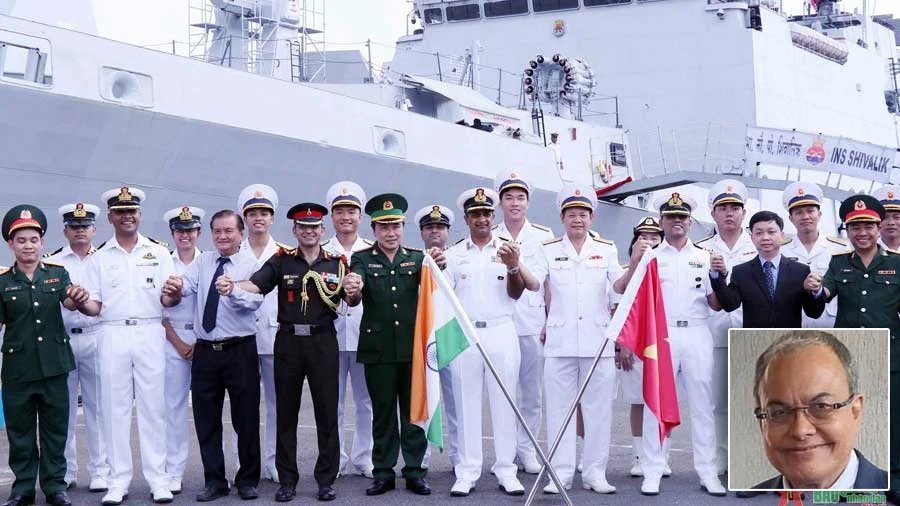
As President of the India–Viet Nam Chamber of Commerce and Industry (IVCCI) — the premier bilateral business body dedicated to advancing trade and investment between our two countries — I have had the privilege of witnessing, at close quarters, the transformation of the Viet Nam – India economic relationship from a promising idea into a fast-maturing reality. The elevation of our ties to an Enhanced Comprehensive Strategic Partnership during the State Visit of May 2026, and the Viet Nam – India Business Forum held in Mumbai on 7 May 2026, together mark a watershed for the business communities on both sides.
The numbers tell part of the story. Bilateral trade reached a record US$16.46 billion in 2025, growing at roughly 10–15 per cent a year, and our two governments have now set a target of US$25 billion by 2030. Two-way investment is taking shape in earnest: total invested capital exceeded US$1 billion in 2025, while bilateral investment commitments — including Vingroup’s entry into the Indian market — have surpassed US$8 billion. Yet the figures, striking as they are, understate the deeper opportunity: Viet Nam’s emergence as a strategic manufacturing base and market gateway for Indian enterprise in a global supply chain is being fundamentally reconfigured.
Viet Nam offers Indian companies a uniquely advantageous platform. Its network of free trade agreements — including the EU–Viet Nam Free Trade Agreement (EVFTA) and the Comprehensive and Progressive Agreement for Trans-Pacific Partnership (CPTPP) — grants goods manufactured in Viet Nam preferential access to many of the world’s largest markets. Combined with a young workforce, competitive costs, political stability and a government firmly committed to openness, this makes Viet Nam a natural gateway for Indian businesses into ASEAN and global value chains. As manufacturers worldwide pursue supply-chain diversification, Indian enterprises that establish a presence in Viet Nam can serve not only its domestic market of some 100 million consumers but also the wider region and beyond.
The Mumbai Business Forum of 7 May 2026 translated this potential into commitments across trade promotion, manufacturing, logistics, digital transformation and green technology. Building on that momentum, IVCCI sees clear and practical pathways for cooperation across a number of priority sectors.
Energy and renewables: Both countries are experiencing rapid growth in renewable energy. India brings strong manufacturing capability and EPC general-contracting expertise in onshore and nearshore wind power, while Viet Nam offers general-contracting capacity for offshore wind projects and is seeing strong growth in liquefied natural gas (LNG) power generation. Joint ventures in solar, wind and LNG infrastructure represent a substantial and immediate opportunity.
Technology and the digital economy: India’s strengths in IT outsourcing, artificial intelligence and fintech services complement Viet Nam’s rapid build-out of large-scale data centres, including AI data centres. We hope Indian technology contractors and technology-finance investors will partner in developing high-performance computing centres, AI data centres, technology hubs and digital services in Viet Nam — reinforced by the digital-technology and digital-payments understandings reached during the State Visit.
Processing and manufacturing: Viet Nam’s supporting industries are still in their early stages, presenting a great opportunity for Indian businesses to invest in joint production and to establish supply chains for electronic and automotive components, including for the fast-growing electric-vehicle sector. The cooperation agreed on critical minerals and rare earth elements adds a further dimension to this industrial partnership.
Pharmaceuticals and healthcare: India is an important pharmaceutical hub, offering high-quality products at reasonable prices, while Viet Nam is a large market that remains heavily reliant on imports. The pharmaceutical-management understanding concluded during the State Visit will help Indian manufacturers and suppliers enter the Vietnamese market with the benefit of comprehensive consulting and trade promotion. Conversely, Vietnamese businesses can supply the pharmaceutical precursors required by Indian companies — extracts of turmeric, ginger, gac fruit, reishi mushroom and various herbal products — and can develop dedicated medicinal-herb cultivation areas with substantial land and production capacity.
Logistics and connectivity: Logistics remains a bottleneck hindering bilateral economic cooperation. Viet Nam is investing in a chain of deep-sea ports from north to south, with total investment running to many billions of US dollars. This is a golden opportunity for Indian businesses to invest in seaport infrastructure and to open direct shipping routes between Viet Nam and India.
Tourism and aviation: The Viet Nam – India tourism sector is at a take-off stage. Indian arrivals to Viet Nam reached approximately 746,000 in 2025, while travel in the opposite direction remains modest — a reflection of constraints in flight connectivity, visa facilitation and cultural familiarity. Easing these bottlenecks, supported by the aviation agreements concluded in Mumbai and the expanding route network, will unlock major two-way growth.
Agriculture and aquaculture: Viet Nam can supply India with spices and agricultural products — pepper, turmeric, ginger, garlic and chili — and can develop cultivation areas to order, without limitation. Through its Blue Economy programme, Viet Nam is also developing high-tech aquaculture industrial zones combined with closed-loop deep processing. This represents a vast market for manufacturers of marine-farming equipment such as cages, rafts and nets, as well as for seafood-processing plants and aquaculture feed.
Across all of these sectors, IVCCI stands ready to serve as a trusted bridge. Drawing on our direct, day-to-day engagement with member companies on both sides, we facilitate market entry, partnership-building, trade promotion and dispute resolution — the practical, often unglamorous work that turns memoranda of understanding into operating businesses.
My recommendation to enterprises in both countries is straightforward: communicate more, and meet more often. Frequent business delegations, sustained dialogue and a willingness to invest in long-term relationships will be decisive — and businesses can proceed with confidence, knowing that both governments are working seriously towards deep cooperation with each other. The Enhanced Comprehensive Strategic Partnership and the US$25 billion trade target for 2030 are not distant aspirations; they are an invitation to act now. For Indian enterprises willing to seize it, Viet Nam offers one of the most compelling growth stories of the decade ahead.



Leave a Reply