

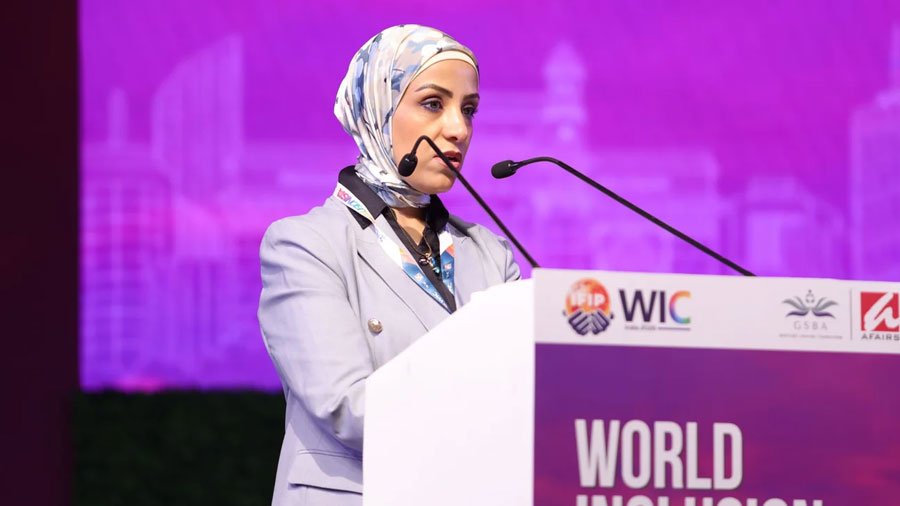
Universities have emerged as powerful diplomatic actors in the 21st century, fostering international partnerships, generating knowledge and strengthening people-to-people connections beyond the traditional boundaries of state diplomacy, said Prof. Hebatallah Adam, Professor of Economics at O.P. Jindal Global University and Founder & President of the Global South Research Foundation, during the Diplomatist Magazine-curated session, The Diplomatic Dialogue on Global Learning, Equity & Internationalisation, at the World Inclusion Conference 2026.
Sharing the Global South perspective on academic diplomacy, Prof. Adam observed that diplomacy today is no longer the exclusive domain of governments, foreign ministries and ambassadors. Universities, she said, have become influential institutions that build long-term relationships through education, research and innovation.
“Diplomacy today extends far beyond governments. Universities have emerged as influential diplomatic actors, creating sustainable partnerships through education, research and people-to-people engagement,” she said.
Prof. Adam noted that while governments continue to play a critical role in strengthening international cooperation, universities complement these efforts by bringing together scholars, researchers and students from across the world to jointly address global challenges.
She emphasised that academic diplomacy should not be measured merely by the number of international students, foreign faculty or global rankings. Rather, it is about fostering mutual understanding, co-creating knowledge and building enduring institutional partnerships.
“Academic diplomacy is much more than student mobility or university rankings. It is about creating mutual understanding, generating knowledge together and building long-term partnerships between institutions and researchers across countries,” she remarked.
Reflecting on the evolving role of the Global South, Prof. Adam argued that international higher education must move beyond the traditional model of one-way knowledge transfer from the Global North to developing countries.
“The Global South is no longer simply a recipient of knowledge. We are producers of ideas, innovators of solutions and equal partners in shaping the future of global education,” she said.
Highlighting India’s contributions, she cited the country’s achievements in digital public infrastructure, financial inclusion and public health cooperation as examples of how developing nations are generating innovative solutions that benefit the wider world.
Calling for stronger South–South cooperation, Prof. Adam said countries of the Global South possess valuable experiences and expertise that should be shared more extensively through collaborative research, academic exchanges and institutional partnerships.
“Academic diplomacy must evolve from a model of knowledge transfer to one of knowledge partnership, where learning and innovation flow in every direction,” she observed.
Drawing from the experience of O.P. Jindal Global University, she highlighted the institution’s emphasis on international faculty, collaborative research, global partnerships and academic exchange programmes as examples of inclusive internationalisation in practice.
However, Prof. Adam cautioned that rapid advances in artificial intelligence, digital technologies and online learning have also created new inequalities. While technology has expanded access to education, she said, it has simultaneously exposed significant disparities in digital infrastructure and connectivity, particularly across developing countries.
“Digital transformation has opened remarkable opportunities, but it has also widened the digital divide. Inclusive academic diplomacy requires equitable access to technology and digital connectivity for every learner, especially across the Global South,” she stressed.
She called upon governments, universities, international organisations and regional institutions to work together to bridge digital inequalities and promote digital literacy, ensuring that technological progress benefits all societies.
Prof. Adam reiterated that universities today are not merely centres of teaching and research but institutions that contribute to peacebuilding, sustainable development and international cooperation.
“Universities today represent development, peace and partnership. They are helping build stronger relationships between countries and have become an integral part of modern diplomacy,” she concluded.


Leave a Reply