United by Necessity: BRICS and the Global South
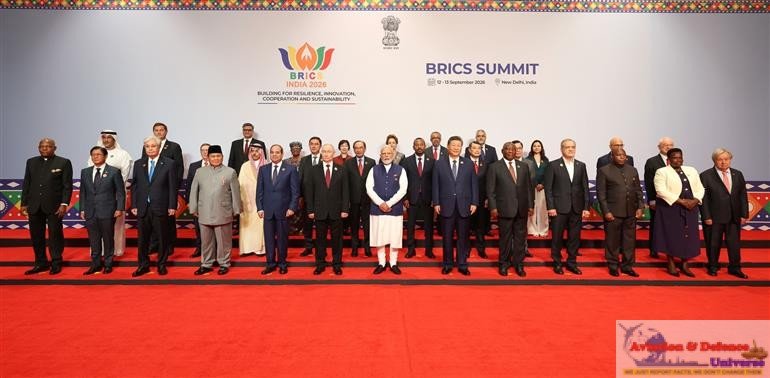
The states in the Global South may disagree with each other, however, they respect each other’s priorities. The 18th BRICS Summit held in New Delhi is a case in point. The New Delhi joint declaration sent a broader message that the bilateral frictions and differences can be compartmentalized when larger and common issues need to be prioritized. The summit brought together rivals amidst a turbulent global order not as an anti-western alliance but as a flexible platform for strategic autonomy, institutional reform and collective bargaining.
The paradox at the heart of BRICS
BRICS is no ordinary or homogenous group. Its members have different political systems, economic priorities, language, interests and cultures. It has significant rivalries, such as, India and China opposing on border issues, the reluctance of Brazil and South Africa to turn BRICS into an anti-western alliance, Russia and China’s views on BRICS as a means to transition away from Western predominance, the differences over the situation in West Asia, particularly involving Iran and the United Arab Emirates (UAE), among others. Building consensus, therefore, in New Delhi was not a minor achievement.
Why does the Global South need to unite?
The term “Global South” was coined by Carl Oglesby in 1969 and he used the term to describe the countries that were politically and economically exploited by the developed nations of the Global North. Today, the exploitation and paternalistic mindset is visible across multiple forums. It is not only limited to the agreements signed between the countries, but also in ways the “rules-based system” is implemented.
- World Bank and IMF- These institutions were established with colonial principles in mind. While some might say that the gap between the Global North and Global South is decreasing, the per capita income gap has quadrupled between the North and South since 1960. This is because of the power imbalance that is apparent in functioning of the institutions like the World Bank and the International Monetary Fund (IMF). For instance, voting power in these institutions is skewed heavily in the favour of the rich countries. For every vote the average person in the global North has, the average person in the global South has only one-eighth of a vote.
- Debt burden- The debt burden falls overwhelmingly on the developing countries. The International Debt Report 2025 stated that developing countries paid out $741 billion more in principal and interest on their external debt than they received in new financing between 2022 and 2024 which is the largest gap in at least 50 years. In all, developing countries restructured $90 billion in external debt in 2024, more than any time since 2010. [1]
- Climate finance- The United Nations Conference on Trade and Development (UNCTAD) cautioned that it will take more than numbers to understand the evolving needs and priorities of developing countries. It reported that the developing countries would need about $1.1 trillion in climate finance from 2025 and around $1.8 trillion by 2030. This is concerning because a larger amount of the climate finance is provided as loans than grants. This will further exacerbate the debt burden. This problem requires a collective approach, therefore, collective bargaining matters. [2]
- Trade rules are being bent- The United States (US)’s imposition of heavy tariffs is telling. It reveals that the mandatory provisions of the World Trade Organization (WTO) are being bent by powerful parties to further their economic interests. For instance, the passing of the Russia Sanctions Bill by the US House targeting Russia’s energy sector and imposing hefty tariffs on countries for importing oil and gas from Russia requires a classic collective action solution. The world, especially developing countries that are already struggling, cannot be at the mercy of powerful countries. Therefore, unity among the states of Global South is of utmost necessity.
How did the 18th BRICS Summit deliver on that need?
Measured against the four problems above, the declaration is strikingly on point. [3]
- Governance and representation– The declaration calls for a more representative, fair and inclusive global order with greater participation of emerging markets and developing countries in global decision-making. It backs comprehensive United Nations (UN) reform, including expansion of the Security Council to give more space to Asia, Africa and Latin America. That is a direct challenge to the representational deficit seen at the IMF and World Bank.
- Debt and financial architecture– The summit did not endorse a single BRICS currency. The declaration makes clear that a unified fiat currency is not on the table. Instead, members committed to deepening local-currency and domestic settlement frameworks and strengthening cross-border payment cooperation. This aims to promote de-dollarisation and reduce the interest-rate shocks that have fed the debt burden. This will help the BRICS members lower the cost of external finance as well as create a buffer against external shocks and pressure.
- Trade coercion and unilateral measures– The declaration opposes unilateral tariffs and secondary economic sanctions that fall outside WTO rules. It also rejects “unilateral acts of war” and calls for the protection of seafarers and commercial shipping routes, reflecting concerns about how geopolitical conflicts are being turned into economic pressure on third countries.
- Climate and sustainable development– The declaration ties climate to broader sustainable goals stressing that climate finance shouldn’t exacerbate the debt burden on the developing countries. Additionally, BRICS members welcomed the Tropical Forest Forever Facility launched at COP30 (the 30th United Nations Climate Change Conference) to mobilise long term financing for forest conservation and adopted principles for landscape restoration across forests, wetlands and arid regions.
- Human rights– The declaration stressed to exercise “maximum restraint” and instead solve the conflicts through dialogue and diplomacy. It condemned the Pahalgam attack and called for global cooperation to counter terrorism. Additionally, it advocated for diplomacy and peaceful dialogue on the West Asia conflict where Iran and the UAE are on competing sides. India managed to build a consensus without assigning responsibility to either side. It also condemned the attack on civilians and civilian infrastructure and advocated for peace and mediation. This showcases that the Global South stands for peace, dialogue and diplomacy rather than resorting to threatening and unilateral measures.
Conclusion
The 18th BRICS Summit was not a minor achievement. The enabling language allowed the countries with internal differences and contradictions to co exist within the same declaration, however, the real achievement and success of the summit will materialize when it provides tangible results, which was also emphasized by the Prime Minister of India. It’s a remarkable achievement that the countries found a common ground which wouldn’t have been possible if not for the principles of mutual respect and inclusivity. The summit will continue to stand as a true example in that respect.
References
[1] World Bank Group, International Debt Report 2025 – https://www.wbginstitute.org/topic/317/international-debt-report
[2] UNCTAD, New Climate Finance Goal on the Horizon – https://unctad.org/news/new-climate-finance-goal-horizon-how-can-developing-countries-benefit
[3] Indian Express, BRICS New Delhi Summit Declaration: Key Takeaways – https://indianexpress.com/article/explained/brics-new-delhi-summit-declaration-key-takeaways-10875050/
Shailja Khetan
Author is a fourth-year B.A. LL.B. student at the Institute of Law, Nirma University, with a keen interest in geopolitics and international law. Her current research examines the intersection of international trade law and international arbitration law, and her paper on power asymmetries and colonial paternalism in the World Trade Organisation (WTO) has been selected for presentation at a WTO conference at HNLU, Raipur.





Leave a Reply