

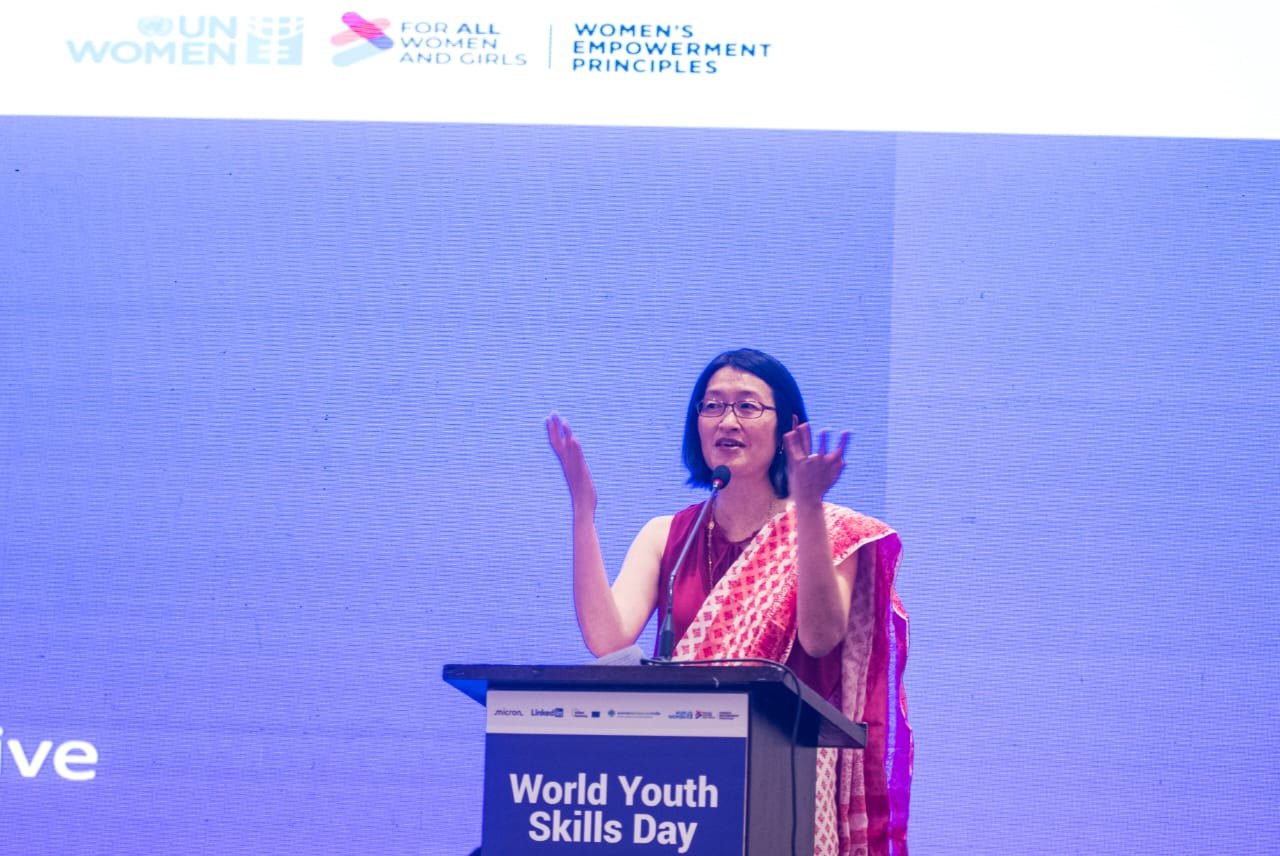
Calling for a decisive shift from merely expanding women’s access to education towards creating meaningful employment opportunities, Shoko Ishikawa, Country Representative, UN Women India, stressed that India must strengthen the pathway connecting education, skills and careers if it is to fully realise its demographic and economic potential.
Delivering the welcome address at the World Youth Skills Day event in New Delhi, organised under UN Women’s WE STEM and LEAP Women initiatives, Ishikawa welcomed representatives from the Government of India, state governments, development partners, industry leaders, educational institutions and young women participating in the programmes.
From Education to Employment
Highlighting India’s remarkable progress in women’s education, Ishikawa noted that women now constitute 43 per cent of enrolment in STEM disciplines in higher education, significantly above the global average.
“India can be proud of this achievement.” However, she pointed out that educational gains have yet to translate into equal participation in the workforce.
According to the figures she cited, women account for only 18.6 percent of STEM professionals engaged in research and development, while among women aged 15 to 59 who had received formal vocational education, only 51.4 percent were participating in the workforce, compared to 83 per cent of men.
“There is a clear gap. We must strengthen the pathway from education and skills to careers, leadership and economic opportunities.”
She warned that as artificial intelligence, digital technologies and the green transition reshape labour markets, failing to fully utilise India’s growing pool of skilled women would represent a significant loss of talent.
“This talent is not only essential for gender equality—it is critical for India’s competitiveness and future economic growth.”
A Global Commitment
Ishikawa noted that international momentum for women’s economic empowerment continues to grow. Referring to the G20 Women’s Ministerial Statement adopted under South Africa’s G20 Presidency, she said the declaration reaffirmed the importance of inclusive education, lifelong learning and holistic skills development.
She emphasised that UN Women’s work is rooted in internationally recognised frameworks, including the Convention on the Elimination of All Forms of Discrimination Against Women (CEDAW), the Beijing Platform for Action, and the 2030 Agenda for Sustainable Development, particularly Sustainable Development Goals 4 (Quality Education), 5 (Gender Equality), and 8 (Decent Work and Economic Growth).
“Advancing women’s participation in STEM is not simply an educational objective. It is an economic imperative and a development imperative.”
Building Inclusive Workplaces
Addressing the private sector, Ishikawa highlighted the importance of the UN Women’s Empowerment Principles, which encourage companies to promote equal opportunities, invest in women’s leadership and skills development, and ensure safe, inclusive workplaces.
She explained that UN Women brings together governments, industries and educational institutions by generating evidence, convening stakeholders and supporting the scaling up of successful models.
WE STEM: From Pilot to Policy
Ishikawa highlighted the success of the WE STEM initiative, which began in Madhya Pradesh as a targeted programme to equip young women with technical, digital and employability skills.
Since then, the initiative has expanded across the state and informed partnerships and replication in Maharashtra and Bihar, demonstrating how existing educational institutions can become more gender-responsive.
The programme has generated practical evidence on removing gender bias in career counselling and placements, engaging parents in girls’ career journeys, sensitising teachers, strengthening workplace safety and prevention of sexual harassment, fostering stronger partnerships between educational institutions and employers, and creating clearer pathways to internships, recruitment and career progression.
“Today we are here to share evidence, discuss common challenges and identify practical solutions together.”
Turning Evidence into Action
Concluding her remarks, Ishikawa reaffirmed UN Women’s commitment to working alongside governments, industry and development partners to transform evidence into systemic change.
“UN Women remains committed to working with all of you to transform evidence into action, strengthen institutions, and expand opportunities for every woman and girl.”
She also acknowledged the financial support of the European Union for enabling the implementation and expansion of the initiative.


Leave a Reply