

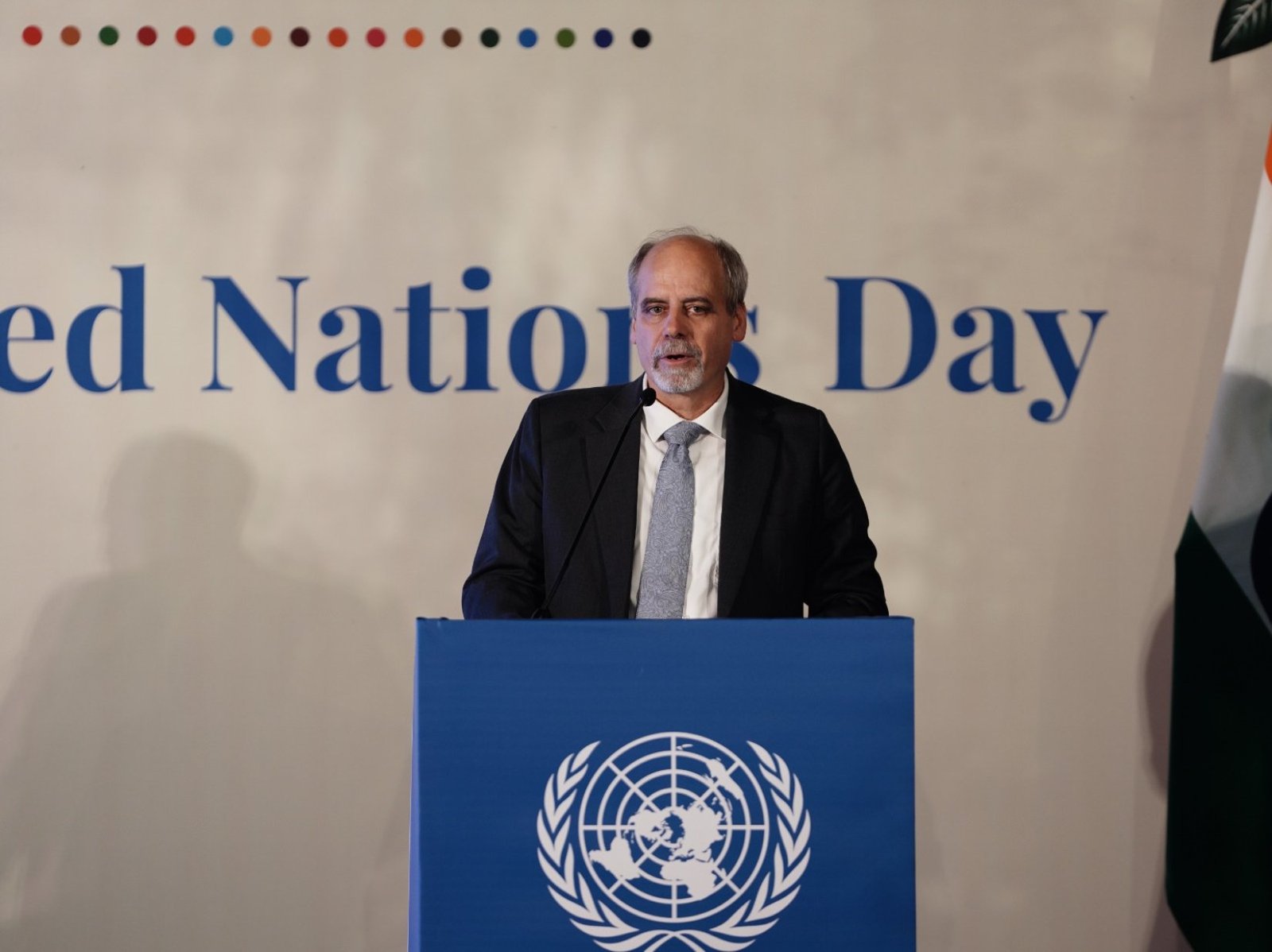
India’s role in shaping global solutions, its achievements in development and its partnership with the United Nations took centre stage as Stefan Priesner, United Nations Resident Coordinator in India, addressed the UN Day Reception 2026 at UN House in New Delhi.
Welcoming Kirti Vardhan Singh, Minister of State for External Affairs and Environment, Forest and Climate Change, alongside diplomats, senior government officials, development partners and UN colleagues, Priesner described United Nations Day as a celebration that belonged to everyone.
“After all, it is ‘We the Peoples of the United Nations’,” he remarked, invoking the opening words of the UN Charter and the collective responsibility underpinning the organisation’s mission.
Held on 23 October, ahead of United Nations Day on 24 October, the reception marked the 81st anniversary of the United Nations. The occasion provided an opportunity to reflect on the organisation’s enduring purpose while considering how international cooperation can respond to a world confronting conflict, climate change, technological disruption and growing inequalities.
Having arrived in India in January 2026, Priesner shared reflections on his first ten months in the country, highlighting India’s influence on the international agenda and the tangible impact of its development experience on communities. His address was structured around three tributes: to UN Member States, to India as the host country, and to the United Nations itself.
India’s Leadership on the Global Stage
Priesner began by reflecting on India’s growing role in international discussions on technology, sustainable development and multilateralism. Among the milestones he highlighted was the India AI Impact Summit, held in New Delhi in February 2026, which brought global attention to the question of how artificial intelligence could benefit humanity more equitably.
The summit, he noted, placed an important question before the international community: how can artificial intelligence serve everyone rather than concentrate its benefits among a small number of people and companies?
He recalled UN Secretary-General António Guterres’s message at the summit: “AI must belong to everyone.”
For Priesner, the statement captured a fundamental principle of inclusive technological progress: innovation must be accompanied by broad participation, equitable access and international cooperation.
He also highlighted India’s leadership during its BRICS chairship in 2026, pointing to the emphasis on resilience, innovation and sustainability at a time of heightened geopolitical uncertainty and fragmentation.
His reflections extended to the United Nations General Assembly in New York, where he observed India’s engagement on some of the defining issues of the day, including technology governance, sustainable development and the future of multilateral cooperation.
“The importance of India for the United Nations and the world cannot be overstated,” he said, underscoring the country’s significance as both a major economy and a partner in addressing shared global challenges.
Priesner also referred to the high-level engagement between India and the UN system, including visits by the Secretary-General, Deputy Secretary-General and senior UN officials. Such engagement, he suggested, reflected the importance of sustained cooperation between India and the international organisation.
Development That Reaches the Grassroots
While recognising India’s international influence, Priesner emphasised that the country’s story was equally significant for its transformation on the ground.
Economic growth, digital transformation and progress in reducing multidimensional poverty were among the developments he highlighted. Yet it was the experiences he encountered at the community level that offered particularly compelling illustrations of how development translates into changes in people’s lives.
One such experience was his visit to Modhera in Gujarat, widely recognised for its solar-powered village initiative. There, he heard women entrepreneurs describe how access to clean energy had changed their lives and created new opportunities.
Reflecting on the experience, Priesner observed that the initiative represented more than an environmental achievement.
“This is not only a climate story; this is a development story of India,” he said.
The example illustrated the interconnected nature of sustainable development: access to clean energy can contribute not only to environmental objectives but also to livelihoods, economic participation and opportunities for women.
For Priesner, Modhera was one illustration of the many initiatives underway across India that connect national development ambitions with the needs and aspirations of communities.
A Partnership Delivering Measurable Results
Priesner expressed particular pride in the close working relationship between UN agencies and India’s national and state governments, describing the cooperation as an important foundation for translating development priorities into practical outcomes.
To illustrate this partnership, he referred to India’s U-WIN digital platform for immunisation, which supports the digitisation of vaccination services and records for pregnant women and children. The platform forms part of India’s wider effort to strengthen public health delivery through digital technology.
The broader lesson, he suggested, was that innovation becomes especially meaningful when it is integrated into public systems and scaled to reach large populations.
He also pointed to the breadth of cooperation between the UN system and government institutions across the country. According to the figures cited in his address, the partnership encompasses 303 lines of activity involving different levels of government.
Rather than presenting these initiatives as isolated interventions, Priesner emphasised their collective significance in advancing development outcomes.
“It makes me proud to witness the results that are being achieved,” he said.
He noted that the UN system was preparing to develop its next cooperation framework with the Government of India, creating an opportunity to build on existing achievements and align future collaboration with India’s development ambitions and international engagement.
Speaking on behalf of the 26 UN entities serving in India, he reaffirmed their commitment to supporting the country’s priorities while contributing to its engagement with global challenges.
Three Tributes for a Changing World
Looking towards the future, Priesner acknowledged that the world faced complex and interconnected challenges requiring collective action. From plastic pollution and pandemics to climate change, artificial intelligence governance and armed conflicts, he argued, no country or institution could address these issues in isolation.
His response was to offer three tributes, each representing an essential dimension of international cooperation.
A tribute to Member States and multilateral diplomacy
Priesner’s first tribute was to the UN Member States represented at the reception by ambassadors and other diplomatic representatives. He recognised their central role in providing the mandates that guide the organisation’s work and in shaping international responses to shared challenges.
He called for continued leadership and collaboration among Member States, particularly in addressing complex issues that require coordination across borders and sectors.
The challenge, he suggested, was not simply to acknowledge global problems but to work collectively towards solutions, whether in environmental protection, public health, technological governance or conflict resolution.
His appeal was a reminder that multilateral diplomacy remains essential to building consensus and sustaining international action in an increasingly interconnected world.
A tribute to India
Priesner’s second tribute was to India, a country whose scale, diversity and development experience give it an important place in international affairs.
Representing approximately one-sixth of the world’s population, India is not only a major economy but also a country whose ideas, experience and leadership contribute to the search for solutions to global challenges.
He expressed the hope that India would continue to inspire the international community through values such as non-violence, compassion, respect for diversity and concern for all living beings.
He also recognised India’s implementation of the Sustainable Development Goals, highlighting the connection between domestic development gains and international solidarity.
His tribute acknowledged the significance of India’s contribution not only through its economic growth and national programmes but also through its participation in shaping the global development agenda.
A tribute to the United Nations
Priesner’s final tribute was to the United Nations itself, which he described as an indispensable platform for international cooperation.
Founded on the conviction that countries can achieve more together than they can independently, the organisation has contributed to major public-health advances, environmental protection, humanitarian assistance and efforts to address conflicts.
Among the achievements he highlighted were the eradication of smallpox, international action to protect the ozone layer and the development of global frameworks for a more sustainable future.
He acknowledged that the United Nations was not perfect, but stressed that its role remained essential in addressing the world’s most difficult problems.
“The UN is not perfect, but it is so essential to solve the biggest problems,” he observed.
The statement captured the central message of his address: the organisation’s value lies not in an absence of limitations, but in its ability to bring countries together around challenges that transcend national borders.


Leave a Reply