

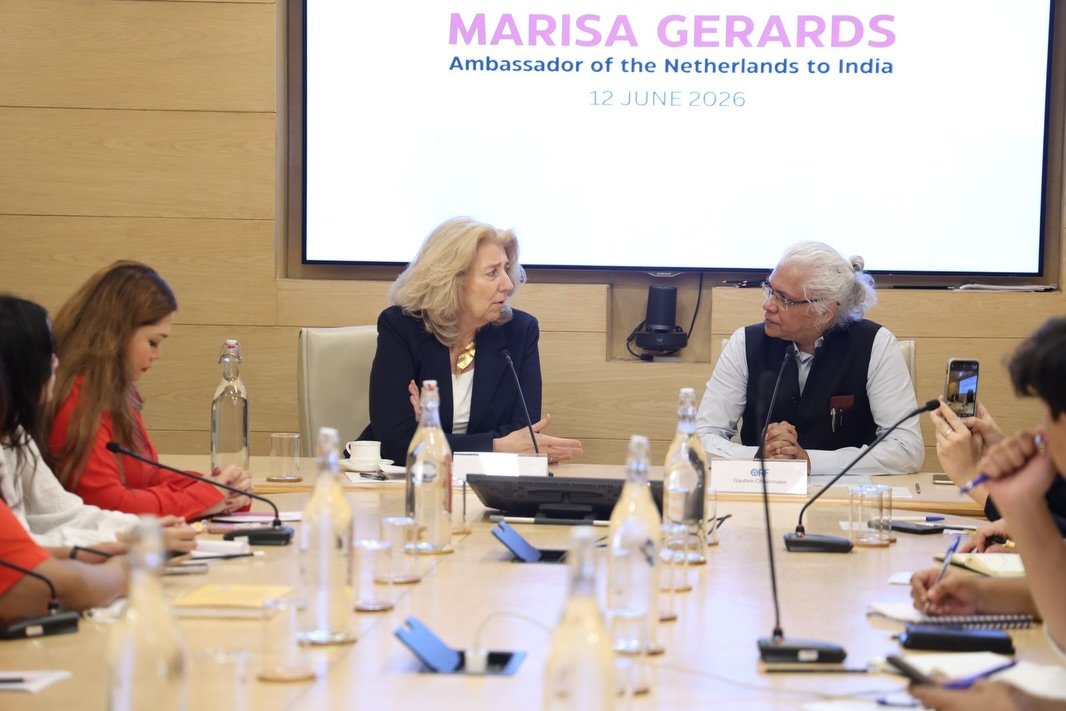
A conversation with H.E. Marisa Gerards, Ambassador of the Kingdom of the Netherlands to India, at ORF’s Diplomat Diaries
As H.E. Marisa Gerards, Ambassador of the Kingdom of the Netherlands to India, walked into the packed room at the Observer Research Foundation (ORF) on 12th June, she greeted the audience with folded hands and a warm “Namaste.” Moderator Gautam Chikermane, Vice President of ORF, smiled and remarked that she had already become the afternoon’s “star celebrity.” The energy in the room made it difficult to disagree.
Introducing the Ambassador, Chikermane argued that relations between India and the Netherlands have entered a new phase. Shared interests are important, he said, but what transforms cordial relations into strategic partnerships is trust. That single word would become the thread running through the entire conversation.
Invited to make her opening remarks, Ambassador Gerards chose not to begin with policy but with a deeply personal reflection. The more she had travelled around the world, she said, the more she realised that every individual is shaped by the nation they come from.
Born in Amsterdam in 1960, she belonged to a generation raised in the aftermath of the Second World War. Her parents had lived through that traumatic period, and Europe itself remained scarred and divided. Growing up in such an environment naturally made her a firm believer in the European project.
For her, the European Union was never merely an economic arrangement; it was fundamentally a peace project, an ambitious attempt to ensure that nations which had once fought devastating wars would instead cooperate.
She recalled travelling across Europe during the Cold War, visiting places such as Moscow, Prague and the former Yugoslavia, and even witnessing the contrast between East and West Berlin before the Berlin Wall came down. Those experiences, she said, taught her that the world looks very different depending on where one stands.
Travelling beyond Europe reinforced another lesson: one only truly understands one’s own identity after encountering the perspectives of others.
The Ambassador also reflected on Europe’s changing security landscape. During her youth, military conscription was a reality for many young people. Although compulsory service in the Netherlands has been suspended, every eighteen-year-old still receives a letter informing them that circumstances could one day require their service. It is, she observed, a reminder that peace can never be taken for granted.
The discussion then shifted from history to the future.
Picking up on the theme of emerging technologies, Chikermane observed that cooperation in areas such as artificial intelligence and semiconductors is unlike traditional trade. These technologies touch national security and strategic autonomy. Such partnerships, he argued, cannot exist without trust.
Ambassador Gerards agreed immediately.
The Netherlands and India, she explained, are trusted partners because they have built a relationship over many decades. At a time when the world has become more uncertain and countries have realised the risks of depending excessively on a handful of suppliers, diversification has become essential.
She pointed to cooperation in semiconductors and key enabling technologies, research collaborations between universities, student exchanges and industry partnerships as examples of how the two countries are investing in the future together.
The Ambassador remarked that strategic partnerships cannot be built overnight. They require years of sustained engagement across governments, universities, businesses and people.
Another important milestone, she noted, was the conclusion of the Memorandum of Understanding on Migration and Mobility after almost ten years of negotiations. The objective, she explained, is not simply to prevent illegal migration but to facilitate legal mobility.
Countries need their young people to study, work and learn from one another, she said, because those human connections ultimately strengthen bilateral relations.
The moderator then posed a fundamental question: if the entire world is now searching for trusted partners, what makes India one for the Netherlands?
Ambassador Gerards responded that the two countries share many interests and values. They both believe in a rules-based international order and cooperate closely on issues such as the freedom of navigation and secure maritime trade routes.
Although India follows a policy of strategic autonomy while European countries often operate through alliances, she observed that both frequently find themselves working towards the same objectives.
She also highlighted the long-standing Indian community in the Netherlands and decades of collaboration in research and innovation as important foundations of trust.
The conversation then moved into more philosophical territory.
Chikermane questioned whether democracy alone remains sufficient as a basis for trust in international relations, noting that recent geopolitical developments have challenged many long-held assumptions about the global order.
Ambassador Gerards responded with notable candour.
“No democracy is perfect,” she observed, adding that this applies equally to the Netherlands and India.
The strength of democracy, however, lies in its ability to correct itself through elections. Political surprises may occur, populism may rise and societies may experience turbulence, but democratic institutions provide mechanisms for renewal.
She acknowledged that Europe is also confronting the challenges of populism and the influence of social media on public opinion, describing these as global phenomena rather than uniquely European problems.
Asked whether she remained optimistic despite these developments, she answered simply:
“I have to.”
The moderator then returned to an idea she had introduced earlier, that Europe is essentially a peace project. He suggested that many now view the European Union primarily as a regulatory power, influencing the world through standards and legislation.
Ambassador Gerards disagreed with that narrow interpretation.
Europe’s greatest achievement, she argued, has been preventing the recurrence of the conflicts that devastated the continent for centuries. The creation of the early European Communities around coal and steel was intended to ensure that countries became economically interdependent rather than militarily confrontational.
She spoke emotionally about passing India Gate in New Delhi and reflecting on the Indian soldiers who lost their lives in Europe’s wars, expressing sadness that so many sacrificed themselves in conflicts whose origins are scarcely remembered today.
She also described the Erasmus student exchange programme as one of Europe’s greatest peace-building initiatives. When young people study and live together across borders, they develop friendships that make future hostility far less imaginable.
Attention also turned to the proposed India-European Union Free Trade Agreement.
Asked about its prospects, Ambassador Gerards explained that the agreement is currently undergoing legal scrutiny and translation into multiple languages before the necessary procedures are completed. Since it does not require ratification by every individual national parliament, she expressed hope that the process could move relatively quickly.
“I hope before the end of the year,” she remarked, while acknowledging that diplomacy often has its own timelines.
Opening the floor to questions, moderator Gautam Chikermane was met with a sea of raised hands, reflecting the audience’s eagerness to engage with the Ambassador. Students, scholars, and policy experts sought her views on a wide range of issues, from the recent visit of Prime Minister Narendra Modi to the Netherlands and the growing momentum behind the newly elevated India–Netherlands Strategic Partnership to cooperation in emerging technologies such as semiconductors, Artificial Intelligence and green hydrogen. Questions also explored collaboration in agriculture, water management, sustainable urban development, Europe’s evolving security landscape, the conflict in Ukraine, and the future of the India–EU Free Trade Agreement.


Leave a Reply