

Some poems celebrate kings. Some immortalise heroes. Others quietly honour the people we pass every day without ever truly seeing.
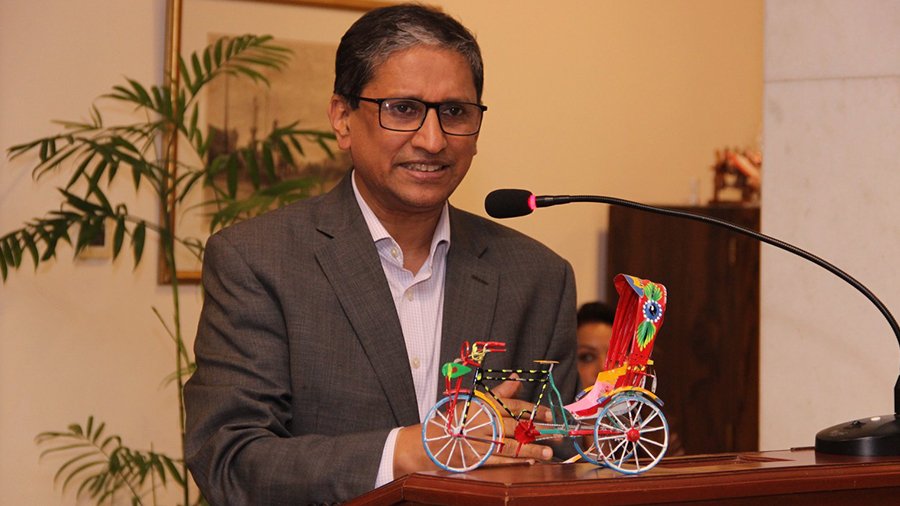
At the Literary Evening jointly organised by the Austrian Embassy and Diplomatist Magazine at the Residence of the Austrian Ambassador on 25 June, H.E. Mr. M. Riaz Hamidullah, High Commissioner of Bangladesh to India, chose to tell precisely such a story.
Rather than selecting a poem about Bangladesh’s rivers, landscapes or celebrated literary traditions, the High Commissioner introduced the audience to “The Story of a Rickshaw Puller” by eminent Bangladeshi poet Nirmalendu Goon, presented from Poems from the SAARC Region (2011), published by the SAARC Cultural Centre, Sri Lanka.
Before beginning his reading, he paused to explain why the humble rickshaw occupies such a special place in South Asian life.
“The word rickshaw originated in Japan,” he remarked, “but over the decades it has become an inseparable part of the identity of cities across Bangladesh and India.”
He spoke of the vibrant colours and intricate paintings that adorn Bangladeshi rickshaws, an artistic tradition now celebrated internationally as rickshaw art. Yet behind every beautifully decorated vehicle, he reminded the audience, is a person whose daily life is defined by hard work, endurance and quiet sacrifice.
With remarkable sensitivity, the High Commissioner read a poem that follows a rickshaw puller through an ordinary day, from the first passenger in the morning to his exhausted journey home at night.
The verses paint a vivid picture of relentless labour under the scorching sun, navigating crowded streets, impatient passengers, sudden rain, hunger, aching muscles and the constant struggle to earn enough to support a waiting family.
As the reading unfolded, the rickshaw puller ceased to be an anonymous figure in traffic. He became a father, a husband and a man carrying not only passengers but also responsibilities, hopes and dreams.
The poem transformed an everyday occupation into a portrait of human dignity.
Following the reading, Ajay Jain, Founder of Kunzum Bookstore, asked the High Commissioner why he had chosen this particular work from the rich landscape of Bangladeshi literature.
His response revealed the philosophy behind his selection.
“I could have chosen something about nature, rivers or water,” he reflected. “Bangladesh has no shortage of such poetry.”
Instead, he deliberately chose a poem that speaks about ordinary people.
“This poem is raw. It is organic. It is real.”
He explained that societies often romanticise or overlook the lives of those at the bottom of the economic pyramid, the workers whose labour quietly sustains everyday life. The poem, he said, restores their humanity, portraying them not as background figures but as individuals with aspirations, families and struggles that deserve recognition.
The High Commissioner also drew attention to the cultural richness surrounding the rickshaw itself. What began simply as a means of transport has evolved into one of Bangladesh’s most recognisable artistic traditions. The colourful motifs and hand-painted designs that decorate rickshaws have become an important expression of the country’s folk art and creative identity.
Yet, he observed, while people readily admire the artwork, they often fail to notice the individual pedalling beneath it.
That contrast, he suggested, is precisely what makes the poem so powerful.
Its purpose is not merely to describe a profession, but to encourage readers to pause and acknowledge the dignity of labour and the resilience of those whose lives often remain invisible.
For a few unforgettable minutes, a familiar figure from the streets of South Asia became the central character of the evening, his story no longer lost in the traffic, but preserved in poetry.


Leave a Reply