

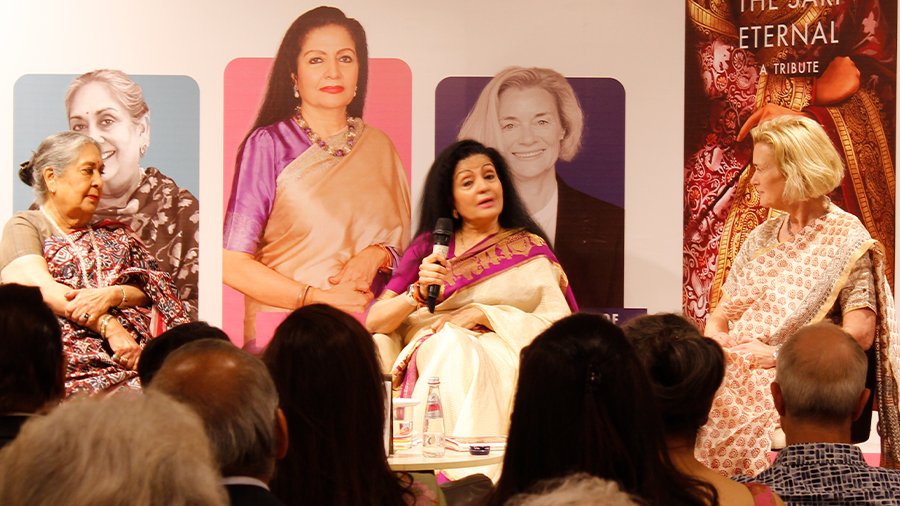
On 16 April 2026, the literary space at Kunzum Bookstore came alive with a celebration of India’s most enduring garment: the sari. Organised in collaboration with VFS Global, the evening marked the launch of “The Sari Eternal” by Lakshmi Puri.
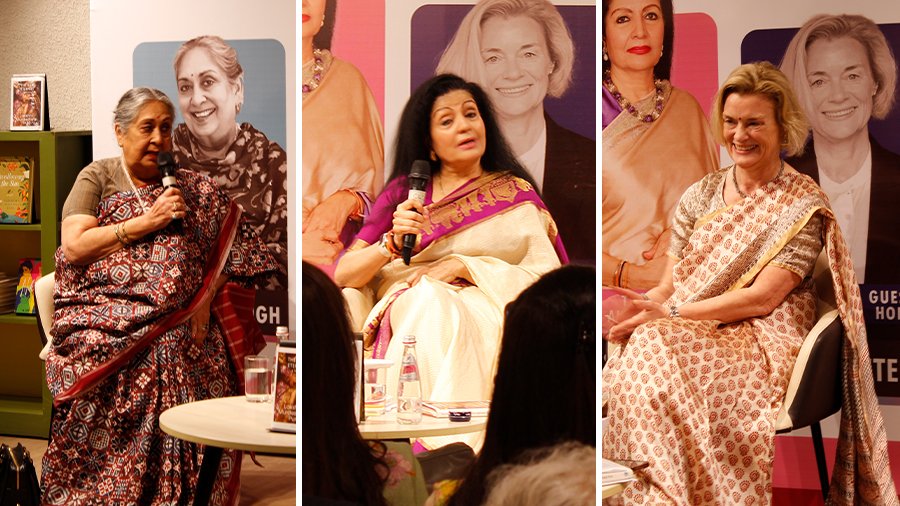
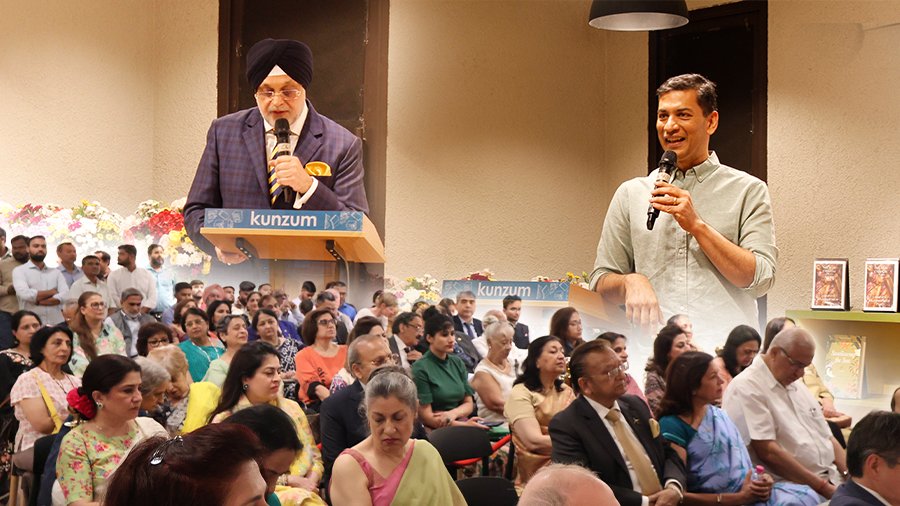
The discussion unfolded as an intimate yet intellectually rich dialogue between Puri and Malvika Singh, moderated with characteristic warmth and candour by Singh herself. Adding a global perspective was the Guest of Honour, May-Elin Stener. The evening was introduced by Sanjeet Joher, Director–Corporate Affairs, South Asia at VFS Global.
A Revival of Books and the Sari
Opening the conversation, Malvika Singh reflected on a cultural shift she has witnessed in recent years, a renewed interest among younger generations in both books and saris. “I’ve personally seen a huge revival in people buying and reading books, and young people buying saris. Somewhere, it has turned,” she observed, setting the tone for a discussion that bridged tradition and modernity.
She then turned to Lakshmi Puri with a simple yet profound question: What inspired the title of the book?
“A Love Letter to the Sari”
Lakshmi Puri revealed that the book emerged from an invitation to write for the “Essential India” series, an opportunity she initially hesitated to accept. “I wondered, why me? There is so much written about the sari. What could I possibly add?” she admitted.
Encouraged by her publisher to “just be yourself,” Puri chose a deeply personal approach. Rather than producing a technical textile compendium, she wrote what she calls a “love letter to the sari.”
Explaining the title, she said: “The Sari Eternal is about the art of being eternal, transcending the limitations of time and place… not just preserving the sari, but carrying it into the future.”
The book, she noted, is both a narrative and a repository, “a mini-encyclopaedia” that invites discovery for both novices and connoisseurs.
Memory, Identity, and the First Sari
One of the most moving moments of the evening came when Singh asked Puri to share a personal story.
Puri recalled a childhood memory that intertwined vulnerability, motherhood, and the sari. Injured and distressed after being teased at school, she was comforted by her mother, who instinctively tore her own sari to bandage her wound.
Reflecting on this, Puri connected the sari to protection, dignity, and emotional memory, echoing a deeper cultural symbolism found in Indian epics and folklore.
The Sari as Power and Presence
A central theme of the discussion was the sari as a symbol of feminine power. Puri spoke of her lifelong association of the sari with Shakti: divine feminine energy:
“It is my second skin… my second soul.”
From freedom fighters to contemporary leaders, she highlighted how women across generations have used the sari not just as attire, but as a statement of identity and authority. “In public life, the sari creates an instant connect,” she noted. “It resonates with people, it carries familiarity, trust, and cultural continuity.”
Unity in Diversity: Draping a Civilisation
Singh steered the conversation toward the sari’s extraordinary diversity, its regional variations, draping styles, and cultural meanings.
Puri described the sari as deceptively simple: “a straight, unstitched fabric” yet capable of infinite expression: “With the simplicity of an unstitched cloth comes the grandeur of limitless possibilities… its textures, colours, and drapes unfolding like a lotus, layer by layer.”
From Kerala’s traditional whites to the vibrant weaves of different regions, the sari reflects India’s ecological, social, and cultural landscapes.
Gen Z and the Future of the Sari
A particularly engaging segment addressed the question of relevance among younger generations. Singh provocatively suggested whether the sari’s survival lies in reinvention, draping it over jeans or reimagining its form.
Puri responded with nuance: “We may need to adapt to adopt.”
She acknowledged practical barriers: mobility, lack of familiarity, and perceptions of being “uncool”, but challenged these notions. “It’s all in the mind,” she said, adding that creative expression and modern styling can make the sari both contemporary and enduring.
Interestingly, she noted that many young men still perceive women in saris as “elegant… even goddess-like,” highlighting a gap between perception and self-perception.
A Foreign Gaze, An Indian Connect
Offering an external perspective, Ambassador May-Elin Stener spoke candidly about her own journey with the sari. “I had never worn a sari before coming to India,” she shared. “But I always thought it looked so elegant.”
Her first experience, choosing a sari in Delhi and sharing it on social media, was met with overwhelming warmth from Indians. “I always feel elegant when I wear a sari… and there is such a strong sense of connection.”
She also reflected on how wearing saris from different regions allowed her to carry memories of places and people across India, transforming the garment into a personal archive of experiences.
Culture, Coloniality, and the Question of Men
In a lively exchange, Singh raised a pointed question: why have Indian men largely abandoned traditional attire while women continue to carry forward textile traditions?
Puri attributed this, in part, to colonial legacies and the adoption of Western formal wear as a symbol of uniformity and modernity.
Yet, she also reframed the debate: “Why should only women bear the responsibility of carrying forward civilisational traditions?”
Bollywood and the Cultural Imagination
The discussion also touched upon the sari’s role in cinema and popular culture, a chapter that particularly resonated with Ambassador Stener.
“It taught me so much about the connection between music, dance, and the sari,” she said, noting how Bollywood has shaped global perceptions of Indian culture.
An Eternal Thread
As the evening drew to a close, what emerged was not just a discussion about a garment, but a meditation on identity, continuity, and cultural resilience.
The Sari Eternal positions the sari not as a relic of the past, but as a living, evolving expression of India—capable of adaptation without losing its essence.
In Puri’s words, it is ultimately about “continuing the sari into the future.”
And perhaps that is where its true power lies, in its ability to remain timeless, yet always of the moment.


Leave a Reply