

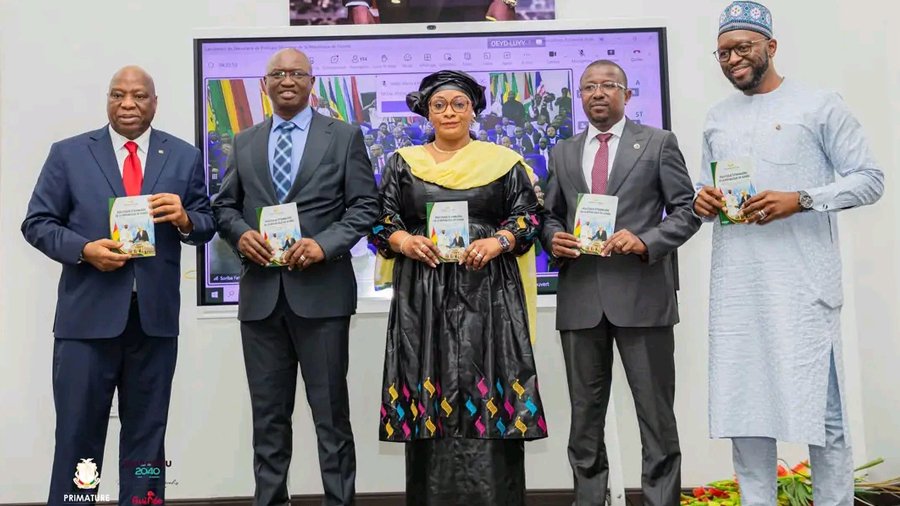
The Republic of Guinea has taken a major step in structuring and modernising its external action with the official presentation of its first Foreign Policy Document since gaining independence on October 2, 1958.
Presented at the headquarters of the Ministry of Foreign Affairs, African Integration and Guineans Established Abroad on September 9, 2026, this document now constitutes a strategic framework of reference intended to strengthen the coherence, readability and effectiveness of Guinea’s diplomatic action.
Born from a will carried by His Excellency Mr. Mamadi DOUMBOUYA, President of the Republic, Head of State, this document aims to define the main orientations of Guinean foreign policy and to better articulate the country’s international commitments with its national priorities.
A strategic vision for Guinea’s external action
The presentation ceremony was presided over by the Prime Minister, Head of Government, Mr. Amadou Oury BAH, under the leadership of the President of the Republic.
It brought together several members of the Government, the Vice-President of the Republic of Sierra Leone, Dr. Mohamed Juldeh JALLOH, former Prime Ministers, senior public administration officials, representatives of international organisations, and members of the diplomatic corps accredited to the Republic of Guinea.
The presence of the Vice-President of Sierra Leone gave a special dimension to this ceremony. It testifies to the importance that Conakry and Freetown attach to strengthening their bilateral relations and developing cross-border cooperation based on good neighbourliness, solidarity and common interests.
Eleven priorities for a diplomacy serving national interests
Structured around three main chapters, the Foreign Policy Document traces the historical evolution of Guinean diplomacy, recalls its fundamental principles and defines the strategic orientations of external action since September 5, 2021.
It is structured around eleven priority areas, including:
Economic diplomacy, a lever for development
Among the major orientations of the new document is the strengthening of economic diplomacy, which is expected to contribute more to the country’s development objectives.
In this perspective, Guinean Embassies and Consulates are called upon to strengthen their contribution to the promotion of investments, the search for partnerships, the opening of new markets and the defence of Guinea’s economic interests.
Already, for some months now, the Embassy of the Republic of Guinea in New Delhi has been fully involved in this dynamic by strengthening its actions with Indian economic operators and businessmen, in accordance with the strategic orientations formulated by Her Excellency Mrs. Droupadi MURMU, President of the Republic of India, during the presentation of the Letters of Credence of Ambassador CONTÉ Alassane, on May 31, 2024.
This orientation reflects a desire to strengthen the operational dimension of diplomatic action and to better put the diplomatic and consular network at the service of national priorities.
It is part of an international environment marked by geopolitical realignments and profound transformations in the fields of security, energy, climate, technology, trade and the global economy.
An instrument of coherence and coordination
Presenting the document, the Minister of Foreign Affairs, African Integration and Guineans Living Abroad, His Excellency Dr. Morissanda KOUYATE, emphasised its historical and strategic significance.
According to the Guinean foreign minister, this document constitutes, for the first time, a unified strategic framework allowing the definition of the principles, priorities and instruments of the external action of the Republic of Guinea.
It is thus called upon to serve as a reference for the State and the entire Guinean diplomatic and consular network, promoting better coordination of external action and greater coherence in the conduct of the country’s international relations.
Defending Guinea’s interests in a changing world
Through this new foreign policy, Guinea reaffirms its commitment to defending its national interests, preserving its sovereignty, respecting its territorial integrity and strengthening its relations with its bilateral and multilateral partners.
The document also intends to place Guinea’s external action within a dynamic of cooperation, African solidarity and contribution to efforts in favour of peace, security and sustainable development.
By adopting this first formalised foreign policy, the Republic of Guinea is thus giving itself a common framework intended to guide the action of its diplomatic and consular representations and to strengthen the coherence of its international commitments.
From vision to action
The presentation of this document marks an important step in the formalisation of Guinean diplomatic doctrine. Its impact will now depend on its effective implementation, its adoption by the stakeholders involved, and its translation into concrete actions serving national priorities.
The Foreign Policy Document is thus intended as a compass for Guinean diplomatic action, making it possible to articulate more clearly the country’s international commitments with its national interests, its development ambitions and its desire to strengthen its role within the African space and the international community.
The presentation of the first Foreign Policy Document of the Republic of Guinea is therefore much more than an institutional formalisation: it marks a desire to give the country’s external action a strategic, coherent and sustainable framework, commensurate with the changes in the international environment.
By clarifying its priorities, strengthening the coordination of its diplomatic apparatus and placing the defence of national interests, economic diplomacy, African integration and the protection of Guinean citizens more at the heart of its external action, Guinea intends to place its diplomacy within a logic of sovereignty, cooperation and contribution to international issues.
This new foreign policy now opens a crucial phase: its implementation. The effectiveness of this new direction will depend on the ability of institutions, the diplomatic and consular network, and all stakeholders to translate the defined principles and priorities into concrete initiatives, lasting partnerships, and tangible results.
Through this approach, Guinea intends to have a tool to better amplify its voice, defend its interests, and leverage its strengths within a constantly evolving international system. The new diplomatic doctrine thus presents itself as a framework for action designed to support national ambitions, consolidate Guinea’s African roots, and strengthen its position within the international community.


Leave a Reply