

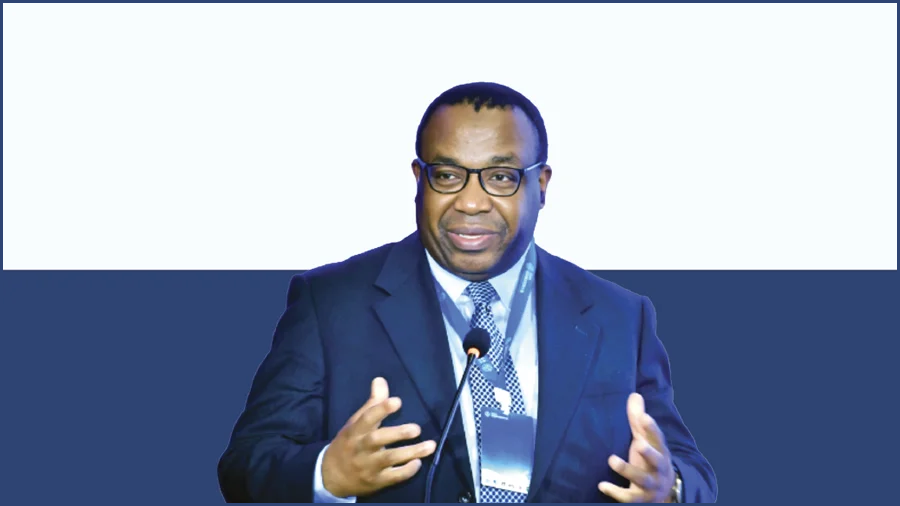
Prof. Obijiofor Aginam
Director, UNESCO Mahatma Gandhi Institute of Education for Peace and Sustainable Development (MGIEP)
In this conversation with Diplomatist, Prof. Aginam reflects on why education, global health and international law are ultimately connected by the pursuit of human flourishing; what education for peace means in divided societies; the ethical guardrails needed for AI in education; and why internationalisation should go beyond student mobility to foster genuine global citizenship. He also explores India’s emerging role in global education and the possibilities of deeper South-South knowledge exchange.
You moved from international law and global health governance into the world of education. What did education teach you about global governance that international law could not, and what did your years in global health teach you about education that an education specialist might miss?
In real life, I don’t see these disciplines as distinct. They are inexorably linked by sustainability and human flourishing. The beauty of the Sustainable Development Goals is the linkages between the 17 Goals once you place the human being at the centre of the Goals. The theoretical perspectives on global health governance, international law, and education may differ but in the practical realities of life, human flourishing connects the dots between them. Quality of education is impacted when a child falls sick or when children go to school hungry and malnourished. Extreme poverty affects virtually every human endeavor. The work I have done in the past three decades in global health governance, international law, and education is largely inspired by the desire to advance sustainability and human flourishing in different regions. Health and education are two essential pillars in this endeavor; both are pathways to sustainable human development.
Education policy is increasingly framed around employability, future skills and preparing young people for the labour market. Yet UNESCO MGIEP places peace, wellbeing, sustainability and global citizenship at the centre of education. Are we measuring the wrong things when we judge an education system primarily by examination scores, university admissions and employment outcomes? What would you put on the report card of a truly successful education system?
No, I don’t think we are measuring the wrong things, as you put it, when we judge an education system primarily by examination scores, university admissions and employment outcomes. Employability, future skills and preparing young people for the labour market are extremely important endeavours. Every government would aspire to grow the economy and incentivize the private sector to create jobs and reduce unemployment. Governments in different regions of the world aspire to achieve that. I have travelled to many countries, and the message is strongly echoed and re-echoed by young people from Asia-Pacific to Africa, Latin America, Small islands, and other places. Having said this, these skills and competencies are often driven by rigorous tests and examination scores, and cognitive literacy to the detriment of social and emotional competencies. Students and learners deal with anxieties because of the pressure to excel in tests and examinations. What then is the purpose of education? Examinations and degrees should not be the only criteria for intelligence. We need holistic education that nurtures the cognitive, and social and emotional competencies of the learner. The problem is that education systems have prioritized cognitive literacy skills over social and emotional competencies.
You have described the need to reimagine learning systems so that young people are empowered to respond to global challenges. If you could remove one deeply entrenched assumption from today’s education system and replace it with a new principle, what would that assumption be and what would you replace it with?
Krishnamurti, the influential Indian thinker and advocate of holistic education and learning, answered that question about seven decades ago. His message that the “purpose of education is not to produce mere scholars, technicians, and job hunters”, remains relevant today. UNESCO has articulated the way forward in the Report of International Commission on the Futures of Education, Reimagining Our Futures Together: A New Social Contract for Education. Young people should be versed in Global Citizenship Education, Social and Emotional Learning, and Media and Information Literacy to navigate the challenges of the 21st century.
UNESCO MGIEP has emphasised education as a means of preventing violence and building cultures of peace. What does “education for peace” actually look like inside a classroom dealing with students who may come from communities divided by war, religion, ethnicity, ideology or historical grievances? Can empathy really be taught, or can education only create the conditions in which empathy develops?
While both approaches are not mutually exclusive, I would like to say that empathy can be taught. You recall the famous quote by Nelson Mandela that “no one is born hating another person because of the colour of his skin, or his background, or his religion. People must learn to hate, and if they can learn to hate, they can be taught to love, for love comes more naturally to the human heart than its opposite.” This remains one of the foundational pillars of education for peace in communities polarized by ethnic, cultural, religious, linguistic, and other differences. Yes, education can create the conditions in which empathy develops.
AI systems can personalise learning, but they can also collect enormous amounts of information about children’s behaviour, abilities, emotions and learning patterns. Who should ultimately own a child’s educational data, the student, parents, school, technology company or the state? And should there be categories of learner data that AI systems should simply never be allowed to collect?
This is a very complex question underpinning the calls for a stringent regulation and governance of AI systems. We must start with reaffirming the need for maximum protection of children. Most countries have existing laws and regulations on privacy of data and certain information about children. In this Age of AI, the problem is not as simple as saying that there should categories of learner data that AI systems should simply never be allowed to collect. The problem is complicated because of the rapid agency of AI systems that overrun humans. How effective can we regulate a system that is beyond our control as humans?
You have been involved in discussions around digital transformation and AI ethics in education, including collaboration with Beijing Normal University’s UNESCO Chair on AI in Education. What ethical principle should be non-negotiable when governments and technology companies design AI systems for children?
UNESCO and various UN agencies have issued series of reports centred on ethics of AI. There is broad consensus that AI systems should have ethical guardrails for children. The problem is whether governments have the political will and the capacity to enforce these guardrails. Part of the problem is that most governments, while not doubting the risks of AI systems, are nonetheless threading cautiously not to stifle innovation in a multibillion industry. My position is that any real or potential risks to children should form part of non-negotiable ethical guardrails for AI systems, and governments and technology companies should address these risks proactively. We need urgent action to stamp out these aggravated risks for children, part of what Pope Leo XIV addressed in Magnifica Humanitas, a recent Encyclical on Safeguarding the Human Person in a Time of Artificial intelligence.
Universities are internationalising rapidly through student mobility, international campuses and cross-border programmes. Yet simply putting students from different countries in the same classroom does not necessarily create global citizens. What is the difference between an internationally exposed student and a genuinely globally minded student?
Global citizenship does not necessarily entail travelling to another country or other countries. One can become a “genuinely globally minded student”, as you put it, without having travelled outside his or her local community or country. This is why UNESCO promotes Global Citizenship Education (GCED) as “nurturing respect for all, building a sense of belonging to a common humanity and helping learners become responsible and active global citizens”. The aim of GCED is to “empower learners to assume active roles to face and resolve global challenges and to become proactive contributors to a more peaceful, tolerant, inclusive and secure world”. It is civic learning that involves students’ active participation in projects that address global issues of a social, political, economic, or environmental nature which can occur anywhere including in rural communities.
India is positioning itself simultaneously as a major source of international students and an increasingly attractive destination for students from abroad. What should India do differently if it wants internationalisation to become an instrument of global citizenship rather than simply an education-export or revenue strategy?
As one of the major players in the Global South, it is logical that India has become an attractive destination for students from abroad especially those from Africa. India’s comparative advantage lies in science and technology where the India Institutes of Technology (IITs) have led the way since the 1950s. We should not forget that many Indian students travel abroad to study in Europe, North America, Japan, Korea and the Middle East. This is a fact of internationalization of education in the 21st century. India’s National Education Policy 2020 has provisions for “universal human values”, and “internationalization of higher education”. The various ways that these provisions will be implemented and rolled out in the coming years would determine how internationalization becomes an instrument of global citizenship in India.
You have spoken about the importance of South-South cooperation. Could the next major transformation in global education come not from traditional North-South knowledge transfer but from universities and educational institutions in Africa, Asia and Latin America learning directly from one another? What would that architecture look like?
I don’t think that we need any formalized normative or governance architecture for a pragmatic South-South cooperative framework on education among the countries of the Global South. While North-South knowledge transfer has been the dominant paradigm in past decades, this has changed remarkedly in recent years because of the innovative alliances ranging from BRICS to bilateral and regional alliances driven by the more advanced economies in the Global South. Universities and educational institutions in Africa, Asia, and Latin America have a lot to learn among themselves. Already this is happening organically through bilateral MOU’s dealing with joint research, student and faculty exchange, establishment of satellite campuses, and other forms of knowledge exchange and transfer.


Leave a Reply