

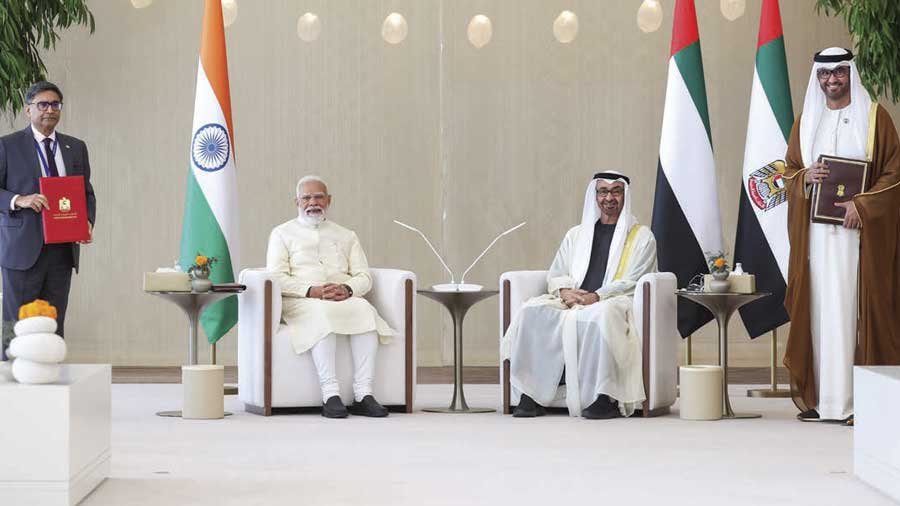
The significance of the new development that the United Arab Emirates is exploring India’s BrahMos cruise missile and Akash air defence system[i] lies not in the weapons themselves, but in what they indicate about the evolving nature of India-UAE relations. When it is read alongside the Letter of Intent for a bilateral Strategic Defence Partnership signed in January 2026[ii] and the Strategic Framework for Defence Industrial Collaboration signed in May[iii], the importance of these talks lies less in the specific systems on the table than in what their very possibility reveals.
UAE is now treating India as a plausible source of defence capability, not merely as a trading partner or a labour and remittance corridor. The shift underway is one of category, from economic to security partner, and it is this reclassification, more than any single platform or agreement that deserves closer analytical attention. Therefore, the most important development is not just the prospect of a missile sale but the emergence of a strategic partnership built around defence-industrial cooperation, operational interoperability, and long-term security integration.
The Arc That Produced This Moment
Rather than seeing these agreements as standalone diplomatic milestones, they should be recognised as successive phases in the development of formal defence collaboration. The Letter of Intent, signed during the UAE President’s visit to New Delhi[iv], committed both sides to cooperation across defence industrial collaboration, training, interoperability, and counterterrorism. By May, during Prime Minister Modi’s visit to Abu Dhabi, that intent had hardened into the signed Strategic Framework, covering joint manufacture of drones, missiles, naval platforms, and ammunition[v].
The platform-specific talks reported in late June are best read as the third step in this progression. It has moved the language of the relationship towards a framework that is inclusive of operational entanglement, shared doctrine and training. Such frameworks are historically reserved for a state’s most trusted security partners
For most of the past decade, the India-UAE relationship was primarily seen through an economic and diasporic lens. The bilateral trade is based on a hundred billion dollars, sovereign investment flows, energy purchase agreements, and the presence of over four million Indians resident in the Emirates. Defence cooperation existed, but as a secondary track, largely confined to joint exercises such as Desert Cyclone and Desert Flag[vi] rather than to the transfer or co-development of frontline systems. What the events of 2026 suggest is that this hierarchy is inverting, or at a minimum flattening. The UAE’s willingness to discuss integrating Indian command-and-control architecture, in the case of Akashteer, alongside its existing American-supplied THAAD and Patriot batteries, signals a degree of trust in Indian systems and in India’s reliability as a supplier that goes well beyond what an economic partnership alone would
This shift cannot be explained by supply-side momentum alone. The Gulf’s own procurement logic has changed. The United States still supplied the majority of Middle Eastern arms imports between 2021 and 2025[vii]. The Iran war that convulsed the region through much of 2026, and the missile and drone strikes the UAE absorbed in greater numbers than any Gulf state, including Israel[viii], have visibly accelerated Gulf capitals’ appetite for supply diversification and resilient air defence.
India offers something distinctive within that search. Defence technology that is demonstrably combat-tested, following its use during the 2025 standoff with Pakistan[ix], but without the alliance entanglements or political conditionalities attached to Western suppliers, and without the geopolitical baggage that would accompany closer defence ties with China. A subtler diplomatic advantage: closer defence ties with India, unlike those with Russia or China, carry little risk of antagonising Washington, allowing Abu Dhabi to diversify without disturbing its relationship with the United States. Another argument describes the deepening UAE partnership as a deliberate counter to the Saudi-Pakistan defence pact signed in September 2025[x], positioning India not as a neutral actor but as an active participant in the Gulf’s internal contest for partners and leverage.
India’s defence exports have grown from a negligible $7.26 million in 2013-14 to over $4 billion in the year ending March 2026[xi], and BrahMos has been central to that trajectory. The Philippines became its first overseas buyer in 2022 through a $375 million contract[xii], deals with Vietnam and Indonesia have since been concluded[xiii], and Thailand, South Africa, Brazil, and Chile have reportedly expressed interest.
When seen through this trajectory, UAE would not be an isolated Gulf breakthrough but the latest instance of a broader reclassification already visible in Southeast Asia and Latin America. India is moving from one of the world’s largest arms importers toward a credible, diversified arms exporter. What distinguishes the UAE case, and what justifies treating it as more than another entry on that list, is that a Gulf security architecture historically dominated by Western suppliers would be absorbing Indian systems at the command-and-control level, not merely acquiring a discrete strike platform.
This argument, however, should not be overstated. Talks on BrahMos and Akashteer remain at an early, unconfirmed stage, and BrahMos exports additionally require Russian sign-off as a co-developer, a step considered unlikely to prove an obstacle but not yet tested at this scale. Nor is the shift from economic partner to security provider complete or irreversible; it is better understood as an emergent, contested trend, one that domestic critics have already questioned on the grounds that closer defence integration with the UAE implicates India in a security ecosystem increasingly overlapping with Israel’s[xiv].
None of this diminishes the underlying point. Whether or not BrahMos or Akashteer are eventually exported, the fact that such talks are taking place at all, following so directly from a signed industrial framework and a political letter of intent, marks a change in how India is perceived within Gulf security thinking. India is moving from a state the Gulf trades and invests with to a state it increasingly considers arming, training alongside, and integrating into its own defence architecture.
That reclassification, and whether it holds under the pressure of India’s own export constraints and the region’s continuing volatility, is the development worth watching most closely in the months ahead. India’s emergence as a defence supplier reflects nearly a decade of domestic reforms under the Atmanirbhar Bharat initiative[xv], sustained increases in indigenous defence production, greater private-sector participation, and an explicit export-oriented defence industrial policy. The UAE discussions, therefore, reflect not only changing Gulf demand but also a structural transformation within India’s own defence ecosystem. The experience of relying predominantly on a single supplier has reinforced a broader preference in the Gulf for strategic hedging[xvi]. Rather than replacing existing American or European systems, Gulf states are constructing diversified procurement portfolios that reduce vulnerability to political conditionality, supply-chain disruptions, and technological dependence. India fits naturally within this emerging strategy because it offers sophisticated defence technologies while maintaining cordial relations across competing regional blocs.
References:
[i] Saurabh Sharma and Aftab Ahmed, Exclusive: India in Talks to Sell Supersonic BrahMos Missile to UAE, Sources Say, Reuters, 22 June 2026.
[ii] Joint Statement: Visit of President of the UAE, His Highness Sheikh Mohamed bin Zayed Al Nahyan, to India, Ministry of Foreign Affairs, United Arab Emirates, 19 January 2026.
[iii] India and UAE Sign Defence Pacts, as Iran War Tensions Simmer, Al Jazeera, 15 May 2026.
[iv] India, UAE Embark on a Strategic Defense Partnership, The Diplomat, 22 January 2026; see also Inside the UAE-India Strategic Defence Push, The National, 26 January 2026.
[v] India, UAE Agree on Framework for Strategic Defence Partnership during Modi Visit, Dawn (Reuters), 15 May 2026.
[vi] Defence Relations, Embassy of India, Abu Dhabi, United Arab Emirates.
[vii] Trends in International Arms Transfers, 2025, SIPRI Fact Sheet, Stockholm International Peace Research Institute, March 2026.
[viii] Reading the Future of Defence Strategies in the Middle East, ORF Middle East, June 2026.
[ix] Sharma and Ahmed, “Exclusive: India in Talks to Sell Supersonic BrahMos Missile to UAE”, Reuters, 22 June 2026.
[x] Could the Pakistani-Saudi Defense Pact Be the First Step Toward a NATO-Style Alliance?, Center for Strategic and International Studies, 14 October 2025.
[xi] Defence Exports Skyrocket to Record Rs 38,424 Crore in Financial Year 2025-26, Press Information Bureau, Ministry of Defence, Government of India, 2 April 2026.
[xii] Philippines Inks $375M Deal to Buy BrahMos Supersonic Missiles from India, Radio Free Asia, 28 January 2022.
[xiii] UAE Eyes India’s BrahMos and Akashteer: The Strategic Pivot Reshaping Gulf Defence Architecture, Indian Aerospace and Defence Bulletin, 26 June 2026.
[xiv] India Bets on a Declining Partner: The Modi-UAE Defence Deal and Its Strategic Missteps, The Wire, 19 May 2026.
[xv] Suchet Vir Singh, Policy Recommendations for Achieving India’s Defence-Export Ambitions, ORF Issue Brief No. 676, Observer Research Foundation, November 2023.
[xvi] The Gulf’s Short-Term, Post-Conflict Foreign Policy Goals, ORF Middle East, May 2026.


Leave a Reply