

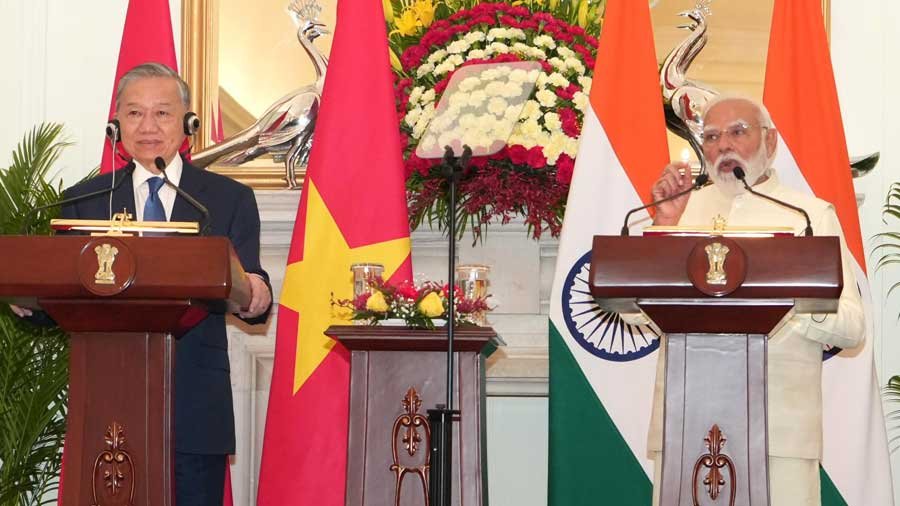
The State Visit of General Secretary of the Communist Party of Viet Nam and President Tô Lâm to India culminated in one of the most significant milestones in the history of India–Viet Nam relations, the adoption of the Joint Statement on the Enhanced Comprehensive Strategic Partnership (ECSP) on 6 May 2026. Building upon nearly a decade of the Comprehensive Strategic Partnership established in 2016, the new framework reflects the growing strategic convergence between two of the Indo-Pacific’s most dynamic powers.
More than a diplomatic declaration, the Joint Statement provides a comprehensive roadmap for cooperation across virtually every sector of bilateral engagement, responding to evolving geopolitical realities and the shared aspirations of both nations.
Political and Diplomatic Cooperation
The leaders reaffirmed their commitment to regular high-level exchanges, institutional dialogue, and close coordination in regional and multilateral forums, including the United Nations, ASEAN-led mechanisms, the East Asia Summit, and the G20. The partnership continues to be guided by mutual respect for sovereignty, strategic autonomy, international law, and a shared commitment to a free, open, inclusive, and rules-based Indo-Pacific.
Defence and Security
Defence remains one of the strongest pillars of the bilateral relationship. The Joint Statement reaffirmed cooperation in defence exchanges, military training, maritime domain awareness, defence industry collaboration, cybersecurity, counter-terrorism, and transnational crime. Both countries reiterated their support for freedom of navigation, peaceful resolution of disputes, and adherence to the United Nations Convention on the Law of the Sea (UNCLOS) 1982, underscoring their shared vision for regional security and stability.
Trade, Investment and Economic Cooperation
Recognising the growing complementarity of their economies, both sides pledged to accelerate bilateral trade, facilitate greater two-way investment, strengthen resilient supply chains, and encourage collaboration between businesses and start-ups. Discussions focused on expanding cooperation in manufacturing, infrastructure, logistics, renewable energy, pharmaceuticals, digital commerce, and financial services while improving market access for agricultural products.
Technology, Innovation and Digital Transformation
A defining feature of the upgraded partnership is its emphasis on emerging technologies. India and Viet Nam agreed to deepen collaboration in artificial intelligence, semiconductors, digital public infrastructure, cybersecurity, biotechnology, fintech, space applications, and critical and emerging technologies. The objective is to promote innovation-led growth while enhancing digital connectivity and technological resilience.
Maritime Cooperation and the Indo-Pacific
The Joint Statement places considerable emphasis on maritime cooperation. Both countries committed to strengthening collaboration in the blue economy, marine scientific research, sustainable fisheries, disaster management, search and rescue, and maritime capacity building. The leaders reaffirmed ASEAN centrality and highlighted the importance of maintaining peace, stability, and freedom of navigation throughout the Indo-Pacific.
Health, Agriculture and Human Development
Healthcare emerged as another expanding area of cooperation, with both governments agreeing to strengthen collaboration in pharmaceuticals, medical regulation, healthcare innovation, and public health preparedness.
Agriculture and aquaculture also featured prominently, with commitments to improve market access, promote sustainable farming practices, strengthen food security, and encourage cooperation in fisheries, livestock, and agricultural research.
Education, culture, tourism, and skill development received renewed attention through expanded academic exchanges, scholarships, institutional partnerships, language training, and cultural diplomacy initiatives aimed at strengthening long-term people-to-people ties.
Connectivity and Aviation
Recognising the growing movement of tourists, students, and business travellers, both sides agreed to enhance civil aviation cooperation and improve connectivity between the two countries. Better transport links are expected to support tourism, trade, investment, and educational exchanges.
A Broad-Based Package of Agreements
Complementing the Joint Statement was an extensive package of more than 50 agreements, Memoranda of Understanding (MoUs), and cooperation frameworks, making this one of the most productive bilateral visits in recent years.
Among the notable outcomes were agreements on digital payments between the State Bank of Viet Nam and the Reserve Bank of India; digital technology cooperation between Viet Nam’s Ministry of Science and Technology and India’s Ministry of Electronics and Information Technology; pharmaceutical regulatory cooperation between the Drug Administration of Viet Nam and India’s Central Drugs Standard Control Organisation (CDSCO); expanded defence cooperation; partnerships in critical minerals; improved agricultural market access; a Cultural Exchange Programme (2026–2030); enhanced tourism cooperation; and an academic partnership between Nalanda University and the Ho Chi Minh National Academy of Politics.


Leave a Reply