

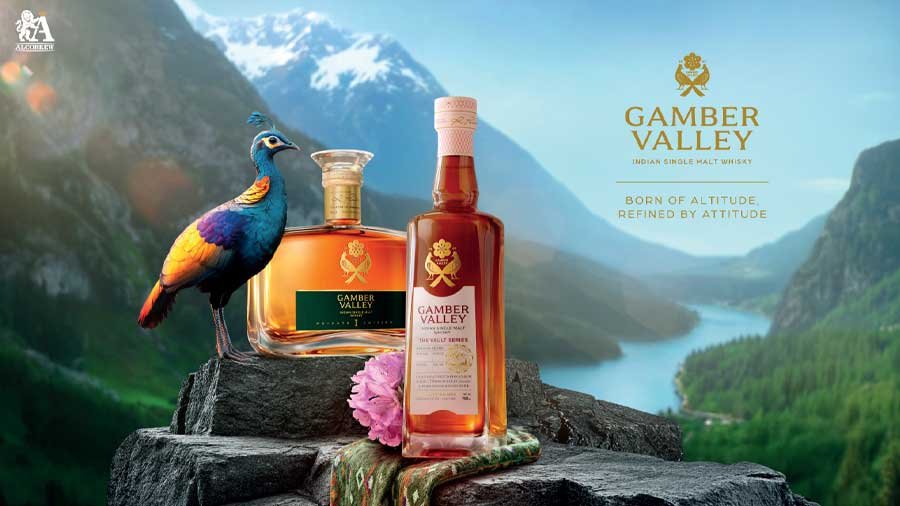
As Indian single malts earn a growing following abroad, Alcobrew’s distillery in the Shivalik hills near Solan is offering a different proposition: whisky shaped by altitude and the seasons, and made to standards that can hold their own internationally.
For much of the last century, Indian whisky was mostly a domestic matter. It was consumed at home in very large volumes and was seldom taken seriously abroad. That has changed. Indian single malt whiskeys now win international awards, appear on the shelves of specialist retailers from London to Singapore, and have become a small but noticeable part of how the country presents its manufacturing and craft to the world. The latest entrant to this category comes from the lower Himalayas.
Alcobrew, a company long associated with Indian-made foreign liquor, set up the Gamber Valley Distillery a few years ago at Kandla in Himachal Pradesh’s Solan district. Gamber Valley Indian Single Malt was launched this year marking Alcobrew’s formal entry into the luxury spirits segment. At Solan it has chosen to produce its own malt. The Gamber Valley Distillery covers roughly 26,944 square metres and houses distillation, maturation and bottling on a single site.
This backward integration brings malt-spirit production in-house. Most of the output is laid down to mature as single malt, and a portion goes into the company’s IMFL blends. The approach reflects a wider trend in Indian manufacturing, in which firms move up the value chain by controlling more of their own inputs.
For any Indian spirit hoping to compete globally, credibility depends on definitions. Alcobrew has joined the Indian Malt Whisky Association, whose standards require:
The company states that Gamber Valley has been produced in full conformity with these rules.
The case for Indian single malt whisky has long rested on climate. Warm conditions speed up maturation, so spirit gains complexity in fewer years than it would in a cool, sea-level climate such as Scotland’s. The trade-off is a higher “angel’s share”, the portion of spirit lost to evaporation.
Gamber Valley adds altitude and seasonality to this argument. Alcobrew points to Solan’s pronounced swings between day and night temperatures. As the spirit warms, it pushes deeper into the wood. As it cools, it draws back out, which accelerates the extraction of wood sugars, tannins and flavour. The Shivalik range of lower himalayas offer cold winters, a monsoon and marked shifts in humidity, conditions that cask-ageing specialists generally regard as favourable. The company also cites the region’s Himalayan spring water and river systems as an asset for fermentation.
The aim is a malt that develops depth quickly without being hurried into harshness. It gives Indian whisky a distinctly Himalayan identity, and a regional narrative of that kind tends to travel well in international markets.
The first releases and the reserve behind them
The debut range is compact and firmly positioned at the premium end. Gamber Valley Private 1 Edition is priced between Rs 15,000 and Rs 21,000. Gamber Valley The Vault Series sits between Rs 7,000 and Rs 10,000. Both are available initially in Haryana, Himachal Pradesh and Chandigarh. A phased rollout is planned into Maharashtra, Uttar Pradesh, Karnataka, Rajasthan, Odisha and Delhi NCR.
The larger story lies in the warehouse. As of 31 August 2025, around two million litres of spirit were maturing in casks at Gamber Valley, a considerable reserve for so young a distillery. That stock underpins future plans for older expressions, special cask finishes and single-cask releases, which are the products that typically build a distillery’s reputation among collectors and connoisseurs overseas.
Whisky as a destination
Alcobrew is also looking beyond the bottle. The company has proposed a new maturation hall and additional cask-storage infrastructure, along with a visitor centre. Guests would follow the spirit’s journey from malting and fermentation through distillation to cask ageing, with guided tours, tastings and a heritage gallery devoted to spirits.
The stated ambition is to make Gamber Valley India’s first Himalayan malt tourism hub. The setting supports the idea. Solan is within easy reach of Chandigarh, lies on the road to Shimla, and already attracts weekend visitors from across north India. Distillery tourism has long been a pillar of Scotland’s whisky economy and its international image. A comparable model in the Himalayas could add a new strand to Himachal Pradesh’s tourism offer and to India’s broader cultural outreach.
A taste of place
Capacity, integration and standards set the stage, but Gamber Valley will ultimately be judged by what is in the glass, and by whether drinkers at home and abroad can taste the mountains in it. Alcobrew has built the infrastructure, adopted the rules and laid down the stock. The hills, with their cold nights, warm summers and restless humidity, are doing the rest.
In a warehouse near Solan, two million litres of spirit are still maturing. Its full character will take several more years to reveal itself. The first chapter, at least, is now in the bottle, and it adds another voice to India’s growing presence in the world of fine spirits.


Leave a Reply