

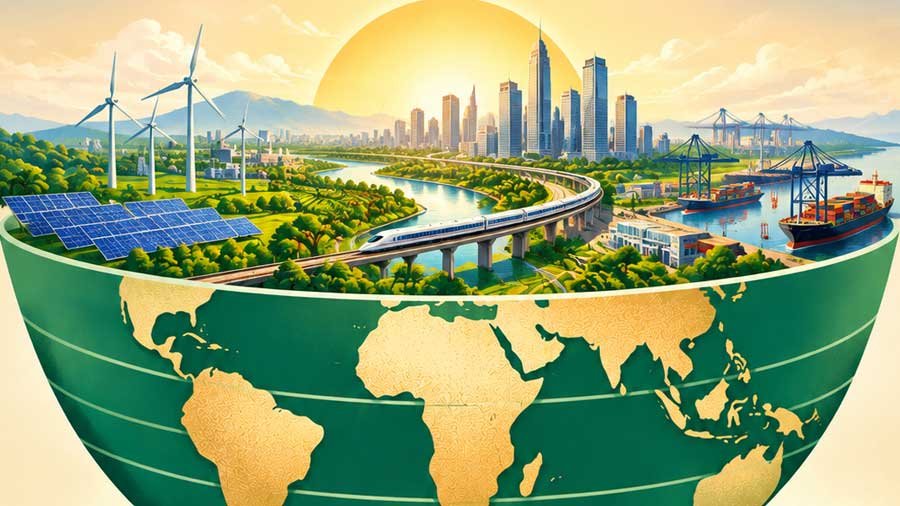
Over the course of 2025 and 2026, “the Global South” has transformed from an academic term into an effective term used in summits, statements and the G20. All of the leaders held meetings in their own countries, such as New Delhi, Johannesburg, Belém and Sevilla, where they talked about “the Global South” as a place authorised to advocate for more just global governance. Nonetheless, there were still other instances proving that “the Global South” is used more like a sentiment rather than a reality. The important question is no longer whether “the Global South” is a legitimate concept or sentiment that exists in the world, but whether it can be turned into a powerful negotiating tool used for obtaining the benefits and concessions from the international community.
The G20 Test Case
In its presidency of the G20 from 2025, the first African country to preside over the G20, South Africa drew from the experience of India that had led to the African Union being represented permanently in G20 forums in 2023.[1] The declaration made at Johannesburg, entitled “Solidarity, Equality, Sustainability”, gained widespread approval from attending officials due to its focus on debt relief and financing for development.[2] Washington, however, took a decision not to attend the summit and challenged the legitimacy of the presidency transfer.[3] President Trump subsequently excluded South Africa from the 2026 summit in Miami, replacing it with Poland[4] and changing the content of the G20 website according to the doctrine of America First – one that emphasises deregulation, security of energy and the technological revolution. The incident heralds the lesson that although consensus politics could be pivotal for the Global South, it does not bind the interests of global hegemons.
G77 and BRICS: A Weight without Unity
Since its inception in 1964, the G77 and China has grown to include 135 countries, which represents over two-thirds of all the member states of the UN.[5] As of January 2026, the group rotates its presidency from one region to another. According to Guterres, the Group of 77 and China is regarded as one of the fundamental “pillars of multilateralism in uncertain times marked by wars, inequities, and debts.” At the same time, research dedicated to the Group’s functions within the General Assembly indicates that different levels of wealth among the Group’s members made consensus-building increasingly difficult. Attempts to create a standing “Global South caucus” within the UN system indicate that the Group is not able to convert its informal solidarity into effective action. BRICS has taken the opportunity to step in. The New Delhi Declaration 2026, which was made by the 11 plus 10 BRICS nations and their associated partner companies, talks about the need to reform the Security Council of the UN, act against unilateral sanctions, and build efficient supply chains of strategic commodities.[6] It must be noted that even though the work of BRICS is somewhat aligned with what the Global South is doing, they are two different concepts.
Development Finance
The strongest demonstration of collective bargaining capacity took place at the Fourth International Conference on Financing for Development held in Sevilla in June and July 2025. This event brought together more than 190 different nations that signed a Sevilla Commitment, the first sincere inter-governmentally based framework for finance since 2015.[7] The conference resulted in the acceptance of 130 voluntary initiatives that would help to address the SDG finance gap worth four trillion dollars per year.[8] Later on, Guterres pointed out that developing countries spend 1.4 trillion dollars every year on making their debt payments, while 3.4 billion people live in countries spending more on servicing their debt than on health care and education altogether.[9] In October 2025, a dedicated Sevilla Forum on debt was initiated.[10] The adoption of this framework itself, considering the weak performance of international aid, shows that the Global South is capable of maintaining leadership in the agenda-setting process, as long as the forum is focused on developing a consensus rather than allowing a veto by a leading state.
Climate Finance
COP30 in Belém, which occurred in the Amazon for the first time in November 2025, resulted in the “Baku to Belém Roadmap”, which commits to raising at least $1.3 trillion annually for developing countries by 2035,[11] as well as the Belém Package, which calls for the tripling of climate finance from 2025.[12] Brazil also launched the Tropical Forests Forever Facility to pay for the use of tropical forests.[13] However, over eighty countries proposed the binding fossil fuel phase-out roadmap to no avail,[14] and negotiators from South Africa expressed satisfaction with the financial achievements made here but cautioned that the financing base was still “too small to address the adaptation challenges faced by developing countries.”[15] The U.S., for the first time in the history of COP proceedings, did not take part in the summit,[16] with Germany also cutting back on six billion euros of decarbonization assistance at the same time,[17] thus making the experience of climate diplomacy demonstrate how the Global South can, indeed, set objectives, as well as influence the normative agenda, but how actual funding still depends on the goodwill of donor governments.
Slogan or Force
The data collected from the years 2025 to 2026 highlight that neither the optimistic nor the pessimistic perspective is accurate. In some settings, the Global South acts as a real negotiating power due to its large numbers and its ability to achieve procedural agreement. However, in other contexts in which one major power still has control over the decision-making, the Global South becomes just minor political baggage, as seen in the case of the failure of the G20 countries to come to an agreement on South Africa’s role. Hence, it can be concluded that there is no strong international bloc, but a number of changing coalitions arise depending on the problem being discussed, including the G77 and China, BRICS, and southern-led UN conferences, which get activated in accordance with their interests.
By Prarabdh Seth
Author is a recent Master of Arts graduate in Diplomacy, Law and Business from the Jindal School of International Affairs at O.P. Jindal Global University. His research interests include issues relating to the Indo-Pacific Region, relations between India and Europe, the Global South, international trade, economic diplomacy, national security, defence, and strategic affairs, issues around maritime security and geoeconomics, critical and emerging technologies, artificial intelligence, semiconductor geopolitics, critical infrastructure, and political risk. His research and policy work have included serving as an intern with the Europe India Centre for Business & Industry (EICBI), the Embassy of Ukraine in New Delhi, the Pankaj Jha Centre for Security Studies, and the Jindal Centre for the Global South. He served as the Events Head for AGORÁ 26: Conversations Beyond Borders, the flagship international diplomacy conference of the Jindal School of International Affairs.
[1] United Nations Office of the Special Adviser on Africa, “Africa’s G20 Johannesburg Summit 2025: In Pursuit of Solidarity, Equality and Sustainability,” un.org/osaa, December 2025.
[2] “G20 Johannesburg Summit: Global South Agenda and India’s Role,” Anantam IAS, November 2025; “2025 G20 Johannesburg Summit,” Wikipedia, accessed September 2026.
[3] Yoshita Singh, “S Africa Not to Receive Invitation to G20 Summit to Be Hosted in Miami in 2026: Trump,” The Week (PTI), November 27, 2025.
[4] “G20: U.S. Replaces S’Africa with Poland for 2026 Summit,” The Guardian (Nigeria), December 2025; “Poland to Join US-Hosted G20 Summit as South Africa Is Shunned,” Mining Weekly, December 4, 2025.
[5] “G77 Indispensable as Strong Pillar of Multilateralism: UN Chief,” IANS, January 15, 2026 (reporting the Group’s membership, founded in 1964 with 77 states, at 134 countries and China).
[6] “New Delhi Declaration: BRICS Challenges Unilateral Sanctions and Calls for Reform of the World Order,” Bursa.ro, September 2026; “New Delhi Declaration Adopted at BRICS Summit 2026: What Are the Key Takeaways,” Outlook India, September 13, 2026.
[7] United Nations Department of Economic and Social Affairs, “Fourth International Conference on Financing for Development Delivers Renewed Hope and Action for Sustainable Development,” un.org, July 3, 2025.
[8] Ibid.; “4th International Conference on Financing for Development,” financing.desa.un.org, 2025 (130 initiatives under the Sevilla Platform for Action, closing the $4 trillion annual SDG financing gap).
[9] “UN Secretary-General Guterres Launches Sevilla Forum to Tackle Debt Crisis in Developing Countries,” The Tribune (India)/ANI, October 23, 2025.
[10] Ibid.
[11] “COP29 and COP30 Presidents Present Baku to Belém Roadmap to Mobilize US$1.3 Trillion in Climate Finance,” cop30.br, November 5, 2025.
[12] “COP30 Adopts Belém Package Without Fossil Fuel Phase-Out,” Enerdata, November 2025 (Belém Package commitment to triple adaptation finance by 2035).
[13] “COP30 Belem Package: Adaptation Finance and the Global Mutirao,” Anantam IAS, November 30, 2025 (Brazil’s launch of the Tropical Forests Forever Facility).
[14] “COP30 Adopts Belém Package Without Fossil Fuel Phase-Out,” Enerdata, November 2025; “Unpacking COP30’s Politically Charged Belém Package,” IPS News, November 2025 (more than 80 countries pushed for a fossil-fuel phase-out roadmap that did not make the final text).
[15] “SA Welcomes Outcomes of COP30,” South African Government News Agency, November 2025, quoting South Africa’s chief negotiator at COP30, Maesela Kekana.
[16] “COP30 Forges Ahead as World’s Biggest Emitter, the United States, Stays Absent,” Sierra (Sierra Club), November 13, 2025; “US Absence at COP30 Exacerbates Financial Challenge to Meet Climate Targets,” Earth.org, November 2025.
[17] “COP30 Nations Demand Funding Amid US Absence, Germany Cuts,” Mexico Business News, November 24, 2025.



Leave a Reply