

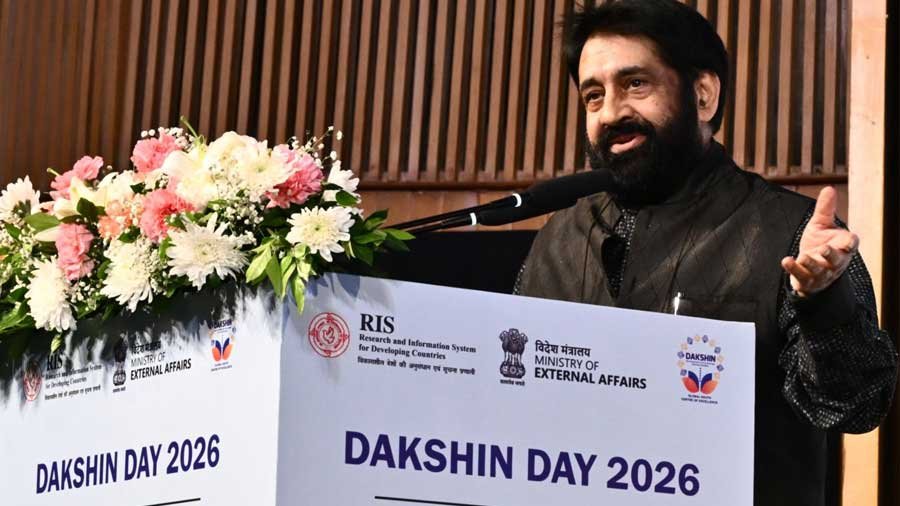
South Africa’s High Commissioner to India says developing nations must move beyond solidarity and take an active role in reshaping global governance.
The Global South is no longer at the margins of international affairs; it is now positioned to shape the emerging world order. This was the central message of H.E. Prof. Anil Sooklal, High Commissioner of South Africa to India, in his special address at DAKSHIN Day 2026, held at the India Habitat Centre in New Delhi on 17 November.
Reflecting on his long engagement with South-South cooperation, Prof. Sooklal described the present geopolitical climate as a defining moment for developing countries. “This is the Global South moment in global history at the present time,” he observed, warning that failure to seize this opportunity could mean losing the chance to provide leadership in an increasingly fractured world.
He also recalled the early thinking behind DAKSHIN, tracing its origins to discussions held in 2019, when Indonesia, India, Brazil and South Africa were preparing to assume successive G20 presidencies. The discussions highlighted the need for these countries to generate knowledge and policy perspectives through their own think tanks and intellectual institutions, rather than relying predominantly on established institutions of the developed world. He welcomed DAKSHIN as an important platform for advancing that vision.
Turning to global governance, Prof. Sooklal noted that Africa and much of the developing world had been underrepresented when key international institutions were established. He argued that the structures created in the aftermath of the Second World War must now reflect contemporary geopolitical and economic realities. Calling for reform of the United Nations and the wider global governance architecture, he stressed that the Global South must be actively involved in shaping the rules and institutions that will guide the future.
He was equally emphatic that emerging leadership must not reproduce the inequalities of the past. The growing influence of developing countries, he said, must be accompanied by inclusivity and solidarity, ensuring that smaller and less-resourced nations are not left behind.
“We must ensure that we are inclusive, that we want to build a just order, an order where everyone finds space,” he said, underlining the importance of respect for international law, fundamental freedoms and the principles of the UN Charter.
Highlighting the role of India, South Africa, Brazil and China, he also pointed to BRICS as an important platform through which the Global South could strengthen its collective influence. Drawing on his experience as a BRICS Sherpa, he spoke of the grouping’s evolution into a significant voice in international affairs.
Concluding with a strong call for collective action, Prof. Sooklal declared: “It’s our moment. It’s our moment to determine the fundamental shape and structure of this new multipolar world.”
He described DAKSHIN as an important vehicle for translating the aspirations of the Global South into knowledge, policy and strategic cooperation, ending with a message that captured the spirit of his address: “The Global South has arrived; our time is now.”


Leave a Reply