

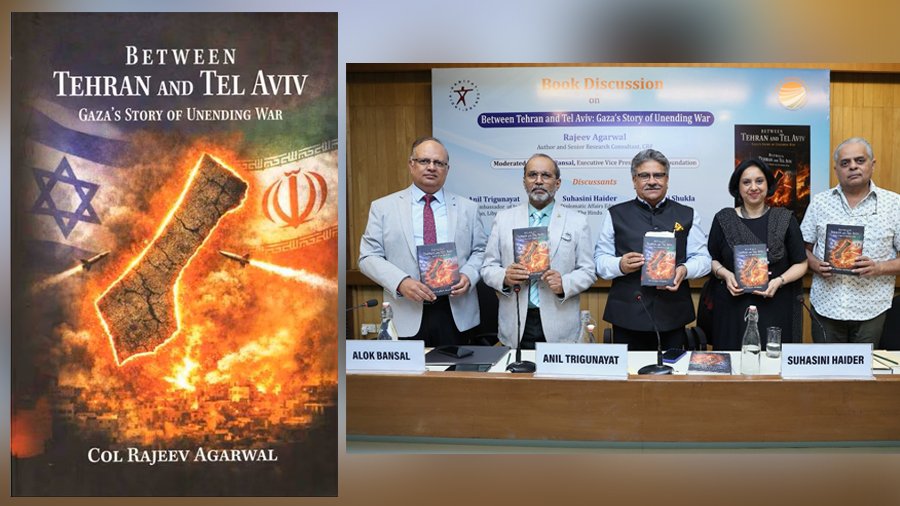
There are books that explain wars, and then there are books that explain why wars refuse to remain confined to the battlefield. Colonel Rajeev Agarwal’s Between Tehran and Tel Aviv: Gaza’s Story of Unending War belongs firmly to the latter category. At first glance, the title suggests another chronicle of the Gaza conflict, a subject that has generated an overwhelming body of literature since October 2023. Yet, as one progresses through the book, it becomes evident that Gaza is not the author’s final destination. It is merely the point of departure.
Colonel Agarwal presents the Gaza war not as an isolated tragedy but as the catalyst that accelerated the transformation of West Asia’s strategic order. The title itself becomes symbolic. “Between Tehran and Tel Aviv” is not simply a geographical reference; it represents the widening arc of confrontation that now stretches far beyond Gaza’s borders, encompassing Iran, Israel, Lebanon, Syria, Yemen, the Gulf and, inevitably, the global powers drawn into the conflict.
The foreword by Ambassador Talmiz Ahmad offers an apt intellectual frame for the book. One of India’s foremost scholars of West Asia, Ahmad reminds readers that no conflict in the region can be understood in isolation from its history, its competing narratives and its constantly shifting regional alignments. That perspective permeates the book. Rather than treating October 7 as the beginning of history, Agarwal traces the political currents that preceded it, from the Abraham Accords and the prospects of Saudi-Israel normalisation to the evolving Iran-Saudi rapprochement, arguing that these developments altered the regional calculus in ways often overlooked in daily news coverage.
What distinguishes the book is the author’s ability to weave together military operations, diplomacy and geopolitics without allowing one discipline to dominate the narrative. As a former military officer, Agarwal is naturally comfortable discussing intelligence failures, operational planning and battlefield decisions. His examination of Hamas’ October 7 attack is particularly compelling because it is analysed not merely as a tactical surprise but as a profound failure of strategic assumptions. Historical parallels, especially with the surprise of the 1973 Yom Kippur War, reinforce the argument that technological superiority can never substitute for strategic vigilance.
Equally noteworthy is the restraint with which the author approaches an emotionally charged subject. In an era where discourse on Gaza often descends into ideological binaries, Agarwal avoids simplistic moral positioning. He acknowledges the brutality of Hamas’ attack while documenting the devastating humanitarian consequences of Israel’s military response. This balanced treatment is perhaps one of the book’s greatest strengths. It neither romanticises armed resistance nor overlooks the immense civilian suffering that has unfolded in Gaza. Such analytical sobriety is increasingly rare in contemporary writing on West Asia.
Yet the book’s most significant contribution lies elsewhere.
Most books on Gaza remain confined to Gaza. Agarwal refuses that limitation.
As the narrative unfolds, the reader gradually realises that the true protagonist is not Gaza at all, it is escalation. Every chapter, whether discussing Hezbollah, the Houthis, Iran’s calibrated military responses or Israel’s expanding security doctrine, examines how a localised conflict gradually evolved into a regional strategic confrontation. The book convincingly demonstrates that modern wars no longer remain geographically contained; they spill across borders through proxy networks, information warfare, cyber capabilities and diplomatic realignments. What begins in one territory rapidly reshapes an entire regional security architecture.
This broader perspective also explains why the book has acquired renewed relevance following subsequent developments in the Iran-Israel confrontation. Interestingly, the manuscript appears to have been written almost in real time, with chapters reflecting successive phases of the conflict as they unfolded. Rather than diminishing the work, this lends it a sense of immediacy. Readers witness not only events themselves but also the evolution of strategic thinking alongside those events, a rare quality in contemporary geopolitical writing.
Another aspect deserving appreciation is the attention given to ceasefire diplomacy. While military campaigns dominate headlines, Agarwal devotes considerable space to examining why repeated attempts at negotiated pauses failed to produce durable peace. His discussion moves beyond diplomacy as process and instead highlights the deeper absence of trust, incompatible political objectives and the lack of credible exit strategies for the principal actors. For policymakers, this may well be among the book’s most valuable sections, reminding readers that wars are rarely concluded by battlefield success alone.
The book is not without its limitations. Because much of it was written alongside unfolding events, certain sections occasionally resemble analytical essays responding to successive developments rather than chapters conceived within a single overarching framework. Readers seeking a more theoretically grounded academic study of conflict or international relations may also find that the book privileges strategic analysis over conceptual debate. Yet these are relatively minor observations in a work whose principal strength lies precisely in its accessibility and its ability to connect historical context with contemporary policy challenges.
Ultimately, Between Tehran and Tel Aviv succeeds because it asks a larger question than its title initially suggests. It is not simply about Hamas, Israel or Iran. It is about the fragility of regional orders, the unintended consequences of strategic decisions and the ease with which local conflicts evolve into international crises. In doing so, Colonel Rajeev Agarwal reminds readers that the Gaza war cannot be understood merely through the language of military campaigns or humanitarian statistics. It must also be read as a story of competing visions of regional order, shifting alliances and the enduring failure of diplomacy to keep pace with escalation.
For diplomats, policymakers and students of international affairs, this makes the book more than a contemporary account of war. It becomes a timely study of how the geopolitics of West Asia continues to evolve, where every battlefield carries consequences far beyond its immediate geography, and where the distance between Tehran and Tel Aviv is measured not only in kilometres but also in the strategic choices that continue to shape the future of the region.



Leave a Reply