

As the Indian traveller becomes more discerning and globally mobile, industry leaders call for stronger connectivity, destination-led tourism, better skills and infrastructure that matches ambition.
India’s tourism story is entering a new phase. Domestic travel has emerged as a powerful engine of growth, Indian travellers are venturing abroad in greater numbers, and international visitors are looking for experiences that go beyond conventional sightseeing. But with the traveller changing rapidly, the question is whether India’s tourism ecosystem, from airports and airlines to hotels, destinations and public infrastructure, is changing fast enough with them.
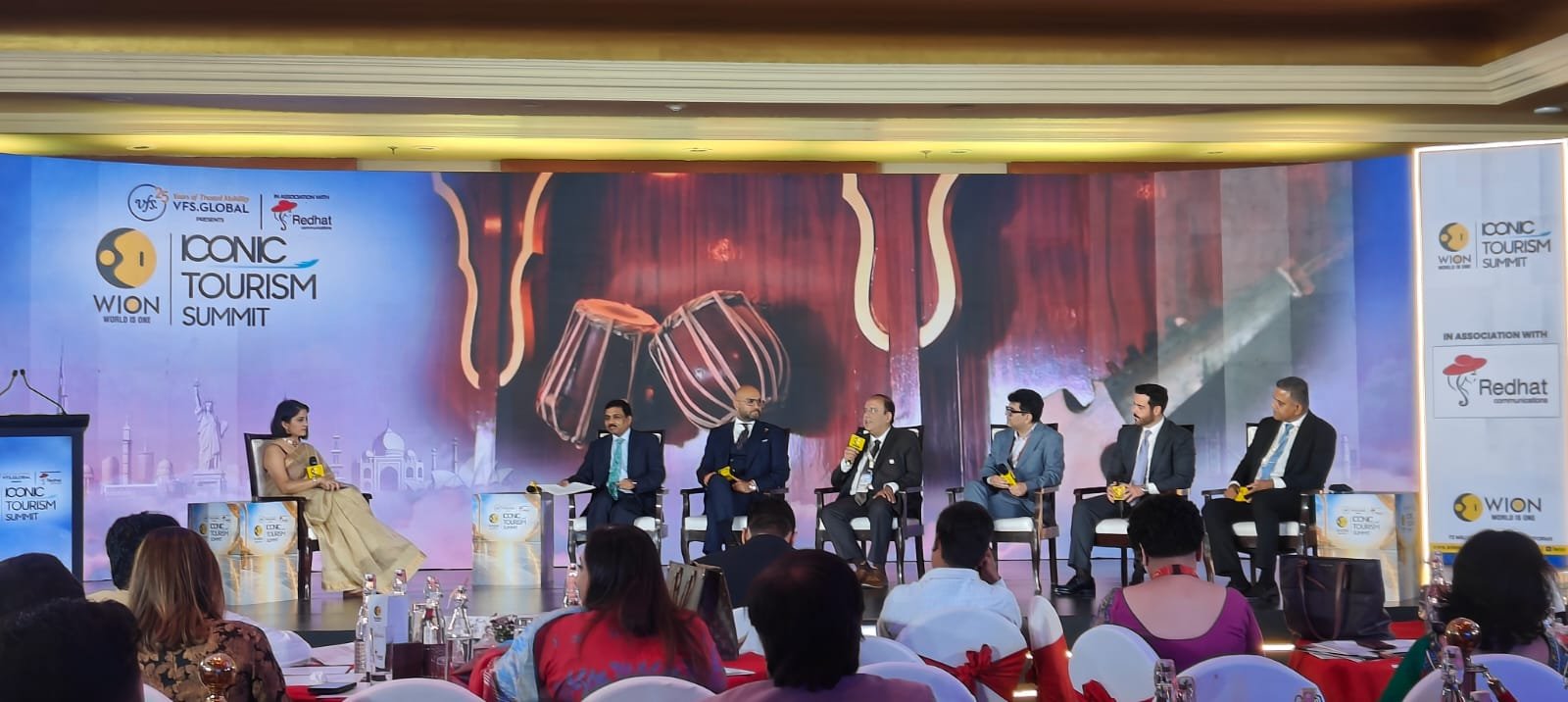
That question shaped the discussion at the WION Iconic Tourism Summit in New Delhi on 23 September, where industry and diplomatic voices came together for the panel ‘The Business of Travel: Aviation, Hospitality & India’s Tourism Infra Story’.
Moderated by Shreya Upadhyay, the panel featured Vikram Lalvani, Managing Director & CEO, Sterling Holiday Resorts; Saurabh Tiwari, Vice President – Middle East, Maldives & Sri Lanka, IHCL; Muktesh Pardeshi, former Secretary to the Government of India and former Ambassador/High Commissioner to Mexico, New Zealand and Türkiye; Manish Puri, Head of Global Sales, Air India and Air India Express; Ahmed Hamed Sharbak, Regional Manager – APAC, Visit Qatar; and Kamal Munasinghe, Senior Vice President – Colombo Hotels, Cinnamon Hotels & Resorts and General Manager, Cinnamon Life at City of Dreams.
Vikram Lalvani: Tourism must become destination-led
For Vikram Lalvani, the next chapter of Indian tourism will be driven less by simply putting another destination on the map and more by creating a compelling reason to visit it.
“The way the industry is moving and should move is more destination-led,” Lalvani said, arguing that the reason to travel matters as much as the destination itself.
He pointed to the changing needs of family travellers, where different members may seek very different experiences. The opportunity, therefore, is to create destinations and circuits capable of combining multiple experiences, from hill stations and wildlife to culture, food and leisure, into one seamless holiday.
Lalvani also made the case for looking at tourism primarily through the lens of India’s enormous domestic market.
“The core issue here is domestic tourism,” he said, stressing that the post-COVID recovery demonstrated the strength of domestic travel. International tourism, he argued, can act as a “force multiplier”, but India’s tourism story cannot be built around foreign visitors alone.
He also called for a stronger narrative around India as a 365-day destination. Rather than concentrating tourism around a few peak seasons or iconic attractions, the industry needs to communicate the experiences available across different regions and seasons.
The opportunity, he suggested, lies in connecting destinations and experiences, and encouraging travellers to discover more of India in the process.
Saurabh Tiwari: The Indian traveller is changing the global hospitality equation
For Saurabh Tiwari, the growth of outbound Indian travel is already forcing global hospitality companies to rethink their offering.
“The global hotels and the hospitality industry in general don’t have a choice,” he said, pointing to the growing spending power and increasingly sophisticated expectations of Indian travellers.
The Indian guest, he argued, is no longer simply looking for accommodation. Brand promise, consistency, food, amenities and experience increasingly influence the decision.
Tiwari also highlighted the changing expectations of today’s traveller. Guests are more informed, digitally connected and conscious of design, culinary experiences and sustainability.
“They want the best experiences in terms of culinary,” he said, noting that restaurants, celebrity chefs and distinctive food experiences can increasingly influence hotel choices.
Sustainability has also moved up the agenda. Travellers are asking hotels what they are doing with water, food and resources, while design and visual appeal have become particularly important in the age of social media.
But technology does not eliminate hospitality’s most important ingredient: people.
“AI is in the neighbourhood; the human touch and human warmth are the most important thing,” Tiwari said in essence, arguing that technology should enhance the guest experience rather than replace the human connection at its heart.
That also makes investment in skills critical. Hotels need employees who are trained not only for today’s requirements but for a traveller whose expectations will continue to evolve.
Amb Muktesh Pardeshi: Tourism is an instrument of economic diplomacy
For Amb Muktesh Pardeshi, tourism belongs firmly within India’s broader economic and diplomatic strategy.
“Tourism is an important component of economic diplomacy,” he said, describing tourism as a vehicle for people-to-people contact as well as an instrument of soft power.
Drawing on his experience as India’s ambassador in Mexico, New Zealand and Türkiye, Amb Pardeshi offered a candid assessment of India’s tourism potential. He argued that India has many of the fundamental ingredients required to become a major global destination — diverse landscapes, heritage, culture, wildlife and the ability to offer experiences throughout the year.
But infrastructure and service quality remain critical.
Amb Pardeshi called for stronger cooperation between government, industry and civil society, arguing that the next phase of India’s tourism development cannot be achieved by one constituency acting alone.
His experience of organising the G20 Summit and more than 200 associated meetings across 60 locations also shaped his argument. The G20, he said, demonstrated how major international events can accelerate infrastructure development and expose smaller destinations to global audiences.
Yet infrastructure, he stressed, is not simply about roads, airports and highways.
Cleanliness, hygiene, mobility, language skills and frontline hospitality are equally important. He recalled an interaction involving a foreign ambassador staying at a Delhi hotel where no member of the reception team could converse in English.
For Amb Pardeshi, such experiences matter because the tourist encounter with India is often shaped by the smallest details.
“Unless industry and government work together, we cannot move to the next stage,” was the thrust of his argument.
Manish Puri: India can become a global aviation hub
The aviation sector is at the centre of India’s tourism expansion, and Manish Puri pointed to the scale of capacity being added by Indian carriers and airports.
He described India’s aviation development as a classic “chicken-and-egg” situation: better connectivity encourages tourism, while growing passenger demand creates the case for additional capacity.
Puri argued that India is well placed to strengthen its position as a global aviation hub over the next five to ten years, supported by the expansion of Indian airline fleets and the development of major airports.
But he identified transit infrastructure and the passenger experience as areas requiring further attention if India is to compete with established international hubs.
The objective, he suggested, should be to make the transit experience itself sufficiently smooth and attractive that passengers consider India not merely as an origin or destination, but as a hub through which they are willing to connect.
Air India and Air India Express have already integrated their sales organisations under Puri’s leadership, creating a unified sales function across domestic and international markets.
Puri also pointed to a change in travel behaviour: travellers are increasingly booking closer to departure, particularly when geopolitical developments or visa uncertainty influence destination choices.
The result is a more agile, less predictable travel market, one in which connectivity and ease of entry can directly influence demand.
Ahmed Hamed Sharbak: Building stronger India–Qatar travel flows
For Ahmed Hamed Sharbak, the opportunity lies in deepening the already substantial links between India and Qatar.
He highlighted opportunities across family leisure, business travel and stopovers, emphasising the importance of giving Indian travellers a reason to experience Qatar rather than merely pass through it.
Qatar’s strategy, he explained, increasingly includes major events and sports tourism. The country’s calendar of international events, alongside its aviation connectivity, creates opportunities to attract visitors for short stays as well as longer holidays.
The idea of the 48- or 72-hour stopover was particularly relevant to the discussion. For travellers already flying between India, Europe, the UK or North America, Qatar can be positioned as an additional experience within the wider journey.
Visa facilitation is another part of that proposition. Visit Qatar’s current visa guidance confirms that citizens of more than 100 countries can access visa-free entry or visa-on-arrival arrangements, depending on nationality and applicable conditions.
For Sharbak, the objective is therefore not simply to increase arrivals but to convert connectivity into experiences, particularly for families.
Kamal Munasinghe: South Asia must start thinking regionally
Kamal Munasinghe brought the conversation back to the wider South Asian tourism ecosystem.
For Sri Lanka, he argued, the next opportunity is not simply to compete with destinations such as the Maldives or Dubai but to develop regional tourism circuits in which travellers combine several countries and experiences.
“Regional tourism is very, very important,” he said.
He pointed to the possibilities of combining India’s cultural and wildlife experiences with Colombo’s urban and luxury offering and then extending the journey towards other South Asian destinations.
Connectivity is central to that vision. Munasinghe highlighted growing air links between India and Sri Lanka and argued that tourism flows need to work in both directions for the corridor to remain commercially sustainable.
He also stressed that connectivity is about more than flights. Visa arrangements, payment systems, cultural understanding, food preferences and human-resource exchanges all contribute to whether a tourism corridor works.
Cinnamon Hotels & Resorts has been pursuing such cross-market engagement, including staff exposure and training initiatives. Munasinghe also highlighted Cinnamon Life at City of Dreams as part of Colombo’s evolving proposition as a destination for luxury, business and entertainment. He currently leads Cinnamon Life while continuing as Senior Vice President – Colombo Hotels.
His larger point was that South Asia needs to begin selling itself as a connected region rather than as isolated national destinations.


Leave a Reply