

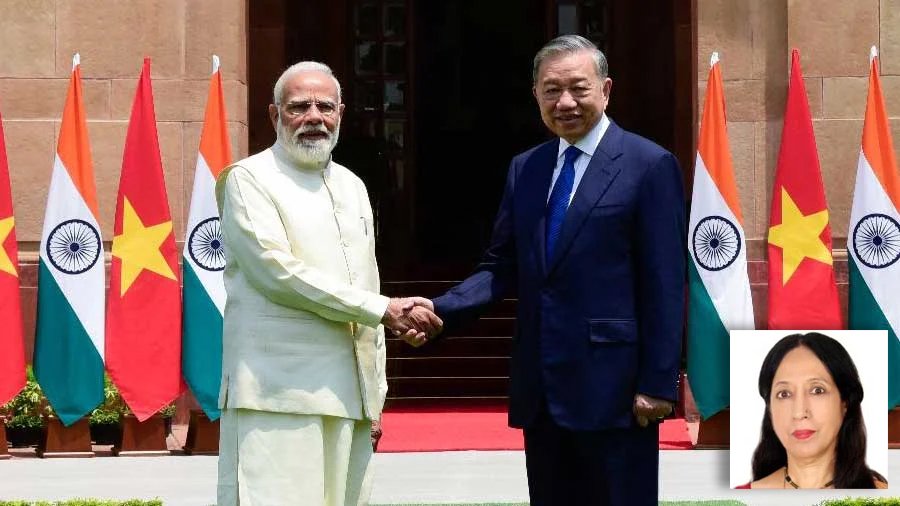
In 2026, we celebrate 54 years of diplomatic relations and ten years of our Comprehensive Strategic Partnership (CSP) that have few parallels. To commemorate this milestone, Viet Nam’s top leader, General Secretary of the Communist Party and President of Viet Nam, To Lam, visited India from 5–7 May 2026, during which ties were elevated to an Enhanced Comprehensive Strategic Partnership. The visit resulted in several key agreements including a new trade target of USD 25 billion by 2030, and thirteen agreements covering rare earths, digital payments, manuscripts, tourism, and cultural cooperation. Viet Nam also joined India’s Indo-Pacific Oceans Initiative, strengthening maritime cooperation and regional strategic coordination.
This confirms what Vietnamese Prime Minister Pham Van Dong once emphasised: this relationship is ‘as clear as a cloudless blue sky.’ Connected since ancient times, our two nations have stood the test of turbulent struggles with courage and are witnessing our ties strengthen further.
When the two nations signed the Strategic Partnership in July 2007, Viet Nam became the first country in ASEAN with which India had entered into such a partnership. Bilateral relations progressed steadily after India’s enunciation of the Act East Policy in 2014. Setting a new benchmark for bilateral ties, the Comprehensive Strategic Partnership (CSP) was signed during Indian PM Modi’s visit to Viet Nam in September 2016. The momentum that was generated, of an Indian Prime Minister visiting this partner country after 15 years, has engendered cooperation and collaborations, especially in strategic ties in the Indo-Pacific and people-to-people ties for shared prosperity.
The two nations have institutionalised mechanisms including the Joint Commission Meeting at the Foreign Ministers’ level for broader strategic cooperation and the Chambers of Commerce and Industry to support B2B exchanges and trade fairs. The 2024–2028 Plan of Action under the Comprehensive Strategic Partnership explicitly prioritises increased trade, investment, and technological partnership, reflecting a shift from symbolic alignment to a more operational economic agenda.
The first gain post 2016 has been an upswing in bilateral trade, driven by sectors like pharmaceuticals, machinery, and agriculture; this reached approximately US$16.4 billion in fiscal year 2025, from USD 10 billion (approx.) in 2016.
Second, Indian companies, which had stayed away from this neighbour are now identifying opportunities for joint ventures, focused on energy, mineral exploration, manufacturing, and IT. Major investors include the Adani Group (ports/energy), ONGC Videsh, Tata, and Marico. Adani Ports and Special Economic Zone Ltd. (APSEZ) has received in-principle approval to develop a new greenfield port in Da Nang in 2026. This has the potential to more than double the existing investment by 2030. Indian investments have doubled from USD 1 billion to over USD $2 billion (approx.) in Viet Nam and Viet Nam’s fast-paced reforms have transformed it to become a hub of inward Foreign Direct Investment. With three high-tech parks and ten more being developed, it is evident that more Indian companies will seek opportunities. In India, Vietnamese projects like VinFast’s Electric Vehicle plant, alongside credit lines for maritime security and digital payments, underscore deepening supply chain integration.
Third, Defence cooperation is a key pillar of this partnership, institutionalized in 1994. Post the signing of the CSP, the convening of the Defence Policy Dialogue (DPD) is more regular, with the Joint Vision Statement on India–Viet Nam Defence Partnership towards 2030 signed in June 2022. The 2024 Plan of Action and the public diplomacy surrounding the partnership both present defence and security as core, not supplementary elements of the CSP.In 2025 the 15th India-Viet Nam DPD was held in Hanoi, with the 16th iteration to be held in New Delhi later this year. VINBAX remains the main bilateral land-for-peacekeeping exercise, and over time has expanded in scale and complexity, including field training, HADR-related validation, and cross-service participation. ‘VINBAX 2025’, the 8th iteration of the exercise, was conducted in Hanoi, Viet Nam, with over 300 personnel from both sides. Over 500 Vietnamese personnel are also being trained annually in hydrography, submarine warfare, military medicine, and search and rescue.
As India ramps up indigenous defence production, it has become a major exporter of defence equipment. India has recently signed the BrahMos Missile Deal with Viet Nam, further strengthening the partnership.
Fourth, people-to-people ties have received a huge fillip in the last decade. While India Viet Nam friendship associations are building bridges of friendship, through several meetings and exchanges, the work of Hanoi Viet Nam India Friendship Association (HAVIFA) is notable.
Tourism facilitated by enhanced air connectivity has been a major game changer in promoting people-to-people ties. The first direct flight from New Delhi to Hanoi started in June 2022, post which several Indian cities are connected with cities in Viet Nam. The number of direct flights per week has risen to 88 in early 2026, underlining the emergence of Viet Nam as a preferred destination for Indian tourists for holiday, destination weddings and Bollywood movie shootings. The visa process has been greatly simplified with the e-Visa facility in both countries. There is no visa requirement for Indians to visit the island of Phu Quoc. The travel of Indian tourists has given a major fillip to the diasporic business community with opening of hotels and restaurants serving Indian cuisine. Yoga teachers from India are also sought after.
While Buddhist connections received a fillip due to direct flights, May 2025 marked a special time, with the historic journey of India’s Sacred Buddha Relics to Viet Nam. This has led to keen interest for visiting the Mahabodhi Temple The establishment of the modern Nalanda University, near Bodhgaya in Bihar in 2010 has gradually expanded its sphere of academic exchanges. As a result, hundreds of Buddhist monks and scholars visit the University for conferences and collaborative initiatives.
To conclude, even as India aims for ‘Viksit Bharat @ 2047’ and Viet Nam endeavours to become a high-income developed country by 2045, collaborations will be important in areas as green economy, circular economy, digital economy and critical industries such as rare earth elements, semi-conductor, nano materials. While the key winner in the past ten years has been people-to-people ties through Buddhist connections, yoga, tourism and wellness, partnerships among Governments, Universities and businesses will witness robust exchanges. With 44 events and initiatives being planned by the Embassy of India in Hanoi for 2026, and with a similar enthusiasm in Viet Nam’s embassy in New Delhi, this year will provide further impetus to futuristic bilateral ties.



Leave a Reply