

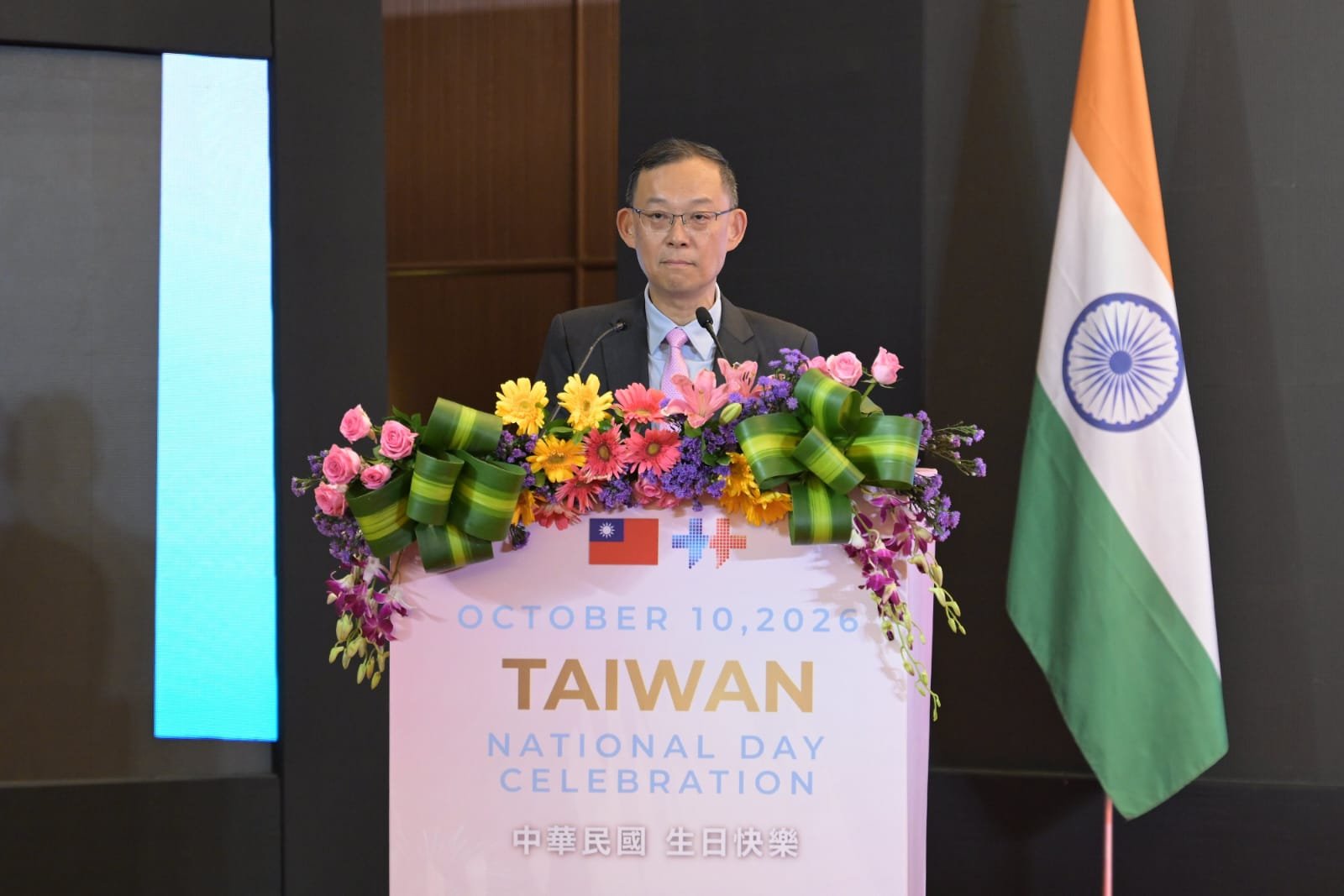
At Taiwan’s 115th National Day reception in New Delhi, Dr Mumin Chen highlights growing economic engagement, parliamentary exchanges and people-to-people connections
Taiwan and India may be separated by approximately 4,000 kilometres, but their growing connections in technology, trade, education and culture are bringing their societies closer. This was the central message delivered by Dr Mumin Chen, Representative of the Taipei Economic and Cultural Centre in India, at Taiwan’s 115th National Day reception held in New Delhi on 8 October 2026.
The reception brought together guests, including Indian officials, members of the diplomatic corps, business representatives and members of the Taiwanese community. Cultural performances provided a fitting backdrop to the occasion, with a Taiwanese group presenting a performance inspired by the Ramayana and Indian university students singing Taiwanese songs in Mandarin. The evening reflected the importance of cultural engagement in strengthening mutual understanding.
Welcoming the gathering, Dr Chen emphasised the shared characteristics of the two societies. “We have a lot of things in common. We are both democracies. We are both proud of our own culture, and we are both energetic and entrepreneurial people,” he said.
His remarks came in a year of particular significance for Taiwan, marking the 30th anniversary of its first direct presidential election in 1996. Reflecting on this milestone, Dr Chen recalled how the Taiwanese people chose democracy despite military pressure and external challenges. Over the subsequent three decades, Taiwan has experienced changes of governing parties and the consolidation of democratic institutions.
He underlined that freedom, democracy and human rights remain fundamental values for Taiwanese society. President Lai Ching-te has also highlighted the anniversary as a milestone in Taiwan’s democratic development, emphasising the resilience of its institutions and the determination of its people to safeguard their democratic way of life.
For Dr Chen, however, Taiwan’s story is not limited to political development. It is equally a story of economic transformation, technological innovation and integration into global supply chains.
He pointed to Taiwan’s strong economic performance, noting that its GDP per capita had reached approximately US$39,000 in the previous year. He also highlighted the economy’s robust growth during the first half of 2026, supported by global demand for information technology products and Taiwan’s position in international manufacturing networks. Official statistics recorded year-on-year GDP growth of 14.55 per cent in the first quarter and 12.93 percent in the second quarter.
“Technology is always at the heart of this transformation,” Dr Chen observed.
Taiwan’s semiconductor industry, advanced machinery, information and communications technology, and electronic manufacturing capabilities have made it an important participant in the global technology ecosystem. The island’s role has become particularly significant as demand for artificial intelligence infrastructure and advanced computing accelerates. Taiwan Semiconductor Manufacturing Company (TSMC), the world’s largest contract chipmaker, reported record third-quarter revenue in October 2026, reflecting the strength of demand associated with AI applications.
Yet Dr Chen cautioned that technological success must be understood against a more complex geopolitical landscape. Intensifying tensions and challenges to the international order, he said, have reinforced the importance of partnerships among like-minded economies and the resilience of supply chains.
Against this backdrop, India is emerging as an increasingly important partner.
One significant development announced at the reception was the revival of the Taiwan–India Parliamentary Friendship Association, with 23 Indian parliamentarians having agreed to join. Dr Chen described parliamentary exchanges as an important channel for building mutual understanding and strengthening connections between the two societies. The announcement was also reported by Taiwan’s Central News Agency.
Economic engagement is another important pillar of the relationship. According to Dr Chen, Taiwan–India bilateral trade reached a record US$12.5 billion in 2025. In the first eight months of 2026, it rose to US$12.9 billion, representing an increase of 60 per cent over the corresponding period of the previous year.
He also highlighted the presence of nearly 400 Taiwanese companies operating in India, with cumulative investment approaching US$7.5 billion and employment supporting more than 200,000 jobs, according to figures cited in his address.
Taiwanese companies bring expertise in semiconductors, electronic manufacturing, precision machinery, industrial automation and advanced manufacturing. India, with its expanding manufacturing base, large domestic market and growing innovation ecosystem, offers opportunities for deeper industrial collaboration. The presence of Taiwanese technology brands, including ASUS, at the reception illustrated the commercial links already connecting the two markets.
Dr Chen also highlighted an emerging collaboration in the tea industry, combining high-quality tea from Meghalaya with Taiwanese machinery and technology. Such initiatives demonstrate how cooperation can extend beyond large-scale industrial investment into specialised sectors, creating opportunities for innovation and value addition.
Science and technology cooperation is similarly expanding. Since 2009, Taiwan and India have supported approximately 180 joint research projects in areas including renewable energy, biomedical technology and nanotechnology, Dr Chen said. Newer areas of engagement include semiconductors, artificial intelligence, quantum computing, sustainable development and social sciences.
He also referred to Taiwan’s knowledge-sharing initiatives on air pollution management and plans for further workshops on cybersecurity and science education. These exchanges offer practical avenues for researchers and institutions to address shared challenges.
Education and people-to-people connections formed another important part of the address. Dr Chen said more than 3,500 Indian students were studying in Taiwan, while approximately 600 Indian young people were undertaking internships there. Taiwan Education Centres across India promote Mandarin language learning and provide opportunities to explore Taiwanese society and culture.
He announced that Taiwan had awarded 95 scholarships to Indian students in 2026, comprising 47 degree scholarships and 48 language scholarships. He also noted the renewal of nine memoranda of understanding and the signing of an additional agreement with an Indian university. Looking ahead, he expressed interest in expanding academic collaboration into semiconductors, artificial intelligence, green technology and biotechnology, including stronger industry–academia partnerships.
Connectivity is expected to provide another boost. EVA Air is scheduled to launch a nonstop Taipei–Delhi service on 1 December 2026, operating five flights a week. The route is expected to make travel easier for businesspeople, students and tourists, strengthening the practical foundations of economic and educational engagement.
Cultural exchanges are also continuing to broaden awareness of Taiwan in India. Dr Chen referred to visits by Taiwanese artists and writers, as well as plans for further film and cultural programmes in Delhi and Mumbai. Such initiatives complement commercial and academic engagement by giving people opportunities to discover each other’s languages, traditions and creative expressions.
Concluding his address, Dr Chen reaffirmed Taiwan’s commitment to international cooperation in healthcare, disaster relief, agricultural technology, digital governance, the net-zero transition and humanitarian assistance.
“Taiwan is a vital partner in this journey,” he said, expressing appreciation for the friendship and support received from the Indian people.


Leave a Reply