

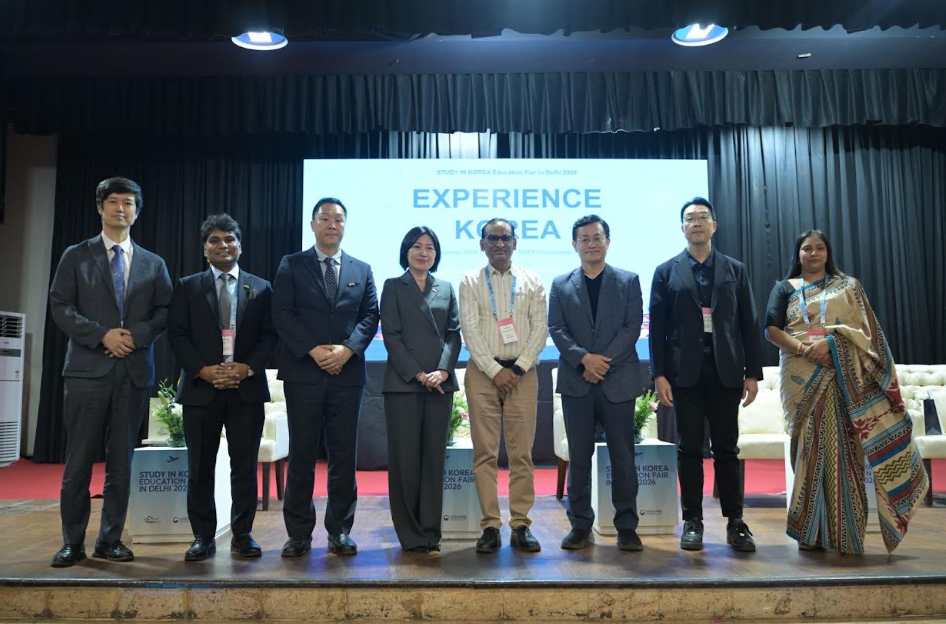
The Study in Korea Education Fair 2026, held on September 18–19 at the NDMC Convention Centre, New Delhi, brought together thousands of Indian students, parents, educators and aspiring professionals with Korean universities, scholarship representatives, GKS alumni, education institutions and industry stakeholders to explore opportunities for higher education, academic exchange, scholarships, cultural engagement and future careers in Korea.
Organised jointly by the National Institute for International Education (NIIED), Ministry of Education, Republic of Korea, and the Korean Education Centre in India (KEC), Embassy of the Republic of Korea in India, the two-day fair recorded a footfall of more than 4,500 students, parents and aspirants. The fair provided visitors with direct access to Korean university representatives, admission information, one-to-one counselling, scholarship guidance and information on academic and professional pathways. Its central vision was to connect the journey from school-level Korean language learning to higher education in Korea and, ultimately, global careers connecting India and Korea.
Opening Ceremony Highlighted Growing India–Korea Educational Partnership
The opening ceremony brought together prominent representatives from the Korean and Indian education sectors, including H.E. Lee Seong-ho, Ambassador of the Republic of Korea to India; Mr. Han Sang Shin, President, National Institute for International Education; Ms. Hojeong Ko, Director, Korean Education Centre in India; Dr. Park Euy Don, President, Southwest Asia Chapter Council of the Peaceful Unification Advisory Council; Dr. Alok Kumar Mishra, Joint Secretary, Association of Indian Universities; and Dr. Biswajit Saha, Director, Skill Education, CBSE.
In her remarks, Ms. Hojeong Ko highlighted the fair’s dual purpose of providing Indian students with practical information and guidance on studying in Korea while creating a platform for dialogue and partnerships between Indian and Korean educational institutions. She emphasised opportunities for student and faculty exchanges, joint research and new institutional partnerships.
Mr. Han Sang Shin highlighted the growing educational relationship between the two countries and noted that 783 Indian students have received the Global Korea Scholarship since 1967, with 296 Indian GKS scholars currently studying in Korea and approximately 2,016 Indian students currently pursuing studies in Korea.
H.E. Lee Seong-ho, Ambassador of the Republic of Korea to India, highlighted Korea’s universities, research capabilities and career opportunities for Indian students, while calling for deeper university partnerships, joint research and student and faculty exchanges as important elements of the Korea–India Special Strategic Partnership.
Three-Zone Fair Created an Immersive Study-in-Korea Experience
The fair was organised across three major zones. The University Zone on the ground floor enabled visitors to meet representatives of participating Korean universities, explore programmes and admission opportunities and receive one-to-one counselling. The Korea Partnership Zone brought together organisations including NIIED/GKS, GKS India Alumni, KOSME, Korea Tourism Organization, India-Korea Research & Innovation Center, Chungnam Economic Promotion Agency and Atomy India. The Korea Experience Zone offered visitors opportunities to experience aspects of Korean culture through Hanbok, photography and K-Food activities.
The official programme also featured university information sessions throughout both days, giving students additional opportunities to interact with representatives and learn about individual programmes and campus support.
India–Korea Education Leadership Forum: From Classroom to Career
A major highlight of Day 1 was the India–Korea Education Leadership Forum, themed around building the Korea–India education pathway and connecting Korean language, higher education and future careers.
Moderated by Prof. Satyanshu Srivastava, Assistant Professor of Korean at the Centre for Korean Studies, Jawaharlal Nehru University, the forum brought together four complementary perspectives: Shri K.S. Upadhyay on school education; Prof. Yeon Gyudeuk on education and institutional exchange; Prof. Neerja Samajdar on the language and academic pathway; and Mr. Phil (H.P.) Chung, CEO, Kinexin Convention Management and Executive Director, KINTEX, on industry and career opportunities.
The discussions examined how Korean language learning can begin at school and connect progressively with student exchange, higher education, GKS and TOPIK preparation, research, internships and professional opportunities. Particular emphasis was placed on developing stronger links between schools, universities, scholarship programmes and industry.
GKS India Symposium 2026 Connected Scholarship with Global Careers
The fair also hosted the GKS India Symposium 2026 – “Talk Concert on Studying in Korea”, organised by the GKS India Alumni Association (GKSIAA). The two-day programme addressed the themes of “Soft Power of Korea and India,” “Korean Language Education and Employability,” “Korean Companies and Workforce Expectations,” and “Career Pathways for GKS Graduates.”
On Day 1, Prof. Satyanshu Srivastava, President, GKS India Alumni Association, delivered the Welcome Address, followed by the Inaugural Address by Ms. Oh Jin-Hee, DCM (Minister), Embassy of the Republic of Korea. Prof. Ravikesh, Registrar, JNU, delivered the Congratulatory Address, while Amb. Skand R. Tayal, Former Ambassador of India to the Republic of Korea, delivered the keynote address.
The second session, moderated by Ms. Juhi Mendiratta, brought together Mr. Kwangil Lee, CEO, SK Engineering, and Dr. Abraham Lee, MD & CEO, Atomy India, to discuss Korean corporate culture, employability, communication, AI, ownership and cross-cultural understanding.
Day 2 focused on workforce expectations and career pathways. Dr. Satyanshu Srivastava delivered the Welcome Address, followed by remarks from Ms. Hojeong Ko and Shri Jagdip Singh, Honorary Consul General of the Republic of Korea. Sessions addressed Korean companies and workforce expectations and career pathways for GKS graduates, featuring academics like Dr. Srijan Kumar from Busan University of Foreign Studies, Dr. Mukesh Kumar Jaiswal from Central University of Jharkhand, Dr. Kumkum from Kyungsung University and industry professionals like Satyajeet Kumar Arun, MD of Cuckoo India, from India and Korea. The two sessions were moderated by Dr. Anshuman Tomar and Dr. Deepshikha.
Korean Universities Meet Strong Student Interest
Participating Korean universities presented their programmes, scholarships and campus support services through promotional sessions and dedicated booths. Students actively sought information about academic programmes, scholarships, internships and opportunities beyond classroom education.
University representatives noted the strong enthusiasm and engagement of Indian students. Wuikyung Shin of Cheju Halla University highlighted students’ active interest in internship opportunities, while Mr. Hunil Yu of Konkuk University Glocal Campus noted that Korean universities now offer a range of programmes and support systems for international students.
A Vibrant Platform for Education, Culture and People-to-People Exchange
Beyond academic counselling and expert discussions, the two-day fair included special performances, Korean cultural experiences and four lucky-draw sessions, creating an engaging environment for students and families. Lucky-draw prizes included BTS merchandise, beauty and lifestyle gifts, Amazon gift cards and a tablet, with support from participating sponsors.
The Study in Korea Education Fair 2026 concluded on September 19 with students and visitors leaving with greater information about Korean higher education, scholarship opportunities, university programmes and career pathways, alongside a renewed interest in Korea and India–Korea educational cooperation.
The successful two-day event demonstrated the growing scope of educational engagement between India and Korea and reinforced the importance of building a connected pathway—from Korean language learning and school education to university study, scholarships, international experience, research and future careers.
The fair thus served not merely as an education exhibition, but as a platform bringing together students, universities, educators, policymakers, alumni and industry to strengthen the people-to-people and institutional foundations of the growing India–Korea partnership.


Leave a Reply