

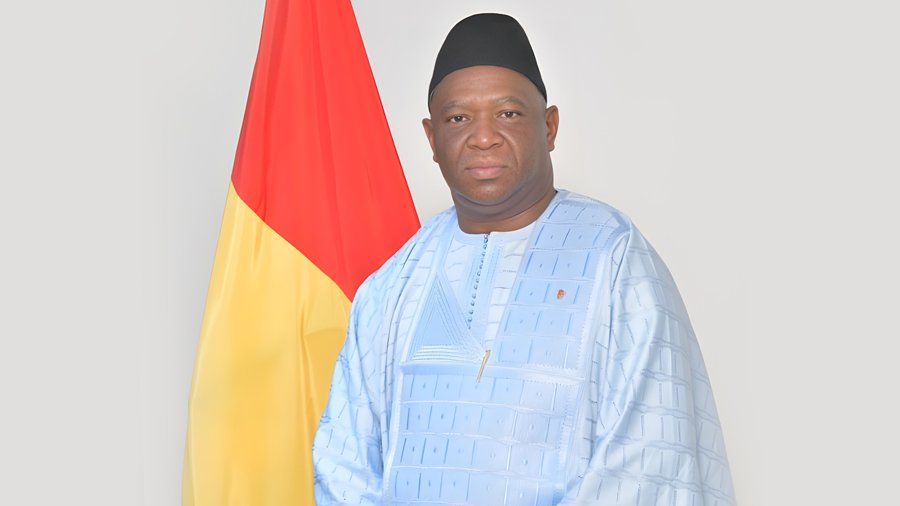
Diplomatist Magazine interviewed H.E. Mr. CONTÉ Alassane, Ambassador of Guinea to India, on the future of India–Guinea relations. He spoke about diversifying bilateral trade, attracting greater Indian investment and strengthening institutional cooperation. He highlighted the opportunities emerging from Simandou 2040 across mining, infrastructure, energy, agriculture, healthcare, technology and manufacturing, while stressing that Guinea is looking for more than capital, technology transfer, skills, training, local processing and job creation.
India and Guinea have maintained cordial relations for decades, but these have gained new momentum in recent years, particularly with the launch of political and diplomatic consultations between the two countries in October 2024. What are the three concrete outcomes you would like to see achieved in India–Guinea relations during your tenure, particularly in the areas of trade, investment and institutional cooperation?
During my tenure, I would like to see three major outcomes achieved that would give a new dimension to the partnership between Guinea and India.
First, we want to increase and, above all, diversify trade. This is not only about increasing volumes, but also about broadening the range of products traded and promoting more processed and value-added products. To this end, we want to multiply contacts between business operators in the two countries and identify new sectors with significant commercial potential.
Second, we want to increase the presence of Indian investors in Guinea. At present, Indian investment remains below the potential offered by our two economies. The Simandou 2040 programme, as well as the many economic transformation projects undertaken by Guinea, nevertheless offer considerable opportunities in mining, infrastructure, agriculture, energy, manufacturing, healthcare and technology. My ambition is therefore to help make these opportunities better known among Indian companies and encourage the emergence of sustainable partnerships.
Third, we want to consolidate the institutional framework of our cooperation. This includes, in particular, finalising and implementing the proposed agreement on visa exemption for holders of diplomatic and service passports, increasing the number of training scholarships granted to Guinea by India, and holding the Guinea–India Joint Commission for Cooperation. These mechanisms are essential for translating our political will into concrete and sustainable results.
Bilateral trade between India and Guinea reached approximately US$2.08 billion in 2023–24, with Indian exports amounting to US$696.48 million and imports to US$1.39 billion. India imports raw materials, particularly gold and minerals, while its exports include rice, pharmaceuticals, engineering products, textiles and transport equipment. What concrete measures is the Embassy implementing to diversify this trade beyond raw materials and create greater opportunities for Indian value-added products as well as Guinean exports to India?
Diversifying trade is indeed one of our priorities. Our objective is to gradually transform a trade relationship that is still heavily shaped by raw materials into a partnership based more strongly on processing, value addition and business-to-business partnerships.
On the Guinean side, we want to facilitate access for our products to the Indian market by identifying the sectors with the greatest potential and establishing stronger links between Guinean exporters and Indian importers, distributors and industrial companies. This includes agriculture, fisheries, livestock, horticulture, agri-food products and, more broadly, products resulting from local processing.
On the Indian side, Guinea offers significant opportunities for companies in several priority sectors: agriculture, fisheries, livestock, industry, production and processing, waste management and treatment, tourism and tourism-related industries. Indian companies have experience and technological capabilities that can contribute to accelerating the transformation of these sectors.
The Embassy also intends to strengthen business missions, B2B meetings and exchanges between chambers of commerce, employers’ organisations and professional associations in the two countries. Trade diversification can only be sustainable if it is supported by direct and regular relationships between Guinean and Indian economic operators.
You have actively encouraged the participation of Indian companies in the Simandou 2040 programme, and the Embassy has worked to organise an India–Guinea Economic and Trade Forum in New Delhi. In your view, which sectors and types of Indian companies can contribute most effectively to the Simandou 2040 programme: mining services, railways and logistics, infrastructure, agriculture, energy, healthcare, digital technologies or manufacturing? And what would Guinea expect from Indian investors beyond capital?
Simandou 2040 should be viewed as a comprehensive economic transformation programme rather than a project limited to the mining sector. This is precisely what makes the opportunities particularly attractive for Indian companies.
We see significant potential in mining services and technologies, railways and logistics, infrastructure, energy, agriculture and agribusiness, healthcare, digital technologies and manufacturing. Indian companies with experience in these different areas can find in Guinea an environment conducive to long-term partnerships.
But Guinea does not expect investors to bring only capital. We also want to benefit from technology transfer, skills development, vocational training, managerial capabilities, research and development, and job creation, particularly for our youth.
We also want to encourage greater local processing of our resources. Our ambition, therefore, is for Simandou 2040 to become a genuine catalyst for a new generation of economic partnerships between India and Guinea, based on value creation in Guinea and the development of local skills.
Guinea has significant bauxite resources as well as substantial deposits of iron ore, gold, diamonds and other minerals. At the same time, Guinea’s investment strategy is increasingly focusing on local processing and industrialisation. What opportunities does Guinea foresee for Indian companies in mineral processing, mining technologies, engineering services and downstream industries, and what policy or infrastructure improvements are being put in place to make these investments commercially viable?
Guinea has considerable mining potential, but our ambition is now to move beyond the extraction and export of raw minerals. We want to progressively develop greater local processing, industrialisation and value chains in Guinea.
The opportunities for Indian companies are therefore numerous: mineral refineries and processing units, mining equipment and technologies, engineering, industrial maintenance, infrastructure, logistics services, energy and the development of downstream industries.
This direction is already beginning to translate into concrete action. In June 2026, Guinea launched construction work on an alumina refinery in Boffa, approximately 130 kilometres from Conakry, with a planned capacity of 1.2 million tonnes per year.
Our message to Indian companies is simple: Guinea has the resources and opportunities; India has the technologies, industrial capabilities and considerable entrepreneurial experience. We must create the conditions that enable these strengths to complement each other.
To this end, Guinea is continuing its efforts to improve infrastructure, connectivity, the business environment and the conditions that allow investors to develop competitive and sustainable industrial projects. The challenge is to make our natural resources a genuine driver of industrial development and value creation for the Guinean economy.
Guinea has identified agriculture as a priority sector, thanks to its vast arable land, abundant water resources and opportunities in rice, fruit, horticulture and agricultural processing. Which Indian agricultural technologies or business models would Guinea most like to adapt: irrigation, agricultural mechanisation, seed technologies, storage, food processing, agricultural finance or digital agriculture?
Guinea has approximately 3.7 million hectares of arable land, of which only 38% is currently cultivated, as well as significant water resources and high average rainfall of around 2,500 mm per year. The agricultural potential is therefore considerable.
We are particularly interested in India’s experience in several areas: irrigation, the improvement and dissemination of seeds, agricultural mechanisation, storage and preservation, agri-food processing, and agricultural finance.
The value of the Indian experience lies particularly in its ability to develop solutions adapted to different categories of producers and different levels of production. Guinea is not seeking to mechanically reproduce a foreign model; rather, we want to identify the technologies and business models that can be adapted to our local realities.
Cooperation could therefore involve not only technology transfer, but also farmer training, the development of value chains, the processing of agricultural products and the creation of partnerships between companies and institutions in the two countries. The ultimate objective is to strengthen agricultural productivity, reduce post-harvest losses and create greater value added in Guinea.
India has provided lines of credit amounting to US$35 million to strengthen Guinea’s healthcare system and US$20.506 million for the construction and modernisation of regional hospitals in Kankan and Nzérékoré. How does Guinea assess the impact of this cooperation today, and what should the next phase of India–Guinea healthcare cooperation look like?
India–Guinea cooperation in healthcare is an important component of our partnership, and we would like it to enter a new phase, with projects more closely focused on the priority needs of the Guinean healthcare system.
It should be clarified that the line of credit, initially announced at US$35 million, was increased to US$75 million to strengthen Guinea’s healthcare system, particularly through the construction and modernisation of regional hospitals in Kankan and Nzérékoré. This financing was ultimately cancelled following difficulties related to identifying and submitting companies that met the required criteria for carrying out the project.
This experience has taught us the importance of strengthening, from the earliest stages, the technical preparation of projects, coordination among the various stakeholders and the identification of companies with the capabilities required for their implementation.
Going forward, we would like to deepen cooperation in areas such as medical and paramedical training, hospital equipment, telemedicine, health technologies, the production and availability of medicines, and the strengthening of healthcare infrastructure.
India has considerable experience in developing accessible healthcare solutions adapted to emerging markets. Guinea would like to benefit more from this expertise within the framework of mutually beneficial cooperation.
As Guinea seeks to play a greater role in Africa’s economic transformation and India strengthens its engagement with the countries of the Global South, what specific contribution can Guinea and India make together, particularly within the framework of South–South cooperation, that goes beyond a conventional buyer–seller or donor–beneficiary relationship?
Cooperation between Guinea and India offers precisely the possibility of building a South–South partnership based more strongly on the sharing of experiences, technology transfer, capacity building and joint investment.
Guinea brings considerable strengths: significant natural resources, agricultural and energy potential, a growing domestic market, a strategic geographical position on the Atlantic coast and access to a vast sub-regional market. Guinea shares its borders with six ECOWAS countries, giving it a natural role as a regional economic platform.
Through the African Continental Free Trade Area (AfCFTA), the prospects for economic integration across the African continent further strengthen this dimension. Guinea can therefore serve as a gateway for Indian companies to a much larger African market, while Indian experience, technologies and industrial capabilities can contribute to accelerating Guinea’s economic transformation.
We must therefore move beyond a model limited to the exchange of raw materials for manufactured products. We can develop industrial partnerships, joint ventures, training programmes, technology transfers, investments in agricultural and mining value chains, as well as collaborations in digital technology, healthcare and infrastructure.
This, in my view, is the full potential of South–South cooperation: not a relationship between a supplier and a beneficiary, but a relationship between two partners who combine their comparative advantages to create value, develop skills and contribute to sustainable growth.
Guinea and India therefore have the opportunity to build a partnership that is economic, technological, institutional and human, serving our two peoples and, more broadly, the development of the African continent.


Leave a Reply