

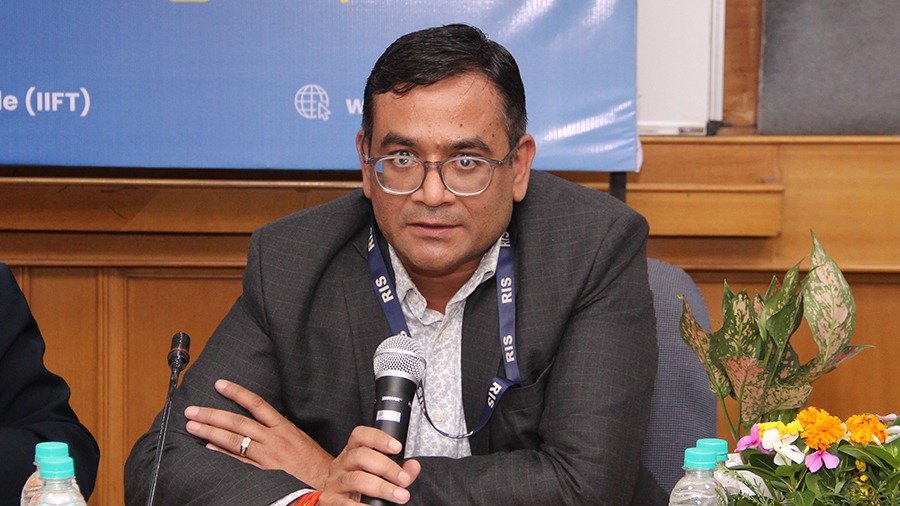
At a time when emerging technologies are rapidly reshaping global power structures, the question of who governs these technologies, and in whose interest, has become central to international discourse. Speaking at “The Global South Speaks: India’s Leadership in BRICS and Beyond” held on April 28 at the Indian Institute of Foreign Trade (IIFT), Dr. Amit Kumar, Faculty/Sr Researcher, Research and Information System for Developing Countries (RIS), underscored the growing importance of BRICS as a collective voice in shaping equitable global governance frameworks for emerging technologies, particularly artificial intelligence (AI).
His central concern was how BRICS is not only participating in, but actively shaping, global governance conversations in the domain of emerging technologies. As he aptly remarked, “If you are not at the table, you are on the menu.” This, he argued, has historically been the predicament of much of the Global South in multilateral decision-making spaces.
Dr. Amit highlighted that the push for a stronger, unified voice of the Global South, championed by India, is rooted in the recognition that collective articulation enhances influence. “If you want to be heard clearly and loudly, you must speak with a collective voice,” he noted, emphasising the strategic importance of platforms like BRICS in amplifying shared concerns.
The urgency of such collective action becomes particularly evident in the realm of emerging technologies. Over time, technological advancements have not benefited all regions and societies equally. Instead, their development and deployment have largely been shaped by a concentration of power among a few countries and corporations.
This imbalance, Dr. Amit argued, became starkly visible during the COVID-19 pandemic, particularly in debates surrounding intellectual property rights and vaccine access. “COVID-19 made us realise why we need an approach that is inclusive, fair and equitable. Technology must be accessible to all; its potential for humanity remains limited,” he observed.
Turning specifically to artificial intelligence, Dr. Amit pointed out that the rapid proliferation of AI technologies, especially following the emergence of generative AI tools in 2022, has far outpaced the development of global governance frameworks. The unprecedented speed and scale of AI adoption have created a regulatory vacuum. “The diffusion of AI has been as free-flowing as water, but the governance mechanisms to ensure fairness and equity have not kept pace,” he remarked.
A key concern he raised relates to the data and algorithmic foundations of AI systems. Since these technologies are trained on datasets that may not adequately represent diverse socio-cultural contexts, their outputs risk reinforcing biases and exclusions. “If your data is not part of the training process, the outcomes will not reflect your realities,” he explained, highlighting the structural disadvantage faced by many countries of the Global South.
In this context, Dr. Amit emphasised the growing relevance of BRICS as a platform for advancing a more inclusive technology governance agenda. A significant milestone in this direction, he noted, was the BRICS Leaders’ Statement on the Governance of Artificial Intelligence during Brazil’s BRICS presidency in 2023. This marked one of the first instances where BRICS leaders collectively articulated principles specifically focused on AI governance.
According to Dr. Amit, this statement laid out several foundational principles. Among them was the importance of sovereignty: national, digital, and technological, ensuring that countries retain control over their data and technological trajectories. Equally critical was the emphasis on multilateralism. “Governance of AI must be led through multilateral processes, ideally within the United Nations system, to ensure inclusivity and representation,” he stressed, cautioning against narrower, plurilateral approaches.
He also drew attention to the need for fair competition and equitable market structures, particularly in the context of standard-setting. Currently, global technology standards are often shaped by a limited set of actors, which can disadvantage developing economies. “Those who are affected by these standards must also have a voice in shaping them,” he asserted.
Another pillar of the BRICS approach, as highlighted by Dr. Amit, is the integration of equity and sustainable development into technology governance. This includes ensuring that technological advancements contribute to broader socio-economic goals while also addressing environmental concerns, such as the energy consumption of data centres. Ethical considerations, including bias mitigation and fairness, were also identified as essential components of any credible governance framework.
Moving beyond BRICS, Dr. Amit situated India’s role within a broader global context. He referred to India’s articulation of initiatives such as a proposed Global AI Compact, which seeks to promote a more inclusive and development-oriented approach to AI governance. He also highlighted India’s consistent emphasis on the principle of “AI for All,” first articulated in its National Strategy on Artificial Intelligence in 2018 and reiterated across multiple international platforms.
India’s recent efforts, including global dialogues on AI and its emphasis on human-centric and development-focused applications, further reinforce this approach. “AI must serve socio-economic development for all, not just a few sectors or societies,” he emphasised.
Dr. Amit reiterated that BRICS offers a unique platform for advancing a governance model that is inclusive, fair, and reflective of the needs of the Global South. The complementarities among BRICS nations, particularly in leveraging technology for public good, provide a strong foundation for collective action.
As he succinctly put it, “BRICS allows us to put forward an approach that is more inclusive, more equitable, and more representative in governing emerging technologies.” In an era where technological power increasingly shapes global hierarchies, such a vision is not only timely, it is essential.


Leave a Reply