

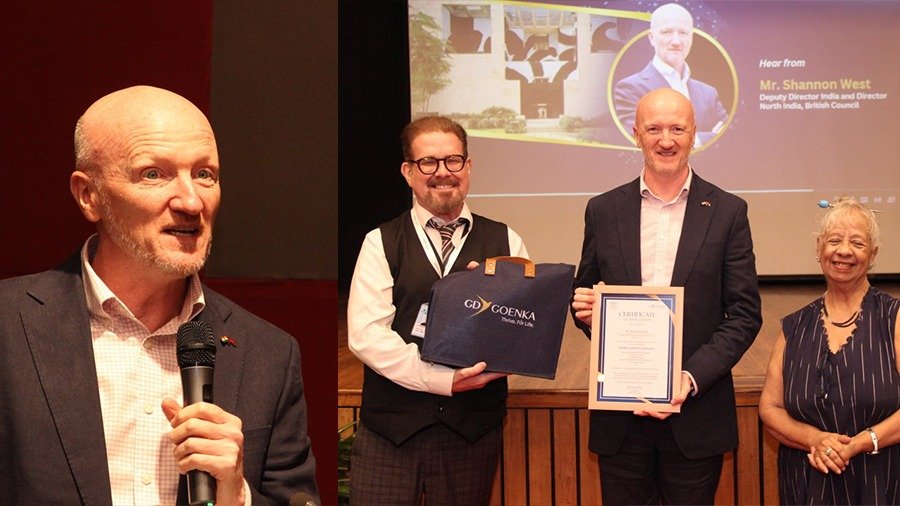
For Shannon West, Deputy Director India and Area Director North India, British Council, education is more than an international opportunity. It is one of the strongest bridges between India and the United Kingdom, connecting institutions, cultures, ideas and young people.
What happens when someone from a small town in Australia becomes a student in the United Kingdom, works there as a foreigner, eventually becomes a British citizen and then returns to the world of international education as a representative of a British organisation?
For Shannon West, the answer is simple: almost anything is possible.
Speaking at the Global Campus Conclave, organised by Diplomatist Magazine at GD Goenka The Flagship School, New Delhi, West began his presentation with a personal story before widening the lens to the rapidly evolving India–UK education partnership.
Born in Australia, West studied and worked in the UK before joining the British Council and becoming a UK citizen.
“So it’s all possible, coming from a small town in Australia.”
It was an understated but powerful opening to a presentation essentially about possibility, and about how international education can change the trajectory of a young person’s life.
Education as a diplomatic bridge
West placed education firmly within the larger strategic relationship between India and the UK.
The India–UK Vision 2035, endorsed by Prime Ministers Narendra Modi and Keir Starmer in July 2025, identifies education and skills as a major area of bilateral cooperation. It calls for deeper collaboration between the Indian and UK education sectors, including transnational education and skills.
For West, the prominence given to education is significant.
The partnership extends beyond education, with a Programme of Cultural Cooperation providing another framework for India and the UK to work together in the cultural sphere. The broader Vision 2035 also identifies people-to-people connections as a central thread running through the relationship.
And it is precisely at the level of people, particularly young people, that West sees the greatest potential.
A UK degree, without necessarily leaving India
One of the most significant developments he highlighted was the growing presence of UK higher education in India.
The UK’s international education relationship with India is no longer confined to Indian students travelling to the UK. UK universities are increasingly establishing a presence within India itself.
For West, this creates a new dimension to international education.
“Not only could people consider studying for a UK qualification in the UK, they can also do that in India.”
That expansion means students can increasingly access international qualifications without necessarily having to travel abroad for the entirety of their education.
It also contributes to the internationalisation of India’s own higher-education ecosystem.
India’s students and the UK’s universities
Of course, the flow also continues in the other direction.
Indian students remain an important part of the UK’s international higher-education community. West described Indian students as the largest group of international students in the UK, bringing with them their own communities, clubs, festivals and cultural traditions.
For students considering the UK, he stressed that the experience is about much more than obtaining a degree.
The UK is an English-speaking education destination, but its campuses are remarkably international. Students encounter peers from across the world and, in West’s words, can experience a genuinely multicultural environment.
That exposure, he suggested, can become an important part of a student’s education.
Four countries, one destination
West’s presentation also challenged the tendency to think of the UK simply as England.
The United Kingdom comprises four nations: England, Scotland, Wales and Northern Ireland, each with its own history, culture and identity.
For an international student, this creates an unusual advantage: a relatively compact geographical space containing remarkably diverse cultural experiences.
“All have their own history and different flavour, different languages and cultures for you to explore.”
And the cultural experience does not end outside the university gates.
West pointed to the UK’s museums, music, theatre, festivals, literature and creative industries — from Shakespeare and the world of Harry Potter to the Rolling Stones and Ed Sheeran.
For students, this means that studying in Britain can also mean immersing themselves in one of the world’s most influential cultural environments.
Why the UK? Think differently
But perhaps the most important part of West’s presentation was not about where students could study, but how they would learn.
He highlighted the UK’s emphasis on independent thinking, problem-solving, teamwork and applying academic knowledge to real-world situations.
“It’s also a place where you might be encouraged to think differently.”
UK universities, he explained, increasingly combine traditional lectures with collaborative learning, group work and practical challenges. Students can be exposed to real-life problems connected to their future professions from the beginning of their academic journey.
This close relationship between universities and industry is another feature West highlighted.
Industry does not necessarily wait until graduation to meet students. Companies can contribute to course design, provide guest lecturers, set practical challenges and work alongside academics.
“Real-life industry challenges [are] part of your tuition and part of your course and qualification.”
For students preparing for a rapidly changing employment market, this connection between education and industry can be particularly valuable.
Research, innovation and the global classroom
West also made a strong case for the UK’s research ecosystem.
Although the UK accounts for less than 1% of the world’s population, it produces a disproportionately large share of highly cited scientific research. He presented the country’s universities as places where students can become part of a research-intensive culture spanning science, technology, innovation and the humanities.
The UK’s academic environment, he argued, is designed not merely to produce graduates, but to encourage students to question, experiment and solve problems.
That matters at a time when India and the UK are themselves seeking deeper cooperation in emerging areas such as AI, quantum technologies, biotechnology, advanced materials and other areas of research and innovation under Vision 2035.
The international student, therefore, is not simply a consumer of education. They can become part of a global research and innovation network.
An international education, without losing your identity
Another theme running through West’s presentation was inclusion.
He described the UK as a multicultural society where students from different national, religious and cultural backgrounds can maintain their identities while becoming part of campus life.
“We’re also very proud of being an open, tolerant and respectful country.”
For Indian students, this can mean finding communities that feel familiar while simultaneously being exposed to new cultures and perspectives.
That balance, retaining one’s identity while becoming more globally connected, is increasingly important in international education.
What happens after graduation?
West also highlighted the opportunity for students to gain professional experience after completing their studies.
The UK’s Graduate Route currently allows eligible graduates to remain in the UK for two years if they apply by 31 December 2026, while applications made from 1 January 2027 will receive 18 months. Doctoral graduates continue to receive three years.
For students, this can provide an opportunity to gain international work experience before returning to India or moving into another stage of their global career.
It is an important distinction: studying internationally can be about more than the qualification itself. The experience of working in another country, collaborating with people from different backgrounds and understanding another professional culture can become part of the whole international experience.
Learning for a changing planet
He highlighted the UK’s work on renewable energy, offshore wind and its commitment to reaching net zero emissions by 2050.
For Indian students, this also presents an opportunity for knowledge exchange.
India and the UK face many shared questions around clean energy, sustainable development, climate resilience and green skills. Vision 2035 specifically envisages an India–UK Green Skills Partnership, bringing together expertise from both countries to address future skill gaps and create sustainable growth opportunities.
For West, international education can therefore contribute to solving problems that do not stop at national borders.
And for the young audience at the Global Campus Conclave, that may have been the most compelling invitation of all: don’t think of studying abroad simply as leaving home. Think of it as expanding the definition of home, academically, professionally and culturally.


Leave a Reply