

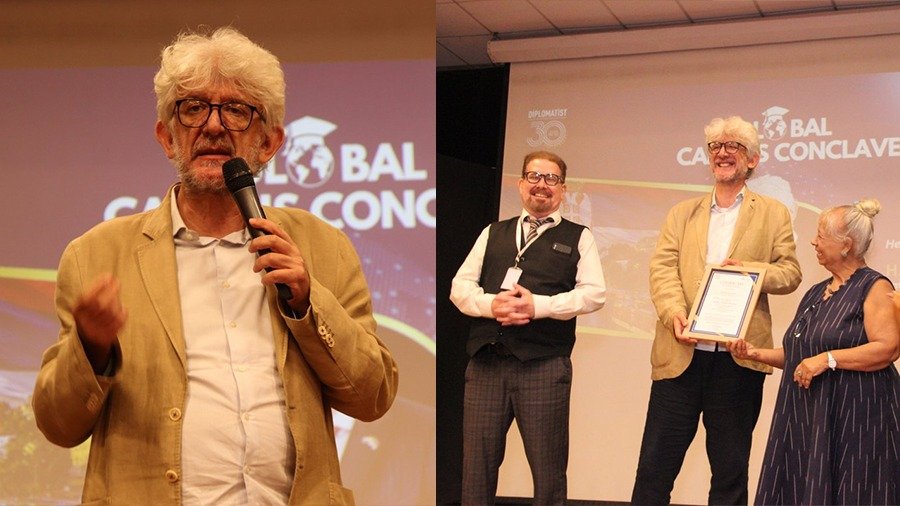
At the Global Campus Conclave, H.E. Siniša Pavić, Ambassador of Serbia to India, highlighted the role of education and young people in deepening Serbia–India relations, and urged students to look beyond the digital world to discover the value of real human connections.
For a diplomat, compromise is almost a professional necessity.
So when H.E. Siniša Pavić, Ambassador of Serbia to India, took the stage at the Global Campus Conclave on 18 August, he began with a characteristic touch of humour.
He had prepared a written speech, he explained, but would attempt a “compromise” between the prepared text and the improvisation that had preceded him.
It was an appropriate opening for a gathering centred on international understanding.
Speaking to students, educators and members of the diplomatic community at GD Goenka The Flagship School, New Delhi, Ambassador Pavić described the Global Campus Conclave as an important platform for connecting young people, educational institutions and countries.
He thanked Diplomatist Magazine and GD Goenka Group for bringing together what he jokingly described as a kind of “mini UN”—with representatives and perspectives from different parts of the world.
But beneath the humour was a serious diplomatic message: education can become one of the most enduring channels of international cooperation.
Education beyond the degree
For Ambassador Pavić, education today is about considerably more than obtaining a qualification.
It is a space where young people acquire knowledge, develop critical thinking, encounter other cultures and prepare themselves to participate in an increasingly interconnected world.
Serbia, he said, is committed to developing a high-quality higher education system with strong international cooperation. Serbian universities and research institutions offer programmes across fields including engineering, medicine, information technology, life sciences and innovation.
He invited Indian students and educational institutions to look towards Serbia as an open and welcoming partner.
Serbia also offers scholarship opportunities to foreign students through programmes such as “The World in Serbia” and through bilateral agreements. The Serbian Ministry of Education confirms that its foreign-student scholarship framework includes opportunities for international students to study in Serbia.
A relationship built through people
The Ambassador emphasised that Serbia–India relations rest on long-standing friendship, mutual respect and peaceful cooperation.
But diplomatic relationships, he suggested, cannot remain confined to governments and official meetings.
Students, academics and young researchers can become “the most important ambassadors of future cooperation.”
That idea gave his address a particularly relevant dimension for a school audience.
International relations are often discussed in terms of treaties, trade and geopolitics. Yet many of the relationships that ultimately endure begin much earlier—with a student meeting someone from another country, a researcher collaborating with a foreign university, or a young person discovering a culture different from their own.
Education creates precisely those encounters.
“Be curious”
The most memorable part of Ambassador Pavić’s address was directed not at diplomats or educators, but at the students.
His advice was simple: “Be curious, open to the world and ready to learn from another.”
In a world where information about virtually every country is available instantly, the Ambassador asked what really makes the difference.
His answer was curiosity.
Students can search for facts about Serbia online. They can read about its history, geography and institutions. But information alone cannot replace the experience of meeting people, asking questions and discovering perspectives that may not be available through digital platforms.
“What makes difference? Your curiosity.” he told the students.
It was a particularly powerful message in an age of artificial intelligence and algorithm-driven information.
Beyond the screen
Ambassador Pavić urged young people to remain open to forms of learning that cannot be replicated through technology.
Digital platforms have made the world smaller, but they can also create the illusion that knowing information about another society is the same as understanding it.
It is not.
“Stay open for meeting and to exchange experience with people from different parts of the world.”
And then came perhaps his most evocative observation:
“Because sometimes in differences, the most precious things are hidden.”
That idea captures the essence of international education.
The purpose of encountering another culture is not necessarily to discover how similar it is to one’s own. Sometimes the greater value lies in discovering the differences and understanding why they exist.
From curiosity to cooperation
Ambassador Pavić concluded by expressing the hope that the Global Campus Conclave would lead not merely to conversations, but to new partnerships and practical initiatives.
That is also where education and diplomacy meet.
A student exchange can become an academic partnership. An academic partnership can become a research collaboration. A research collaboration can create professional networks that last decades.
And sometimes, a simple conversation between two young people from different countries can become the beginning of something much larger.
For Serbia and India, the opportunity lies in creating more of these connections.
The Ambassador’s message to the young people in the room was therefore both simple and deeply diplomatic: Stay curious. Look beyond what is immediately familiar. Meet people. Ask questions. Learn from differences.
Because long before young people become diplomats, researchers, entrepreneurs or policymakers, they are students.
And it is often in the classroom and through encounters beyond it, that the foundations of tomorrow’s international relationships are laid.


Leave a Reply