

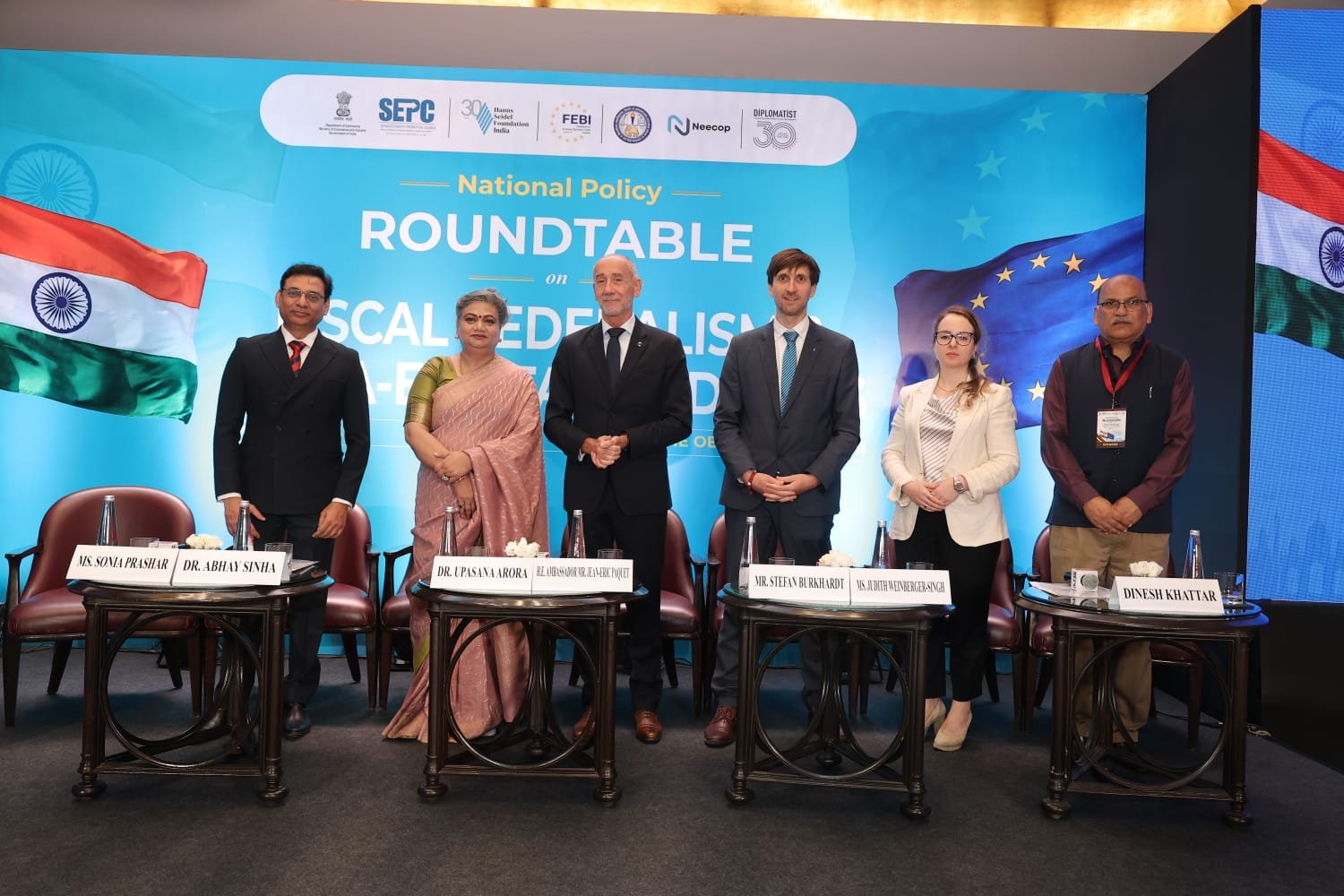
SEPC’s National Policy Roundtable brings policymakers, diplomats, industry and academia together to examine the fiscal, institutional and state-level capabilities needed to translate the India–EU FTA into tangible economic opportunities.
As India and the European Union move towards a new phase of economic engagement, the success of the India–EU Free Trade Agreement (FTA) will depend not only on the agreement itself, but also on India’s ability to implement it effectively across states and sectors.
This was the central focus of the National Policy Roundtable on Fiscal Federalism and India–EU FTA Readiness, organised by the Services Export Promotion Council (SEPC) in collaboration with the Hanns Seidel Foundation (HSS) India, the Federation of European Business in India (FEBI), Diplomatist Magazine and other institutional partners at The Oberoi, New Delhi, on 6 October.
The full-day conference brought together policymakers, senior government officials, diplomats, international representatives, industry leaders, academics, researchers and other stakeholders to examine India’s institutional and fiscal preparedness for the implementation and utilisation of the India–EU FTA.
A key theme running through the discussions was the role of state governments and sub-national institutions. While trade agreements are negotiated at the national level, many of the factors that determine their practical impact — from infrastructure and skills to standards, investment facilitation and sustainability — are closely linked to state-level capabilities.
Beyond Tariffs: The Implementation Challenge
The discussions highlighted that effective utilisation of the India–EU FTA will extend well beyond tariff reductions and market access. Businesses will also need to navigate standards and certification requirements, sustainability norms, digital infrastructure, skills availability and increasingly resilient supply chains.
Many of these areas fall substantially within the functional and implementation responsibilities of state governments.
Against this backdrop, the Roundtable examined India’s institutional and fiscal preparedness for the FTA, the role of states in addressing non-tariff measures and sustainability requirements, and the implications of fiscal federal arrangements and state-level public investment for export competitiveness.
Another important area of discussion was the proposed EU–India FTA State Readiness Index, which seeks to identify measurable indicators for assessing how prepared individual states are to leverage the opportunities created by the agreement.
The discussions also underlined the importance of stronger Centre–State coordination, institutional capacity and export-oriented public investment in enabling Indian states and businesses to translate market access into sustained economic activity.
High-Level Inaugural Session
The inaugural session featured welcome remarks by Dr Upasana Arora, Chairperson, SEPC, followed by introductory remarks from Prof. Dinesh Khattar, Principal, Kirori Mal College, University of Delhi.
Dr Abhay Sinha, Director General, SEPC, provided the context-setting remarks, while Ms Judith Weinberger-Singh, Resident Representative, HSS India; Mr Stefan Burkhardt, Head of Division, South and Southeast Asia, Hanns Seidel Foundation, Germany; and Ms Sonia Prashar, Secretary General, Federation of European Business in India, also addressed the opening session.
The keynote address was delivered by H.E. Ambassador Jean-Eric Paquet, Delegation of the European Union to India and Bhutan, bringing a European perspective to the evolving India–EU economic partnership.
Assessing Institutional and Fiscal Readiness
The first technical session, “Assessing India’s Institutional and Fiscal Readiness for the India-EU FTA,” examined the broader institutional and fiscal architecture required to ensure that states are equipped to participate effectively in the new trade environment.
The session featured Prof. Rekha Saxena, Prof. Chanchal Kumar Sharma and Prof. VN Alok, with Mr Sujit S. Nair, Chairman, Europe India Centre for Business & Industry, serving as moderator.
The discussion considered the relationship between fiscal federalism, public investment and export competitiveness, particularly in the context of preparing states to take advantage of emerging international market opportunities.
Building State Capabilities
The second technical session, “Building State Capabilities for India-EU FTA Implementation: Non-Tariff Barriers, Sustainability and Resilience,” shifted the focus towards the practical requirements of implementation.
Speakers included Dr Bipin Sapra, Partner–Leader, Indirect Tax & Economic Policy, EY; Mr Ajay Bisaria, Corporate Strategic Advisor and Distinguished Fellow, ORF; Dr James J. Nedumpara, Head, IIFT–Centre for Trade and Investment Law; and Mr Dinesh Chand Sharma, Director, Standards and Public Policy and Seconded European Standardization Expert in India.
The session was moderated by Prof. Basanta Sahu, Professor & Head, Economics Division, IIFT, Delhi.
The discussion explored the challenges posed by non-tariff measures and sustainability requirements and the institutional capabilities that states will need to develop to help businesses comply with evolving international standards.
From Market Access to Market Presence
The third session, “From Market Access to Market Presence: What Businesses Need from States to Make the India–EU FTA Implementation Effective”, brought the perspective of European businesses into the discussion.
Dr Bidisha Bhattacharya, Associate Fellow and Head–Research, Centre for Economy and Trade, Chintan Research Foundation, provided the context-setting remarks.
The panel featured Mr. Bikas Kr. Singh, Vice-President & India Head, Government Affairs, SAP; Mr. Rishi K. Chawla, Vice-President, Corporate Affairs, Carlsberg India; Mr. Sidharth Prasad, Director – Public Affairs & CSR, Michelin India; and Mr. Vineet Gupta, Head of Government Affairs, Siemens Healthineers. The session was moderated by Mr Alok Kesari, Director, Policy Advocacy and Trade Facilitation, FEBI.
The discussion placed the spotlight on what businesses require from state governments to move beyond the promise of market access and establish a stronger and more competitive presence in international markets.
A Broad International Stakeholder Dialogue
The Roundtable also reflected the wider European interest in India’s evolving trade and investment landscape. Representatives from the Czech Republic, Malta, Croatia, Poland, Cyprus, Lithuania, Austria, Sweden, the Netherlands, the Russian Federation, Romania and Belgium participated, along with the Lumora Foundation delegation representing Estonia.
The wider participant group included representatives from government institutions, public sector undertakings, industry, professional organisations, research and educational institutions, media and international delegations.
This broad participation underscored the importance of bringing together government, business, academia and international stakeholders when discussing the implementation of a major trade agreement.
Strengthening the Centre–State Connect
One of the key messages emerging from the Roundtable was the need to move beyond a purely market-access-oriented understanding of the India–EU FTA towards a broader framework centred on implementation, competitiveness and institutional preparedness.
For Indian states, this means strengthening export-oriented infrastructure, improving regulatory and institutional capacity, facilitating investment, responding to sustainability requirements and helping enterprises access international markets.
For businesses, it means ensuring that the opportunities created by the FTA can be translated into practical outcomes on the ground.
The Roundtable therefore sought to contribute to a policy framework that strengthens Centre–State coordination and builds the institutional capacity required to ensure that the benefits of the India–EU FTA reach businesses and regions across the country.
The conference concluded with a valedictory session addressed by Dr Abhay Sinha, Director General, SEPC.
As India prepares to deepen its economic engagement with the European Union, the discussions highlighted an important reality: negotiating market access is only the beginning. The real test will be building the institutional capacity, infrastructure, and business ecosystem needed to turn that access into investment, exports, jobs, and sustained competitiveness across Indian states.


Leave a Reply