

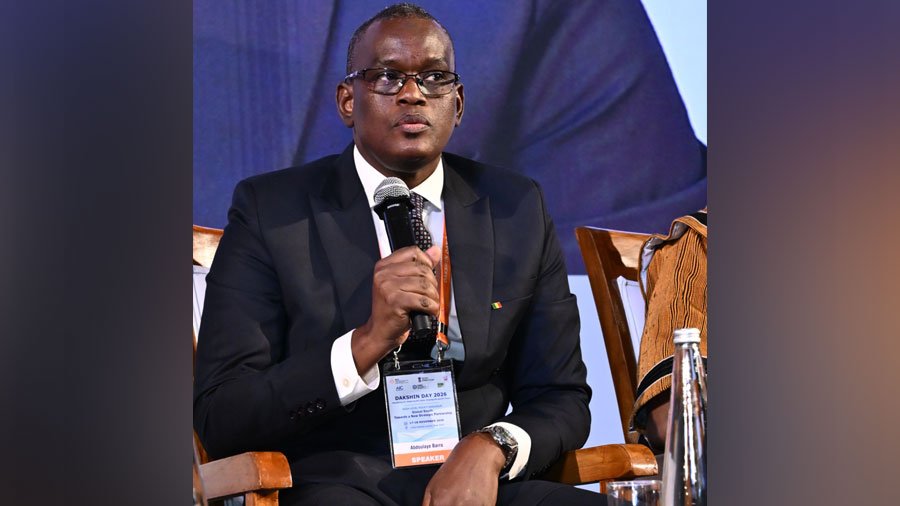
H.E. Abdoulaye Barro outlines five guiding principles and four areas of collective action to strengthen the voice and influence of the Global South.
The future of India–Africa relations must be built on equality, shared prosperity and a stronger role for developing countries in global decision-making, said H.E. Abdoulaye Barro, Ambassador of the Republic of Senegal to India, at DAKSHIN Day 2026 in New Delhi on 17 November.
Speaking during the session on “New Global South Strategic Partnership” at the India Habitat Centre, Ambassador Barro argued that the Global South is more than a geographical expression. It reflects shared histories, common experiences and a political vision shaped by the aspirations of countries across Africa, Asia and Latin America.
He emphasised that the relationship between developing countries must move beyond conventional donor-recipient arrangements. “We need no longer aid, but partnerships in a mutually beneficial way,” he said, calling for partnerships “where both speak and both listen”.
For the next generation of India–Africa cooperation, Amb Barro proposed five guiding principles: equality, mutual prosperity, local ownership, innovation and global solidarity. In his view, these principles must ensure that partnerships are shaped by the priorities of African countries, create shared economic value, encourage technological and entrepreneurial collaboration, and strengthen the collective voice of the Global South.
He then identified four areas where India and African countries could work together to translate this vision into action.
The first is reform of global political governance, particularly the United Nations Security Council. Amb Barro reiterated the African position seeking two permanent seats for the continent and expressed support for India’s aspiration for permanent membership. He also called for closer coordination between developing countries in intergovernmental negotiations.
The second is reform of global economic governance. He urged greater representation for developing countries in institutions such as the International Monetary Fund, World Bank and World Trade Organisation, alongside stronger cooperation through platforms including the G20 and BRICS. Recalling India’s support for the African Union’s admission as a permanent member of the G20 during India’s 2023 presidency, he highlighted the importance of sustained solidarity in multilateral forums.
The third priority is climate justice and energy access. Amb Barro called for stronger climate resilience, fulfilment of international climate commitments and wider access to affordable clean energy. Highlighting the scale of the challenge, he noted that around 600 million people in Africa still lack access to electricity. He also pointed to the International Solar Alliance as an important platform for advancing clean and affordable energy solutions. The Alliance’s Ninth Assembly had concluded in New Delhi on 5 November 2026.
The fourth area is technology, innovation and human capital. He advocated cooperation on digital global governance, the promotion of Digital Public Infrastructure and more affordable access to technology, with the aim of bridging the digital divide.


Leave a Reply