

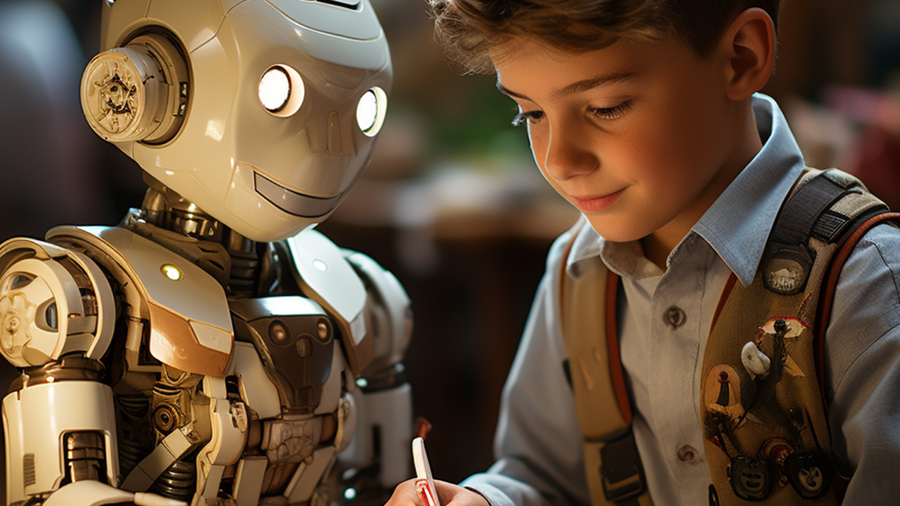
Artificial intelligence is entering classrooms, careers and childhood itself with a speed that education systems can no longer ignore. But do we really know how to synergise AI with old school learning?
“Everything we know about you guys is wrong.”
— Hiccup, How to Train Your Dragon (2010) [1]
When Hiccup says this in How to Train Your Dragon, he is not only discovering a new fact about dragons. He is realising that an entire inherited system may be wrong. His village had taught him to fear dragons, fight them and prove courage by destroying them. But when he observes Toothless closely, the enemy becomes something else: powerful, intelligent, vulnerable and capable of relationship.
That is not a bad metaphor for education in the age of AI. One instinct is to ban the dragon: treat AI mainly as cheating, a threat to homework and a danger to thinking. The opposite instinct is to worship it: assume every child can ride it immediately and every old subject can be replaced. Both are incomplete. AI is neither a monster to be slain nor magic to be worshipped. It is powerful precisely because it needs a trained rider.
AI as literacy, not destiny
Across the world, education systems are moving in this direction. China’s “AI + Education” approach seeks to build AI literacy across schools, universities, vocational education and lifelong learning. Beijing has introduced AI learning in primary and secondary schools. India, too, has announced Artificial Intelligence and Computational Thinking from Grade 3 from the 2026-27 academic session. [2][3][4]
These are important signals. Students who do not understand intelligent tools may be disadvantaged in higher education and work. Doctors, journalists, designers, lawyers, teachers, entrepreneurs and administrators will all use AI in some form. But that does not mean AI is ‘the career’ now for everyone. For some, yes. For most, AI will be an enabling skill: essential, powerful, but not the centre of education.
The centre must remain the human being. A student who knows nothing cannot use AI well. A weak rider may climb onto the dragon, but that does not mean he knows how to fly. A child with poor language can ask AI to write an essay, but may not know whether it has an argument, voice or truth. A student without science can ask AI to explain a disease, but may not know when the answer is dangerously incomplete. Unfortunately, AI can create the appearance of competence before competence exists.
What the professional knows
The amateur sees AI as an answer machine. The professional sees it as an assistant, critic, simulator, research aide or second reader, but never as a substitute for judgment.
In medicine, a patient may type symptoms into an AI tool and receive a list of possible conditions. It may frighten him unnecessarily or reassure him wrongly. A doctor uses AI differently. She may ask it to scan recent literature, compare lab reports, check medicine interactions or prepare a patient-friendly explanation. But she knows the person before her is not a bundle of keywords. He has a body, history, family, fear, context and constraints. The machine offers information; the doctor carries responsibility.
In journalism, an amateur can ask AI to write an article and receive fluent prose. But journalism is not typing. It is finding out. A serious journalist may use AI to organise interview notes, build a timeline, test a headline or compare policy claims. Yet she knows which source has an agenda, which statistic is being used selectively, which quote is too convenient and which silence needs another phone call. AI can draft sentences. It cannot develop a beat, earn trust or feel the cost of getting a public-interest story wrong.
In entrepreneurship, a first-time overzealous founder can ask AI for ten startup ideas and a pitch deck. The output may look investor-ready. But entrepreneurship does not begin with a slide. It begins with a gap in the market: a real problem, felt by real people, for which someone will pay. A seasoned entrepreneur uses AI to analyse customer feedback, model pricing, sharpen positioning, prepare for investor objections or draft outreach. But she still has to meet customers, build trust, survive rejection and stay with the problem after the glamour fades.
The foundation becomes more valuable
In every case, the difference is not access to AI. The amateur and professional may use the same tool. The difference is depth. That is why foundational education still matters: not rote learning, but language, logic, mathematics, science, history, craft and ethics. Facts matter because they give the mind something to work with. Vocabulary matters because, without words, thought remains vague. Mathematics trains structure. Science teaches disciplined doubt. History protects us from shallow novelty. Literature deepens imagination and empathy. Ethics reminds us that power without restraint is dangerous.
AI does not make these subjects obsolete. It makes them more necessary. Education should not replace subjects with AI; it should teach AI through subjects, after foundations and with judgment. In language classes, students can use AI to compare styles, but must still find their own voice. In science, they can simulate possibilities, but must still understand evidence. In history, they can test interpretations, but must still respect context. In art and design, they can generate variations, but must still develop taste.
This also changes the role of teachers. Their authority can no longer rest only on delivering information, because information has escaped the textbook. The teacher becomes more important as a designer of questions, a guide to sources, a coach in reasoning and a guardian of intellectual honesty. Assessment, too, must move beyond homework that can be generated in seconds. It must test process, oral defence, problem framing, teamwork, reflection and the ability to improve an answer after criticism. In other words, AI should push education away from mechanical completion and towards visible thinking.
The mirror in the machine
Perhaps the more moving line from the film is: “I looked at him… and I saw myself.” [5] That is also true of AI. It is not an alien intelligence floating outside humanity. It is made from us: our language, data, biases, creativity, shortcuts, brilliance and errors. When students look at AI, they are also looking at a reflection of civilisation returned at speed.
That is why education cannot become merely AI training. The question is not only how children should use machines. It is what kind of people they should become while using them. Schools must teach children to ask, verify, imagine, empathise and decide, and to keep returning to the question of why a tool is being used at all. The future of education is not about producing better machine users. It is about producing fuller human beings who know how to use machines well in pursuit of enduring human objectives: to ride the dragon, but not be ruled by it.
References:
https://www.imdb.com/title/tt0892769/quotes/
https://english.www.gov.cn/news/202604/15/content_WS69df29e6c6d00ca5f9a0a6b1.html
https://english.www.gov.cn/news/202503/12/content_WS67d18e9ec6d0868f4e8f0c40.html
https://www.pib.gov.in/PressReleasePage.aspx?PRID=2184211
https://www.pib.gov.in/PressReleasePage.aspx?PRID=2247963&lang=1®=3



Leave a Reply