

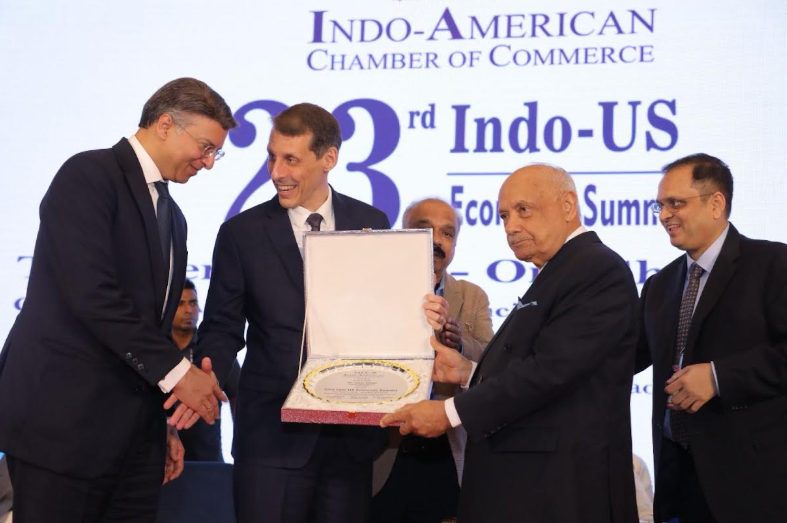
US Deputy Chief of Mission highlights expanding cooperation in critical minerals, advanced technology and manufacturing, while inviting Indian businesses to explore investment opportunities in the United States.
Calling for a more resilient and mutually beneficial economic partnership between India and the United States, Jason Meeks, Deputy Chief of Mission at the US Embassy in India, underscored the importance of fair market access, diversified supply chains and deeper industry collaboration while addressing the 23rd Indo-US Economic Summit, organised by the Indo-American Chamber of Commerce (IACC) in New Delhi.
Speaking under the theme ‘Two Democracies – One Shared Future’, Meeks described the current moment as an important opportunity for both countries to advance their strategic economic partnership, particularly as the United States marks its 250th anniversary and India pursues its vision of Viksit Bharat.
Acknowledging the IACC’s contribution to strengthening bilateral business engagement, he said the Chamber had created a valuable platform where dialogue between industry and government could translate into practical outcomes.
“Here, ideas turn into action,” he remarked, appreciating the Chamber’s role in promoting trade, investment and a conducive business environment for companies in both countries.
Highlighting the expanding scope of bilateral cooperation, Meeks noted that the partnership had moved well beyond conventional trade in goods to encompass energy, pharmaceuticals, critical minerals, advanced technology and manufacturing. He also pointed to the growing presence of American companies in India, creating jobs and building local capacities, alongside Indian businesses investing and expanding across communities in the United States.
A key focus of his address was the need to develop resilient supply chains capable of responding to global disruptions, whether caused by pandemics, geopolitical developments or natural disasters.
“Resilient supply chains are not just a strategic policy goal. They are a practical necessity,” he said, stressing that businesses must be able to adapt, diversify and maintain production even during periods of uncertainty.
He recognised Indian manufacturers as increasingly reliable partners in sectors ranging from automotive components and pharmaceuticals to electronics. While Indian businesses bring manufacturing capabilities and skilled talent, American companies contribute technology, capital and expertise, creating opportunities for complementary growth.
On trade negotiations, Meeks emphasised that market access must remain a central principle of the bilateral relationship.
“Fair market access helps all sides,” he observed, adding that both countries should work towards an environment where suppliers and technologies can reach manufacturers and consumers, while Indian companies are able to compete fairly in the US market.
He also referred to the Pax Silica Declaration, signed by India and the United States in February 2026, as an important framework for strengthening cooperation in critical technology and supply chains. He further highlighted the San Francisco Declaration, signed by India, the United States and seven other countries on November 15, 2026, underscoring the shared commitment to securing sensitive technologies and critical infrastructure.
Turning to investment opportunities, Meeks encouraged Indian businesses to consider expanding their operations in the United States, whether through manufacturing facilities, research and development centres or distribution networks.
“The United States is open for business,” he said, inviting companies to engage with the US Embassy’s SelectUSA team for assistance in connecting with state and local economic development organisations and identifying investment opportunities.
He also invited Indian businesses to participate in the 2027 SelectUSA Investment Summit, scheduled for May 2–5 at National Harbour, Maryland. The annual gathering provides international investors with an opportunity to connect with US state representatives, economic development organisations, industry leaders and government officials.
Meeks said the future of the bilateral relationship would be shaped by entrepreneurs, engineers, innovators and manufacturers who recognise the value of working together.
As the two countries approach significant milestones in their respective national journeys, he expressed confidence that closer economic engagement would help build a more open, resilient and prosperous future for both nations.


Leave a Reply