

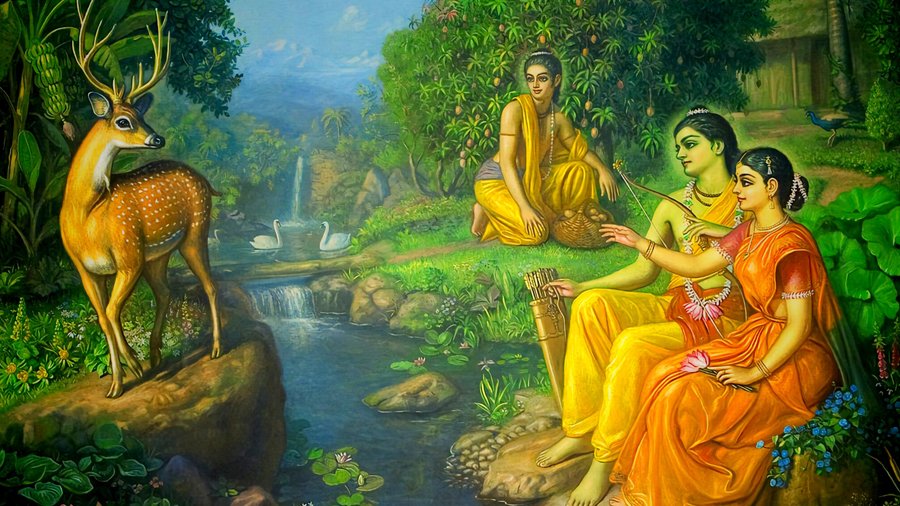
In this deeply reflective essay, Jianbo Wu revisits the Ramayana through the lens of the age of artificial intelligence. Drawing from his personal experience of rereading the epic while witnessing the rapid rise of AI, he explores the profound difference between information and wisdom. Through the timeless figures of Rama, Ravana, and Hanuman, Wu argues that true understanding is born not from limitless knowledge, but from lived experience, vulnerability, devotion, and the transformative journey of the reader.
Hanuman in the Study
A one-meter-tall wooden Hanuman stands in my Hong Kong study, where real estate is measured in the brutal arithmetic of square footage. Carved from a single block of timber by a roadside artisan in Anuradhapura, he has followed me through relocations and intellectual seasons. Now the humid air of Hong Kong has begun to open thin cracks along his grain — a quiet reminder that bodies, even wooden ones, respond to the world that holds them.
Looking back from 2026, I realize I brought home a form of friction. My professional life has long been built on matrices and networks — the cold architecture of global energy systems and geoeconomic risk. More recently, I have watched massive algorithmic models read and synthesize literature at a scale that mocks human limitation. Yet the more these systems devour our digitized archives, the less interested I am in their computation. What unsettles me is the belief beneath the technology: that if we accumulate enough text, wisdom will appear automatically.
Artificial intelligence behaves as if ignorance were a gap in a spreadsheet. It is engineered to swallow language faster than meaning can form. Looking from the screen to the cracking timber on my desk, my thoughts drift back to the Ramayana — an epic that survives not because it eliminates uncertainty, but because it insists that uncertainty is the precondition of wisdom.
Ravana and the Burden of Knowing
The Ramayana makes a striking choice: its antagonist, Ravana, is not ignorant. He is a scholar of the highest lineage, a master of the Vedas, and a strategist who engineered Lanka into a sealed loop of golden architecture — an island insulated from friction.
Iconography grants him ten heads, a metaphor for a consciousness that refuses limitation. Ten heads allow him to process and retain the entirety of human and divine text simultaneously. There is an uncomfortable rhyme between Ravana’s many-headed mind and the systems we have built in 2026 to remember everything for us. Both treat the universe as something to be catalogued rather than encountered.
Yet the epic is skeptical. Ravana does not suffer from a lack of information; he suffers from an incapacity for hesitation. As destruction approaches, he decodes every omen correctly. He knows the law and understands his vulnerability. But his ten heads let him out-think the feedback, reframing warnings as technical problems and mistaking total memory for immunity to consequence.
A cold loneliness settles around him. Because his archive is complete, his world becomes airtight, yet his freedom narrows into a deterministic march toward his own pyre. Artificial intelligence is this condition stripped of blood: a machine can ingest every poem about the sea, yet it remains untouched by salt, incapable of the vulnerability that makes wisdom possible.
Rama and the Forest of Broken Paths
Against Ravana’s monopoly of total information, the Ramayana compresses. Divine order realigns not by scaling up but by condensing into a mortal vessel: Rama. An intelligence bounded by skin, subject to fatigue and grief, Rama operates within limits.
When a broken vow revokes his coronation and imposes a fourteen‑year exile, political logic would demand resistance. Rama does not resist. His freedom does not lie in multiplying options but in accepting a boundary. Limits give shape to judgment the way banks give shape to a river. Without something that pushes back, nothing can move with direction.
The forest he enters is a landscape of friction. When Sita is taken, Rama does not respond with precision; he collapses, weeping among the trees, asking rivers and deer if they have seen his wife. A modern search algorithm would bypass this grief entirely, generating a probabilistic map of interventions. Yet the epic locates divinity precisely in those tears. Rama treats suffering not as an information problem but as a reality to be endured. The machine remains flawless because it has no skin to tear and no heart to break. By pursuing an intellect that eliminates vulnerability, we risk forgetting how to weep among the trees.
Hanuman and the Leap of Devotion
Hanuman enters from the margins — the ungoverned forests of Kishkindha. Modern imagination often reduces him to a bureaucrat of obedience, but the epic presents him as agency realized through alignment with what lies beyond the self.
The hinge of his narrative occurs on the southern shore. The search party stands before a trackless ocean — a barrier that defeats all strategy. This is the ancient equivalent of an algorithmic simulation yielding only dead ends. At this moment, Hanuman leaps.
A machine can optimize logistics or predict structural loads, but it cannot leap. Probability cannot justify it. Hanuman’s crossing is driven by Bhakti — an intense relational force that collapses the distance between lover and beloved. He succeeds not because strength guarantees success, but because he is unburdened by ego.
Yet the epic pairs this mountain-shattering power with delicate intimacy. Finding Sita in the Ashoka grove, the being who can expand to block the sun compresses himself into a small monkey. In the quiet climax, he extends Rama’s ring. A creature capable of altering geography must now calibrate his body to the precision of a butterfly’s wing. This is what artificial intelligence does not know. A machine can carry a mountain of text, but it has no fingers that tremble when handing over a ring. Wisdom is not the ability to lift the mountain; it is knowing when the world requires only a token of fidelity.
The June rain turns Hong Kong inward. Outside my window, Kowloon dissolves into a soft grey blur. Inside, the humid air has crept into the grain of the wooden Hanuman. The cracks are darker now than when I first brought him home. The lacquer has thinned. Time has left its marks — not defects, but the honest evidence of exposure.
Digital systems preserve our archives without fatigue or decay, untouched by the abrasion of weather and years. Nothing fades. Nothing warps. Everything is held in place. But a machine cannot enter into a relationship with what it reads. Information arrives without asking anything of you. A narrative asks for time. It asks for attention. It asks that the reader bring a particular life to the page. The Ramayana I read today is not the one I read years ago. The text has remained where it always was; the reader has shifted. Passages once overlooked now glow with an unwelcome clarity. Characters once judged harshly begin to draw sympathy. The book has not changed. I have.
A machine can map every permutation of Rama’s exile, compare translations, and retrieve forgotten commentaries. It can assemble them into a structure that appears complete — only because nothing in it resists. What it cannot know is the quiet dislocation of returning to a familiar line and realizing that the person who first read it no longer exists.
A digital system measures time through synchronization. The carving measures it through exposure. Outside, the rain continues its long, unbroken sheets across the harbour. Yet the wooden Hanuman does not merely stand — he bears the room’s weather. The cracks in his timber record what no archive can hold: humidity, patience, and the stubborn fact of having remained in the world.
Perhaps great books leave their marks in much the same way.



Leave a Reply