

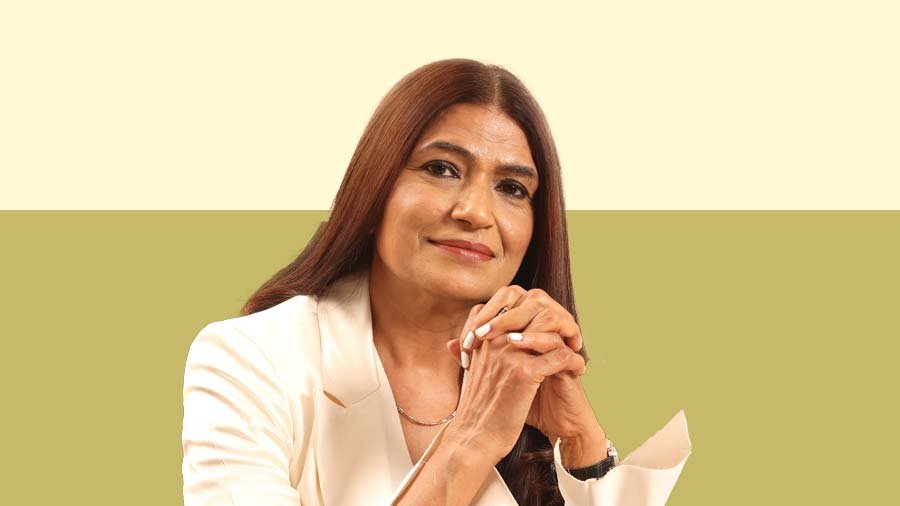
Mrs. Renu Goenka
Vice Chairperson, GD Goenka Group
In an exclusive interview with Diplomatist, Mrs. Renu Goenka, Vice Chairperson, GD Goenka Group, speaks about the transformation of education in an era of artificial intelligence, global mobility and changing career aspirations. She discusses GD Goenka’s vision of creating global learning ecosystems, India’s potential to emerge as a preferred destination for international students, and the responsibility of educational institutions to prepare young people not merely for careers, but for life.
Three decades ago, GD Goenka began with a single school in Vasant Kunj. Today, it has grown into one of India’s largest education groups spanning schools, higher education, healthcare and skill development. Looking back, what do you believe were the defining decisions that transformed a successful school into a national education movement?
Looking back, I believe the defining decision was to build education around the changing needs of the child and the changing world, rather than around the conventional definition of schooling. The journey began with the vision of our Group Chairman, Mr. A. K. Goenka, who believed that a truly child-centric school must nurture the whole individual. When GD Goenka began with its first school in Vasant Kunj, the focus was clear: provide children with world-class infrastructure, progressive curriculum, innovative pedagogy, technology and, above all, a safe, stimulating and nurturing environment in which learning could be joyful.
The success of that first school encouraged us to think beyond a single institution. The establishment of our IB-accredited school in Sohna, Gurugram, followed by early-years institutions such as GD Goenka La Petite and Toddler Houses, reflected our response to what parents and society were asking for, globally relevant education beginning from the earliest years. The establishment of GD Goenka University was another important step, allowing us to extend our philosophy of holistic, future-oriented education into higher education and create what we call “Foundation to Flight.”
What transformed GD Goenka from a successful school into a larger educational movement was not expansion alone. It was the ability to anticipate change, listen to stakeholders and continuously reinvent education while remaining anchored in our core values. Today, relevance is at the heart of our vision.
Academic knowledge remains important, but so are critical thinking, creativity, collaboration, emotional resilience, ethical values, technology and the ability to learn continuously. Our endeavour is to ensure that GD Goenka remains relevant to the future and that students do not merely succeed in examinations or careers, but thrive for life, as confident, compassionate, capable and globally aware individuals. That, ultimately, is the journey of GD Goenka: from one school to an educational ecosystem, and from a vision of better schooling to a larger vision of preparing young people for an ever-changing world.
The education sector is witnessing unprecedented disruption, from artificial intelligence to changing student aspirations and global mobility. If you were designing GD Goenka from scratch in 2026 instead of the 1990s, what would you do differently, and what founding principles would remain non-negotiable?
If GD Goenka were being established in 2026 instead of the 1990s, it would undoubtedly embrace a very different educational landscape shaped by Artificial Intelligence, global mobility, changing career aspirations, and rapidly evolving technologies. However, while the methods, learning environments, and tools would transform significantly, the founding philosophy of GD Goenka would remain unwavering because true educational values are timeless.
At its heart, GD Goenka would continue to uphold the principle that every child is unique, with individual strengths, talents, aspirations, and learning styles, and that education should help every learner realise their fullest potential rather than fit into a standard mould. Academic excellence would continue to be important, but it would be complemented by equal emphasis on creativity, emotional intelligence, leadership, collaboration, communication, character, and lifelong learning.
If designed today, the curriculum would move beyond content-heavy instruction to competency-based learning that develops critical thinking, problem-solving, innovation, entrepreneurship, financial literacy, environmental responsibility, global citizenship, and ethical decision-making. Artificial Intelligence would not replace teachers but become a powerful learning companion, enabling personalised learning pathways while teachers evolve into mentors, facilitators, and learning architects who inspire curiosity, creativity, and purpose.
Many institutions speak about producing global citizens, yet relatively few create truly international learning ecosystems. How is the GD Goenka Group preparing students not only to study abroad but also to compete, collaborate and lead confidently across cultures?
For us, preparing students to become global citizens is not simply about making them ready to study abroad. It is about preparing them to stand confidently anywhere in the world, while remaining deeply rooted in who they are.
We therefore see global readiness as much more than international exposure. It is about developing young people who can enter any environment, understand different perspectives, collaborate across cultures, communicate with confidence and ultimately create their own place in the professional world. Through exposure to diverse ideas, global conversations, collaborative and interdisciplinary learning, entrepreneurship, technology, innovation and real-world experiences, students are encouraged to look beyond the boundaries of their classroom and their own cultural perspective.
A truly international learning ecosystem also depends on the educators who create it. If we are entrusted with preparing future nation-builders and global citizens, then the people shaping those young minds have to be chosen with equal care. At GD Goenka, we look beyond qualifications to value curiosity, empathy, professional competence, openness to new ideas and, most importantly, the ability to recognise and nurture the potential in every child.
The GD Goenka Group today offers a complete educational journey, from preschool to university and professional skilling. Was this expansion always part of the original vision, or did it evolve organically as you understood the changing needs of learners and industry?
The expansion of the GD Goenka Group has been both intentional and evolutionary. While our larger vision has always been to make a meaningful contribution to education, we did not begin with a rigid blueprint covering every stage of the learner’s journey. As we grew, we listened closely to students, parents, educators and industry, and understood that the needs of learners were changing rapidly.
This led us to see education not as a series of disconnected stages, but as a continuum—from early childhood and school education to higher education, professional development and skilling. Each new initiative has been a natural extension of our core philosophy: to create future-ready learners equipped not only with knowledge and skills, but also with confidence, adaptability and a strong sense of purpose.
Parents today are perhaps more anxious than ever about the future. Careers are changing rapidly, AI is redefining jobs, and traditional professions are evolving. When a parent entrusts their child to GD Goenka, what promise do you believe the institution is truly making, not just academically, but for life?
When a parent tells us “I am entrusting my child to you,” they aren’t really handing over a child for six or seven hours a day. They are placing in our hands a part of their future, their hopes, their dreams — and, perhaps most importantly, their trust. I think that is the most profound promise a school has to honour.
Parents today are perhaps more anxious than ever because the world their children will inherit is changing at an extraordinary pace. Careers are evolving, technology is transforming how we live and work, and artificial intelligence is already redefining what knowledge and skill even mean. At the same time, children are growing up amid immense opportunity but also unprecedented pressure — competition, comparison, social media, uncertainty, and a constant expectation to perform. A large part of our responsibility, therefore, is to protect emotional wellness and help children find genuine joy in learning, not just push them toward outcomes.
So if I had to express the promise GD Goenka makes to every parent in a single sentence, it would be this: we will give your child the sharp, independent mind to think and reason for themselves, the values to use that thinking responsibly, the resilience to rise when things go wrong, the confidence to discover who they are, and the empathy to make a meaningful difference to the world around them.
Across more than 160 schools, multiple curricula and a university, how do you ensure that every institution reflects the same ethos while still encouraging innovation and responding to local aspirations?
When an institution grows from one school into a network of more than 160 schools across different geographies and curricula, and now into higher education, the real challenge is not expansion; it is ensuring that growth never dilutes the purpose with which the journey began.
We do not believe that preserving an ethos means making every institution look or function in exactly the same way. Education cannot be built around a one-size-fits-all model. Different communities have different aspirations, cultural contexts, learner profiles and opportunities. Our role is therefore to establish a strong common foundation while giving individual institutions the freedom to respond meaningfully to their local realities.
We also see the Group as a learning community. A good idea should not remain confined to the institution where it originated. Through academic collaboration, mentoring and shared resources, effective practices can travel across the network, be tested and adapted to different contexts. That makes standardisation a process of shared learning rather than uniformity.
If a young student from another country were reading this interview while deciding where to study, what would you want them to know about India, about GD Goenka, and about the kind of future they could build here?
I would want them to know three things: India is not merely preparing for the future; it is helping shape it. GD Goenka is not merely an institution where you earn a qualification; it is a place where you discover your capabilities. And the future you can build here is limited far more by the boundaries you place on yourself than by the boundaries of geography.
For an international student, India offers much more than an academic experience. It offers the opportunity to engage with different languages, cultures, perspectives and ways of thinking. In learning to navigate this diversity, students develop qualities that are increasingly essential in a global world—adaptability, openness, empathy, collaboration and the ability to find common ground across differences.
So, for an international student considering GD Goenka, I would encourage them to ask not only, “What programme will I study?” but also, “What kind of person will I become while I am here?”
Will I become more confident in expressing my ideas?
Will I learn to question rather than simply accept?
Will I discover interests and abilities beyond the classroom?
Will I learn to collaborate with people from different backgrounds?
Will I become more adaptable and prepared for uncertainty and change?
These are the questions that matter in the world our students are entering.
Ultimately, I would want a young student to arrive in India with curiosity rather than preconceived notions, and to arrive at GD Goenka with ambition—but also with an openness to learn.
You may come here to pursue a degree, a career aspiration or a particular programme. But I would hope you leave with something much larger: a wider worldview, lifelong relationships, the confidence to cross boundaries, and the ability to look at a changing world not with apprehension, but with possibility.
Because the future does not belong only to those who can predict it. It belongs to those who are prepared to shape it.


Leave a Reply