

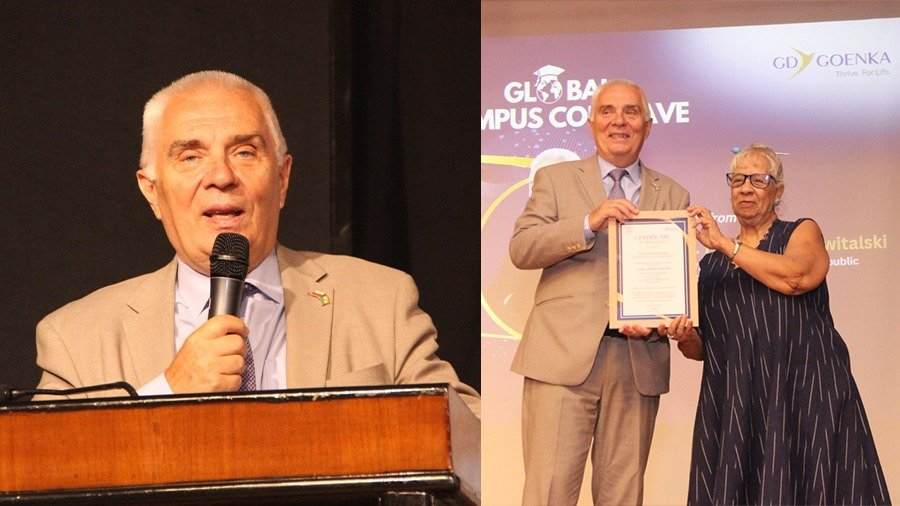
At the Global Campus Conclave, H.E. Piotr Antoni Świtalski invited Indian students to look beyond the traditional destinations for overseas education and discover Poland as a high-quality, affordable and welcoming European study destination.
For H.E. Piotr Antoni Świtalski, Chargé d’affaires a.i. of the Republic of Poland in New Delhi, the Global Campus Conclave offered a welcome departure from the routine of diplomatic life.
“This occasion for me is a good excuse to leave the office and meet the future of India, or rather, the present day of India, the young generation of Indians,” he told students at GD Goenka The Flagship School on 18 August.
His message was clear: when Indian students consider studying abroad, Poland deserves a place on their list.
An old country with a modern outlook
Introducing Poland to students who may know little about the country, Świtalski spoke of a nation with more than a thousand years of statehood, a complex history and a rapidly transforming economy.
But it was Poland’s education ecosystem that formed the heart of his address.
Poland currently has 345 higher-education institutions, with more than 1.3 million students enrolled in 2025/26.
The Chargé d’affaires highlighted disciplines including medicine, engineering, information technology, business and economics as areas in which Polish universities offer strong opportunities for international students.
He also pointed to the country’s long academic tradition, including the Jagiellonian University in Kraków, one of Europe’s oldest universities and the institution attended by astronomer Nicolaus Copernicus.
Quality, affordability and access
For Indian students weighing their options, Świtalski identified three particularly important advantages: quality, affordability and safety.
Compared with several traditional Western European destinations, he argued, the cost of studying and living in Poland can be more accessible.
Poland also offers opportunities for international students to study in English, while government-backed programmes such as the Stefan Banach NAWA Scholarship Programme provide eligible students, including applicants from India, with opportunities for Master’s-level study in Poland. The 2026 programme supports second-cycle studies in Polish or English and includes a scholarship and, for eligible applicants, tuition-fee exemptions at public universities.
But for Świtalski, the attraction is not only academic or financial.
“We can be for you a friendly gateway to Europe.”
That phrase captured the broader proposition he was putting before India’s young learners: Poland as a place to study, experience European life and build connections beyond the classroom.
A growing Indian presence
The Chargé d’affaires noted the growing interest among Indian students in Poland and pointed to an existing Indian student community.
He encouraged prospective students to speak directly to those already studying there and learn from their experiences.
His invitation was straightforward: “Come to Poland. Explore Poland, enjoy Poland and make this bridge between our two countries stronger.”
He also reflected on the growing institutional interest in strengthening India–Poland educational links, from student mobility to broader academic cooperation.
Discovering a country through experience
Perhaps the most engaging aspect of Świtalski’s address was its personal tone.
He acknowledged that Indian students traditionally look towards destinations such as the United Kingdom, the United States, Australia, France and Germany. His appeal was not to abandon those choices, but simply to look a little wider.
Poland, he suggested, is a destination worth discovering.
And discovery, ultimately, is what international education should be about.
Not simply collecting a foreign degree, but experiencing another society, meeting people, understanding a different culture and returning with a wider view of the world.
For Indian students contemplating their next step, his message was simple:
“Come to Poland.”
The invitation is open and perhaps the next generation of India–Poland relations will be built not in diplomatic offices, but in classrooms, laboratories, campuses and friendships between young people.


Leave a Reply