

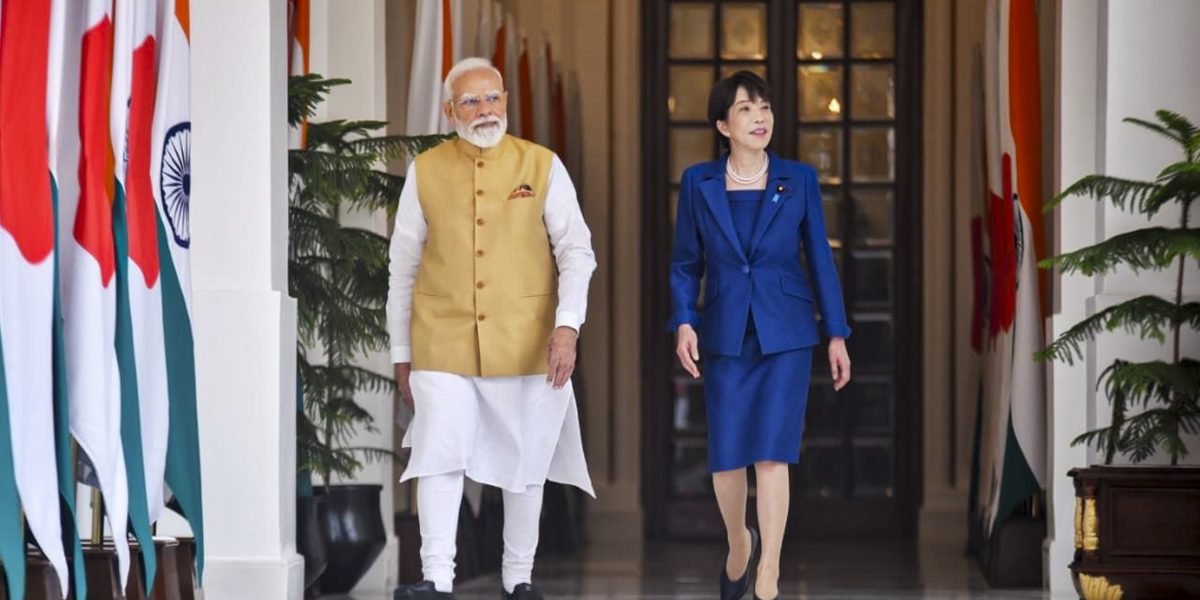
Something was quietly holding the India-Japan relationship together that did not appear on any agenda when Prime Minister Sanae Takaichi arrived in New Delhi on 1 July for the 16th India-Japan Annual Summit. The talking points were familiar: semiconductors, critical minerals, resilient supply chains, economic security. A large delegation of Japanese business executives travelling with her underscored what kind of visit it was. All of that matters. But it does not explain why this particular partnership has proven so durable, so resistant to the political turbulence that has destabilised comparable relationships in Asia. For that, you have to look elsewhere — and what you find there is soft power.
What holds it together is a civilisational connection that predates modern statecraft by more than a millennium, a degree of mutual popular warmth that is unusual by any regional standard, and a growing web of people-to-people ties that embed the relationship in the daily life of both societies.
Pew Research Centre surveys have consistently found that a majority of Japanese hold favourable views of India, among the highest in the Asia-Pacific region, and Indians return the sentiment in kind. Every year, tens of thousands of Japanese tourists travel to India, many making Buddhist pilgrimages to Bodh Gaya, Sarnath, and Kushinagar. Japan’s largest Indian cultural festival, Namaste India, has drawn enormous crowds to Yoyogi Park in Tokyo every September since 1993. These are not the symptoms of a relationship driven by strategic anxiety. They are the signs of something more durable.
A Civilisational Imprint
The civilisational roots go back to 736 CE, when an Indian monk named Bodhisena arrived in Japan at the invitation of Emperor Shomu. He stayed for the rest of his life, teaching Sanskrit and Kegon Buddhist doctrine, and in 752 performed the eye-opening ceremony of the Great Buddha at Todai-ji in Nara, one of the most significant religious events in Japanese history. The transmission of Buddhism from the Indian subcontinent to Japan was not simply a religious transfer.
It was a civilisational one, and its traces are visible in Japanese culture in ways that have no equivalent in Japan’s relationships with most other Asian countries. The Indian goddess Saraswati is worshipped across Japan as Benzaiten, one of the Seven Gods of Fortune, depicted holding a biwa just as Saraswati holds a veena. Several other Vedic deities crossed into Japanese religious life through the same Buddhist transmission. These connections were not manufactured for diplomatic purposes. They accumulated over centuries and left an imprint that persists.
That imprint is visible in contemporary cultural life, and the flow runs in both directions. Japanese anime and manga have found a substantial audience among young urban Indians over the past two decades. Yoga, meanwhile, has become embedded in Japanese daily life in ways that go well beyond a fitness trend. Every year, the Indian Embassy organises the International Day of Yoga at Tsukiji Hongan-ji, one of Tokyo’s most prominent Buddhist temples, drawing large crowds of participants. The choice of venue is not accidental. Staging India’s most visible annual public event inside a respected Japanese Buddhist temple quietly enacts the very civilisational connection that no summit communiqué can adequately describe.
Why Soft Power Matters
Why does any of this matter for a summit rightly focused on semiconductor supply chains and maritime security? Because strategic partnerships are not self-sustaining. They require something to draw on when interests stop aligning perfectly, when a government changes, or when an economic dispute creates friction.
The distinction worth making is between a partnership that deepens, through more agreements, more defence cooperation, more investment commitments, and one that also thickens, meaning it acquires a stable social presence and popular legitimacy that makes the whole structure more resilient over time. The India-Japan relationship has both. The Takaichi-Modi summit deepened it further. What tends to go unacknowledged is how much the thickening matters. This is, in essence, the soft power dimension of the partnership, and it deserves more analytical attention than it typically receives.
The contrast with India-China is instructive. Trade between India and China dwarfs India-Japan commerce by a considerable margin, yet that relationship is structurally brittle, prone to crisis, and carries essentially no reservoir of popular goodwill to draw on when things go wrong. The India-Japan relationship has that reservoir. It was not created by any summit communiqué and cannot be destroyed by one. But it can be neglected — and neglect has costs that accumulate slowly and become visible only when you need to draw on something that is no longer there.
Perhaps the clearest illustration of what is at stake comes from the Mainichi Shimbun, one of Japan’s national newspapers, which reported in 2025 that Japanese children now constitute more than half the student body at the GIIS in Tokyo. School choices are high-stakes decisions. They reflect judgments about reliability, institutional quality, and long-term fit. When Japanese families make those judgements in favour of an India-linked institution, the relationship is operating at a depth that no joint declaration can engineer and that no amount of strategic signalling alone could have produced.
Gaps That Remain
There are real gaps worth noting. Language remains a significant barrier in both directions. Visa access for Indian travellers to Japan has historically been more cumbersome than the relationship warrants. Bilateral exchange targets are ambitious, and the practical infrastructure to support them is still catching up. Educational exchange, which tends to produce the most durable people-to-people connections, remains underfunded relative to the scale of ambition both governments express at the summit level.
Conclusion
None of this featured prominently in the readout from the summit talks. That is understandable. Supply chains are urgent, and Buddhism is not. But the relationship Takaichi and Modi managed rests on foundations they did not build, and which no joint declaration can replicate. The monk Bodhisena spent twenty-four years in Japan. The civilisational imprint he and his contemporaries left is still, fourteen centuries later, doing quiet work in the background of a strategic partnership. The least that analysts and policymakers can do is notice.


Leave a Reply