

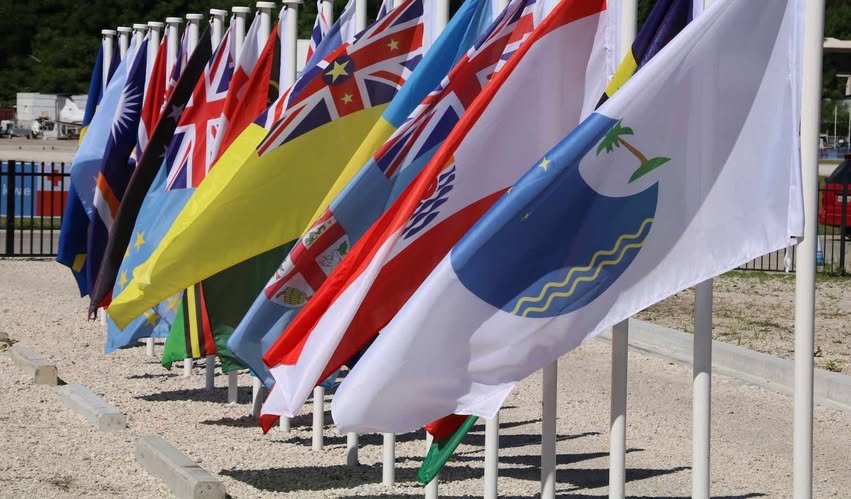
The 55th Pacific Islands Forum (PIF) Leaders Meeting will convene in Palau under the theme, “Building Economies: Life, Action, Unity,” from August 30 to September 4 this year, and is expected to have significant geopolitical implications for the wider Indo-Pacific region.
It is noted that the Forum meets annually to develop collective responses to Pacific Islands issues and to deliver on a vision for a resilient Pacific region characterised by peace, harmony, security, social inclusion, and prosperity, ensuring that all Pacific peoples can lead free, healthy, and productive lives.
The Pacific Islands Forum comprises 18 members — Australia, the Cook Islands, the Federated States of Micronesia (FSM), Fiji, French Polynesia, Kiribati, Nauru, New Caledonia, New Zealand, Niue, Palau, Papua New Guinea (PNG), the Marshall Islands, Samoa, Solomon Islands, Tonga, Tuvalu, and Vanuatu.
However, it must be noted that the summit assumes additional importance because of its venue itself, as Palau is an important country in Micronesian geopolitics where China and the United States are increasingly competing for influence.
There is a significant degree of regional tension among Polynesian, Micronesian, and Melanesian countries for influence within the Pacific Islands region.
Further, the Pacific Islands are likely to witness an important geopolitical contest between Polynesian and Melanesian countries.
In that context, China’s outward projection into the Pacific appears inevitable, necessitating accompanying refuelling and support facilities to sustain such strategic expansion.
In other words, if not the Solomon Islands, it could eventually be another location. Nevertheless, the move is particularly bold given the Islands’ proximity to New Zealand and Australia and the fact that they have historically fallen within Australia’s sphere of influence.
While some specifics of the deal remain unclear, it is evident that China has been granted the authority to station security personnel on the tiny Polynesian archipelago. This includes both police and military personnel, allowing for the possibility of a People’s Liberation Army military base some 2,000 kilometres off the east coast of Australia at some point in the future, with potentially significant implications for the Pacific Islands region.
On the other hand, recent meetings between Micronesian leaders and security experts in Guam have already spent two days this week quietly assessing what such great-power brinkmanship could mean for their own security and how best to respond.
Guam remains the ultimate regional backstop and the source of much of the United States’ military power in the region.
China’s development of long-range “anti-access, area denial” capabilities — missiles designed to push U.S. carriers and aircraft farther away from any Taiwan contingency — has forced Washington to rethink how it would operate during a crisis.
It is noted that the Pentagon’s evolving “archipelagic defence” concept relies heavily on dispersing forces across island chains and logistics hubs. This, in turn, places enormous pressure on Guam as a staging point, even as other global conflicts continue to strain U.S. missile stockpiles.
The above scenario increasingly resembles a Cold War-type environment, where there is an implicit suggestion that the West “lost” the Solomon Islands by allowing China to offer a more attractive economic deal. By extension, the response appears to be an effort to lure the archipelago back into the Western fold by improving economic engagement. Otherwise, there remains the risk of an ideological rival establishing a military base nearby. Few situations could reflect a more classic Cold War dynamic than this.
Importantly, the emergence of China as a potential superpower has altered the Oceanic geopolitical environment, particularly along its southwestern fringe. The end of the Cold War resulted in a period of relative neglect by traditional extra-regional partners, into which the People’s Republic of China has steadily expanded its influence.
This geopolitical shift has provided Pacific Island countries with greater flexibility in their foreign policies, allowing them to pursue stronger economic and diplomatic ties with non-traditional partners in Eurasia and the Middle East.
At the same time, the overall result is that Pacific Island countries continue to maintain a “Looking North” orientation, but with an increasingly non-Western focus. This shift provides individual states and regional organisations with a level of diplomatic latitude previously unavailable because of their dependence on Western partners.
In conclusion, it must be noted that the Pacific Islands region is likely to witness increased geopolitical tensions this year during the Palau summit, with external powers such as India, China, and the United States competing for influence alongside regional actors including Australia and New Zealand.


Leave a Reply