

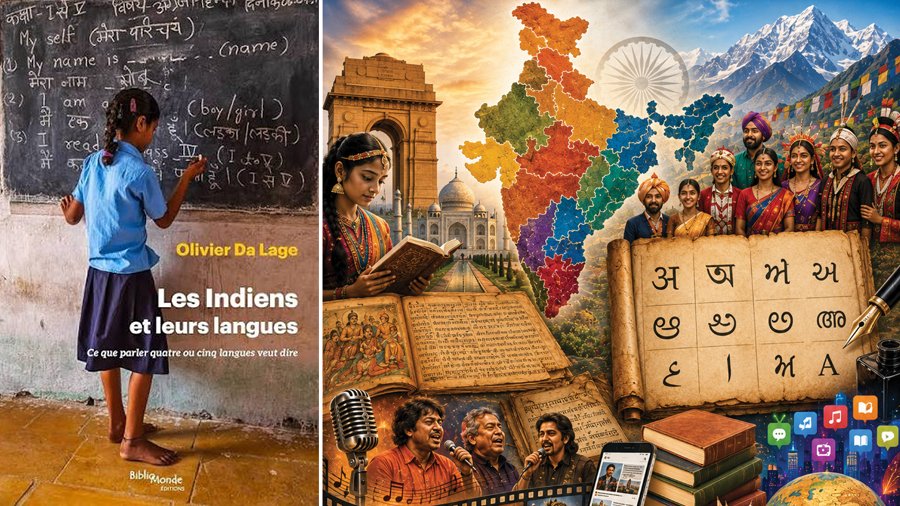
India is one of the most linguistically diverse countries in the world. While the Constitution recognises 22 official languages, hundreds of other languages and dialects are spoken across the nation. From Kashmir to Kanyakumari, and from Gujarat to the Seven Sister States of the Northeast, language is an integral part of India’s cultural identity. Few countries display such extraordinary linguistic diversity across regions, communities, and traditions. For millions of Indians, speaking two, three, or even four languages is a normal part of daily life. This remarkable ability to embrace diversity while maintaining national unity makes India unique. In his insightful book Les Indiens et leurs langues (The Indians and Their Languages), French author and senior journalist Olivier Da Lage takes readers on a fascinating journey through India’s multilingual landscape, revealing how languages serve as living bridges between history, culture, identity, and the spirit of one of the world’s oldest civilisations.
Les Indiens et leurs langues, published by BiblioMonde Publications in Paris, introduces international readers to India’s extraordinary linguistic diversity. Through research and real-life examples, Olivier Da Lage shows that languages are not merely tools of communication but expressions of culture, identity, and history.
A former journalist with Radio France Internationale, Da Lage explores how multilingualism is a natural part of Indian life, where people often speak several languages for different purposes. The book also highlights major Indian languages, including Bengali, Marathi, Gujarati, Punjabi, Tamil, Telugu, Kannada, and Malayalam, showcasing India’s rich linguistic and cultural heritage.
Da Lage explains that Indian languages belong to different language families. The largest group is the Indo-European family, which includes Hindi, Bengali, Marathi, Gujarati, Punjabi, and several others. The Dravidian family includes Tamil, Telugu, Kannada, and Malayalam. There are also Tibeto-Burman and Austro-Asiatic language groups, especially in the northeastern and tribal regions of India. This diversity reflects thousands of years of migration, cultural exchange, and historical development.
The author also explores the relationship between language and identity. In India, language is often closely linked to culture, history, and regional pride. Many states were formed on linguistic lines after Independence. People often feel a deep emotional connection to their mother tongue because it represents their heritage and traditions. At the same time, Indians maintain a broader national identity while speaking different languages. This ability to balance regional pride with national unity is one of the strengths of Indian democracy.
Another fascinating aspect of India’s linguistic diversity is its writing systems. Hindi uses the Devanagari script, while Bengali, Tamil, Telugu, Kannada, Malayalam, Gujarati, and several other languages have their own distinctive scripts. Urdu uses a script derived from Persian and Arabic. These writing systems are an important part of India’s cultural heritage and reflect centuries of history and development. Today, many people also use the Roman script while typing Indian languages on mobile phones and social media, showing how languages continue to adapt to modern technology.
Language in India is much more than a means of communication. It is a powerful expression of identity, culture, history, and emotion. This is clearly visible in the country’s music, cinema, media, and publishing industries, all of which are deeply connected to India’s linguistic diversity.
Indian music provides some of the finest examples of this relationship between language and culture. Urdu has given the world the poetic traditions of the ghazal and qawwali, made famous by artists such as Nusrat Fateh Ali Khan and Jagjit Singh. Hindi has produced countless devotional songs, film songs, and popular music enjoyed by millions. Regional languages have their own rich musical traditions, including Punjabi bhangra, Bengali Rabindra Sangeet, Tamil devotional music, and Marathi folk songs. These traditions preserve language, literature, and cultural memory while entertaining audiences across generations.
Indian cinema has played an equally important role in promoting Indian languages. For decades, Bollywood helped spread Hindi throughout India and among overseas Indian communities. Bollywood songs often became more popular than the films themselves and created a shared cultural experience for people across linguistic boundaries. In recent years, however, regional film industries have achieved remarkable success. Tamil, Telugu, Malayalam, Kannada, and Bengali films now attract audiences not only in their home states but throughout India and internationally. The growing popularity of regional cinema reflects the continuing strength of India’s linguistic diversity.
India’s media landscape also reflects this diversity. Newspapers continue to enjoy a large readership, supported by rising literacy levels and a strong advertising market. Hindi-language newspapers have the largest circulation, followed by English and several regional languages. Television reaches almost every corner of the country through hundreds of channels broadcasting in multiple languages. At the same time, smartphones and digital platforms have transformed the way people consume news and entertainment, allowing audiences to access content in their preferred language at any time.
The publishing industry mirrors these trends. English remains the dominant language in India’s book market, while Hindi accounts for a significant share of publications. Regional-language publishing continues to play an important role by producing literature, poetry, children’s books, religious texts, and translations.
Language in India is much more than a tool for communication. It carries memories, traditions, beliefs, and ways of life that have been passed down through generations. Every language spoken in India tells a story about the people who speak it, the places they come from, and the cultures they have created over centuries.
What makes India truly unique is its ability to accommodate this diversity without losing its sense of unity. In many countries, linguistic differences have led to division and conflict. In India, despite occasional debates and disagreements, hundreds of languages continue to coexist within a democratic framework. People from different linguistic backgrounds work together, study together, conduct business together, and contribute to the growth of the nation.
One of the strongest messages in Da Lage’s book is that diversity can be a source of strength. India shows that people speaking different languages can live together, work together, and build a strong nation. At a time when many languages around the world are disappearing, India’s multilingual culture offers an important lesson. It demonstrates how different languages can survive and flourish within a single society.
Through Les Indiens et leurs langues, Olivier Da Lage has given international readers a valuable introduction to India’s linguistic diversity. His book explains how languages influence everyday life, culture, education, media, and identity in India. More importantly, it shows that multilingualism is not a problem to be solved but a treasure to be celebrated.
Through Les Indiens et leurs langues, he invites readers to discover the extraordinary linguistic wealth of India and to appreciate the cultural wisdom preserved within its many languages. His book demonstrates that languages are not merely instruments of communication; they are living repositories of history, literature, traditions, and collective memory.
By bringing India’s remarkable linguistic diversity to an international audience, Da Lage has made a valuable contribution to cross-cultural understanding and global dialogue. More than a study of languages, his work is a tribute to the spirit of India itself, a civilisation that has embraced diversity for centuries while maintaining its unity. In an increasingly interconnected world, his message is both timely and universal: when a language is preserved, a culture survives; when a language is lost, humanity loses a part of its shared heritage.



Leave a Reply