

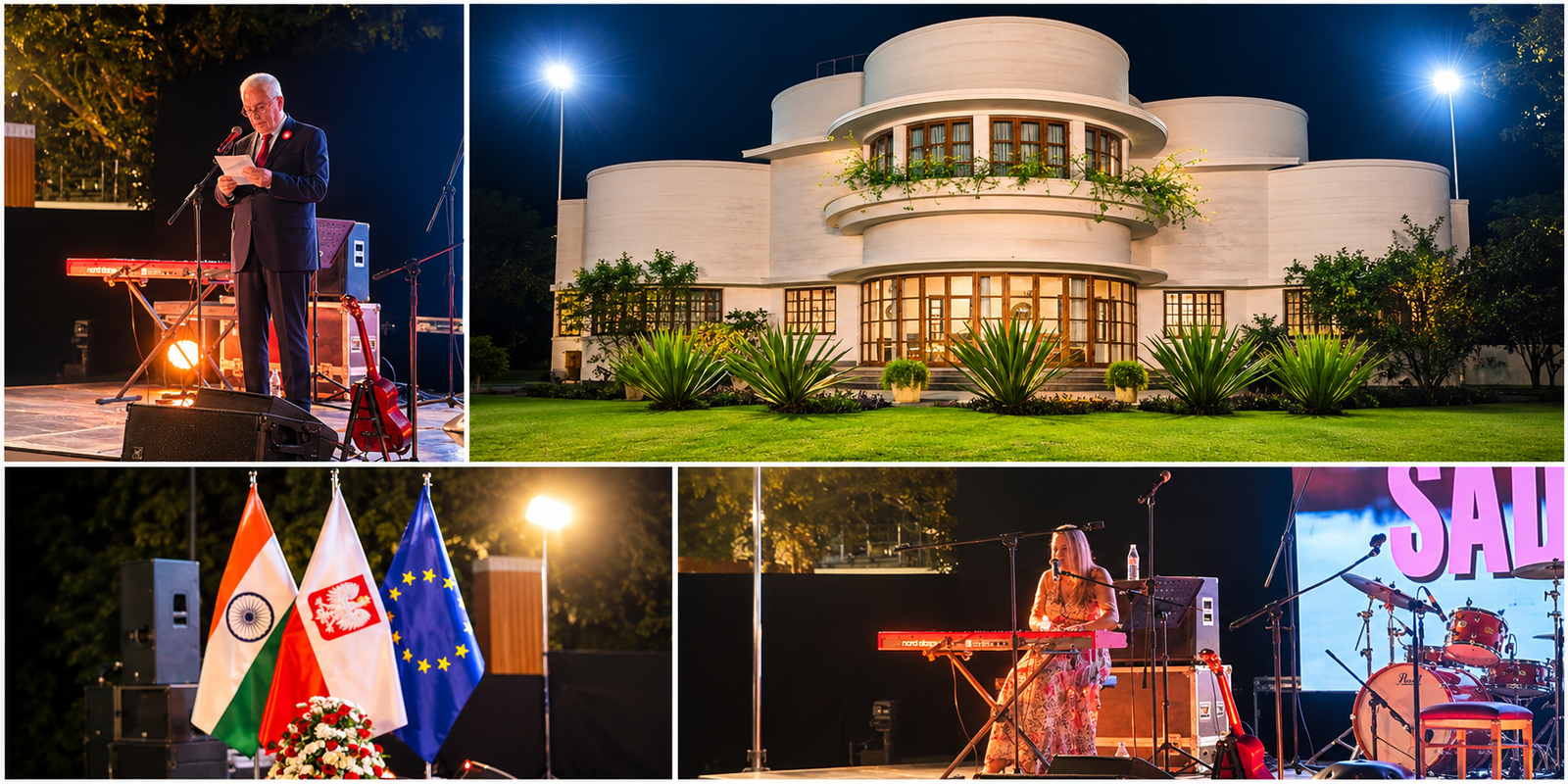
A little history, a lot of music and a diplomat who knows how to make his guests smile – quite a Polish way to celebrate November.
“Every nation has a specific month on the calendar that serves as a mirror to its deepest soul. For Poland, that month is November.”
With these words, Dr Piotr Antoni Świtalski, Chargé d’Affaires of the Republic of Poland in India, began his remarks at an evening of jazz, culture and celebration at the Polish residence in New Delhi on 2 November. What followed was not quite a conventional diplomatic address. It was a fascinating journey through Polish history, traditions, music and the country’s enduring love for freedom, delivered with a warmth and humour that made the audience feel more like guests in a friend’s home than attendees at a formal diplomatic reception.
For Dr Świtalski, November is much more than the transition from autumn to winter. It is a month that brings together two defining aspects of the Polish national identity: remembrance and independence.
He began by taking his guests back to 1 November, when Poland observes All Saints’ Day, followed by All Souls’ Day. Across the country, families visit cemeteries to remember their departed loved ones, lighting millions of candles that transform burial grounds into breathtaking seas of flickering light. The sight, he suggested, is reminiscent of India during Diwali.
But this tradition carries a deeper meaning. During the 123 years when Poland was partitioned and disappeared from the map of Europe, remembering its ancestors and preserving its cultural traditions became acts of national resistance. With the Polish language suppressed and the national flag outlawed, collective memory helped keep the idea of Poland alive.
“For Poles, memory is not a passive act. It is a patriotic duty,” he remarked.
When Jazz Became an Expression of Freedom
From candlelit cemeteries, the diplomat moved to something rather unexpected: jazz!
He introduced the audience to Zaduszki Jazzowe, Poland’s distinctive All Souls’ Day jazz tradition, which began in Kraków in 1954. During the communist years, jazz faced ideological suspicion and restrictions. Yet musicians continued to play, often in private spaces and informal gatherings. Its improvisational spirit became an expression of individual freedom and creative resistance.
At the heart of this story was Krzysztof Komeda, the celebrated Polish jazz pianist and composer, regarded as one of the founding figures of the Polish jazz school.
Dr Świtalski had a particularly charming way of expressing his admiration for two musical greats: “If I had two hearts, one would beat to the rhythm of Chopin, but the other to the rhythm of Komeda.”
It was this spirit of remembrance, creativity and musical freedom that the evening sought to bring to New Delhi.
From Remembering the Past to Celebrating Freedom
The story then moved towards 11 November, Poland’s National Independence Day.
After 123 years of partitions, Poland regained its independence in 1918. For generations, Poles had fought to preserve their language, culture and national identity, even when their country no longer existed as an independent state.
Dr Świtalski spoke passionately about the Polish determination to fight for freedom, adding that the country’s struggle had never been only about its own liberty.
Drawing parallels with India, he observed that both countries understood the painful journey from colonial subjugation to independence. Both knew the value of cultural identity, historical memory and the responsibility of safeguarding freedom for future generations.
It was a particularly meaningful observation for an Indian audience.
An Evening of Polish Jazz in Delhi
Dr Świtalski turned the attention to the evening’s performer, Maria Sadowska, whom he described as a Renaissance woman – a singer, songwriter, composer, screenwriter, fashion designer and film director.
He also highlighted her contribution to keeping Komeda’s musical legacy alive through recordings and interpretations inspired by his work.
“Tonight, we are incredibly honoured to bring that exact spirit of freedom, nostalgia and memory here to Delhi,” he said.
And so, the evening moved from words to music, with Maria Sadowska bringing the sounds of Poland to the diplomatic gathering.
Supported by sponsors including Maspex, TZMO, ISI and WB India, the event offered guests more than a musical performance. It was an introduction to a country that finds ways to connect its past with its present – through remembrance, poetry, music and an enduring love for freedom.


Leave a Reply