

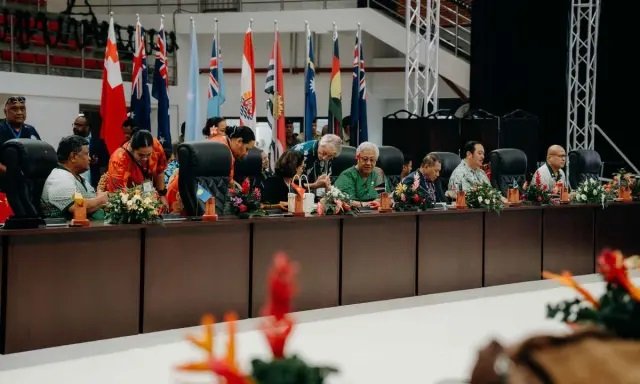
As New Zealand’s election dates have been announced, the future role that Wellington will play in the Pacific Islands is expected to be watched with keen interest.
On this note, the incumbent New Zealand government, both before and after the elections, is expected to strengthen cooperation through the South Pacific Defence Ministers’ Meeting (SPDMM).
It is noted that the South Pacific Defence Ministers’ Meeting (SPDMM) faces growing pressure to prove its relevance, as the Pacific becomes increasingly vulnerable to natural hazards and extreme weather events intensified by climate change. At the same time, the region is confronted with mounting geostrategic rivalry, marked by sharper competition for influence, including through military deployments.
The SPDMM is the premier defence ministerial dialogue in the South Pacific, enhancing cooperation and driving Pacific-led responses to shared regional security challenges since 2013. Members have discussed new trends in security challenges facing the region and reaffirmed the importance of operational collaboration between their militaries in promoting a secure and resilient Pacific.
It is also noted that Chile, as a member of the SPDMM, views the Pacific from an east-to-west perspective compared with other countries in the region.
The SPDMM’s future will largely depend on its capacity to strengthen both its effectiveness and legitimacy. This will hinge on fostering a stronger civil-military dimension and adopting a more Pacific-led and recipient-driven approach, while advancing interoperability, lessons learned, and training among armed forces, as well as empowering local authorities. Enhanced coordination with regional institutions and multilateral frameworks, together with people-to-people exchanges and a greater emphasis on prevention, will also be essential. France is playing a significant role in supporting these efforts.
The scheduled elections to be held in New Caledonia next month are expected to have strategic implications for the wider geopolitics of the Pacific Islands. New Caledonia is an important overseas territory of France in the Melanesian region of the Pacific. At present, the Melanesian Spearhead Group (MSG) comprises the four Melanesian states of Fiji, Papua New Guinea, Solomon Islands, and Vanuatu, along with the Kanak and Socialist National Liberation Front of New Caledonia. In June 2015, Indonesia was recognised as an associate member.
As Pacific Island Countries (PICs) push back against the growing militarisation of their region, the SPDMM has begun working to strengthen a more balanced civil-military dimension.
Earlier, at its 2024 session in Auckland, the forum endorsed Australia’s initiative to establish the Pacific Response Group (PRG), supported by a multinational Pacific Special Advisory Team (PSAT), which includes a French officer and is based in Brisbane during the high-risk weather season.
It is noted that the PSAT has participated in key planning and interoperability exercises across the region, including the French-led multilateral exercise Croix du Sud, held in New Caledonia in April-May 2025, as well as the Long Reach 2025 tabletop exercise hosted by Tonga in August.
Another key question, related to both the legitimacy and effectiveness of the SPDMM, is its ability to be coordinated within the broader regional security architecture, with particular priority given to the Pacific Islands Forum (PIF), the region’s primary multilateral political organisation. At the 2024 SPDMM in Auckland, the Forum was represented for the first time in observer status by Baron Waqa, Secretary-General of the PIF.
Obvious synergies exist among a number of regional mechanisms, and efforts should be made to streamline activities, avoid duplication, and enhance effectiveness—objectives that lie at the very core of the SPDMM’s original mandate.
On the other hand, France’s military forces, based in New Caledonia and French Polynesia, play a key role in regional cooperation initiatives by supporting Pacific Island countries in monitoring their Exclusive Economic Zones (EEZs), providing logistics for Humanitarian Assistance and Disaster Relief (HADR) operations, and coordinating with other SPDMM member countries.
At the 2023 SPDMM in Nouméa, France agreed to adjust its ship-riding practices and enter into agreements with SPDMM partners and other countries, including Vanuatu. Since then, inspectors from partner countries have been able to embark on French military vessels, facilitating monitoring and enforcement procedures within their EEZs. France’s Pacific Academy in Nouméa has expanded its training programmes in civil-military crisis planning and management, helping to strengthen the expertise of regional defence and security forces. In coordination with partners and under the Povai Endeavour framework, the Pacific Academy seeks to complement existing training programmes in the Pacific on HADR and civil security by focusing on practical skills and technical areas with direct utility for partner forces.
Coming back to New Zealand, Winston Peters, Deputy Prime Minister and Foreign Minister, was credited with improving New Zealand-United States relations during his tenure as Foreign Minister in the last Helen Clark-led Labour Government (2005-08). The expectation now is that Wellington and Washington will cooperate more closely in the Asia-Pacific region, including the South Pacific. However, the extent of cooperation in the broader Indo-Pacific theatre will be worth watching. It is, for instance, not yet clear whether the New Zealand Government will continue deploying Royal New Zealand Navy (RNZN) frigates to the western Indian Ocean under the auspices of the Combined Maritime Forces’ counter-piracy and maritime security Task Forces 150 and 151.
Wellington’s explicit support for Washington’s pivot, or rebalance, to the Indo-Pacific is an important aspect of the 2016 Defence White Paper, which went further than its 2010 predecessor. The policy was reflected in the White Paper’s reaffirmation of the need to keep the Sea Lines of Communication in the Indo-Pacific open.
This approach was subsequently reinforced through a strategic partnership—if not an alliance in all but name—between Wellington and Washington, formalised by the Wellington Declaration (2010) and the Washington Declaration (2012).
The Defence White Paper 2016 reaffirmed both the Wellington and Washington Declarations, which had been undertaken with the support of the Labour Party. These aspects may require clear confirmation from any new Labour-led government, particularly to reassure strategic partners such as India, Australia, Indonesia, and the United States.
If the Labour Party under Chris Hipkins comes to power, New Zealand may place less public emphasis on its Five Eyes intelligence partnership, at least rhetorically.
It has, however, given positive signals regarding the Trans-Pacific Partnership (TPP) and would ideally like to see the United States return to the agreement as part of its broader foreign policy. As the US seeks to maintain its influence in the Indo-Pacific, it has looked to countries such as India, Vietnam, Indonesia, Australia, and New Zealand for support. The warming of US-New Zealand defence relations over the past few years confirms the importance Washington places on working more closely with like-minded countries across the wider region.
On that note, New Zealand may also seek to deepen its relationship with France, including through the France-Australia-New Zealand (FRANZ) Agreement, signed in 1992, to facilitate better maritime cooperation in the Indo-Pacific. While that agreement includes provisions for improved intelligence sharing, the Five Eyes arrangement will continue to be New Zealand’s primary and pre-eminent intelligence partnership.
A Labour-led government, in which Priyanca Radhakrishnan could potentially serve as Minister of Foreign Affairs or Minister of Defence, is also likely to strengthen relations with countries such as India and Indonesia, building on the progress made by the previous government. Over time, this process could mature into a broader defence partnership.
However, if the National Party remains the incumbent government, it is expected to continue supporting the existing security architecture in the Pacific Islands and the wider South Pacific, despite any differences it may have with Washington on issues elsewhere in the world.


Leave a Reply