

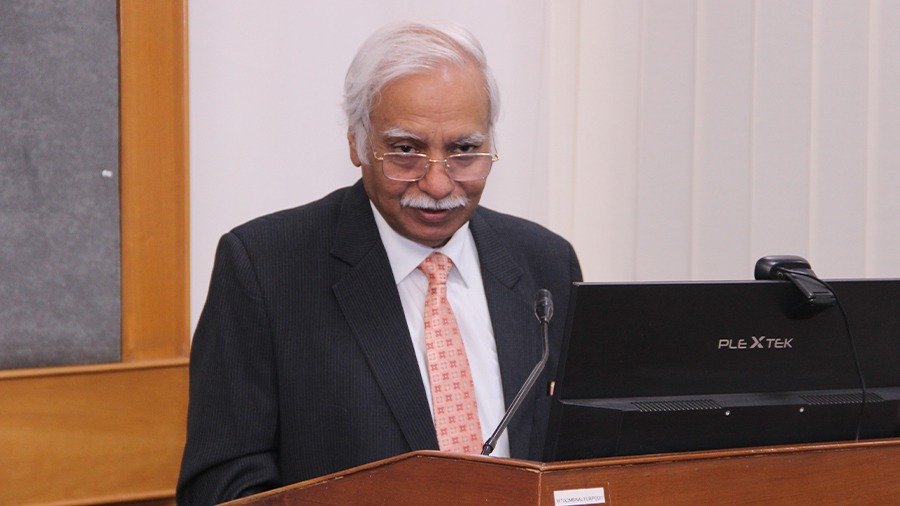
Opening the discussion on “The Global South Speaks: India’s Leadership in BRICS and Beyond,” Prof. Dr. R.M. Joshi, Vice Chancellor of the Indian Institute of Foreign Trade (IIFT), set the tone with a candid and reflective address that captured the complexity of the current global moment and the weight of India’s upcoming BRICS presidency.
He made a simple but powerful observation: India assumes the BRICS presidency at a time of profound global disruption.“India has taken over the presidency of BRICS at a time of unprecedented geopolitical turbulences… the whole world has been witnessing economic and geopolitical instability over the past year and a half.”
He pointed to the overlapping crises that define the present moment: economic uncertainty, rising geopolitical tensions, and shifting power dynamics. In a striking remark, he referred to the changing global security discourse, noting how the language of “defence” itself appears to be hardening into that of “war,” reflecting a world that is no longer merely preparing for conflict, but actively grappling with it.
This evolving context, he argued, has made both trade and diplomacy significantly more complex. Traditional frameworks no longer provide reliable answers. “Diplomacy today has become far more complex and multidimensional than at any time in recent history.”
Prof. Joshi highlighted the growing disconnect between classical economic theories and present-day realities. With tariffs rising globally and protectionist measures becoming more widespread, he suggested that conventional trade models are increasingly inadequate in explaining or guiding policy decisions. “Trade theories, as we understood them, are not working in today’s world.”
Instead, he emphasised that the ability to navigate this uncertain terrain now depends less on textbook frameworks and more on the evolving practice of diplomacy, an area that itself demands deeper study and adaptation.
Turning specifically to BRICS, Prof. Joshi noted that, unlike institutions such as the World Trade Organisation, the grouping lacks a formal, rule-based structure. While this offers flexibility, it also places greater responsibility on member states to sustain cooperation through negotiation and trust. “BRICS does not have a rule-based framework… the extent of collaboration depends largely on the proficiency of diplomacy.”
He also drew attention to an inherent paradox within BRICS: its members are not only partners but also competitors: economically, strategically, and geopolitically. This duality, he suggested, makes collaboration both necessary and challenging.
The recent expansion of BRICS, while enhancing its global weight, adds another layer of complexity. With a larger membership representing a significant share of the world’s population and economic output, the grouping’s influence has grown, but so have the difficulties of coordination and consensus. “Embracing more countries makes BRICS stronger in numbers, but negotiation and collaboration become more complex.”
Yet, Prof. Joshi remained optimistic about India’s ability to steer the grouping through these challenges. He pointed to the country’s strong diplomatic capabilities and its demonstrated ability to engage with diverse partners across regions. “India has remarkable diplomatic strength, and I am confident we will be able to navigate through these challenging times.”
He further highlighted India’s broader vision for its BRICS presidency, one that emphasises resilience, innovation, and constructive engagement. Even as globalisation faces pushback and protectionist tendencies rise, he noted that countries across the world are increasingly turning inward, prioritising self-reliance and domestic capacity-building.
Referencing both contemporary policy shifts and philosophical insights, he observed how the global system often follows the lead of major powers. “When the largest economies turn towards protectionism, others inevitably follow.”
In this context, concepts such as self-sufficiency, once seen as exceptions, are becoming mainstream across nations. For India, this aligns with its own developmental strategies, but it also raises broader questions about the future of global economic integration.
Despite these challenges, Prof. Joshi emphasised that moments of crisis also create opportunities. He called for identifying complementarities within BRICS, areas where member countries can work together constructively despite their differences. “This is a challenging time, but it also provides immense opportunity for India’s leadership to transform BRICS into a more vibrant and effective platform.”
He expressed hope that through dialogue, cooperation, and strategic vision, BRICS can evolve into a meaningful force for global stability and development.


Leave a Reply