

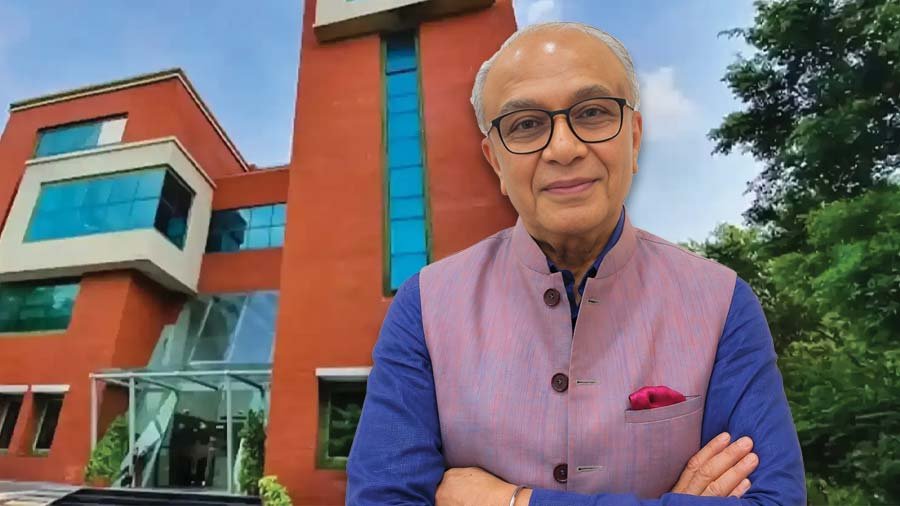
Dr V M Bansal, Chairman, NDIM
In an exclusive interview with Diplomatist, Dr. V. M. Bansal, Chairman, New Delhi Institute of Management (NDIM), reflects on his journey from public administration to institution building, and shares his vision for nurturing globally competent, ethically grounded, and future-ready leaders. Drawing upon decades of leadership in government and higher education, he discusses the growing role of artificial intelligence, industry-academia collaboration, entrepreneurship, global exposure, and values-based education in shaping the next generation of professionals.
Your career includes handling labour strikes, managing critical public infrastructure during the 1982 Asian Games and the 2010 Commonwealth Games, and leading difficult administrative reforms. Which leadership lesson from those high-pressure years has become the cornerstone of your philosophy, and how do you ensure your students internalise it?
When I look back at my career, I realise that almost every assignment was a lesson in leading through uncertainty. Whether it was handling labour strikes, managing 50,000 DDA workers during the 1982 Asian Games, coordinating the successful execution of the 2010 Commonwealth Games, acquiring lands of several high-profile villages for Delhi’s International Airport, transforming loss-making organisations; or closely interacting with Chief Ministers, Union Ministers and the Prime Minister’s Office; there was rarely a ready-made solution. In many ways, I was dealing everyday with what the corporate world today calls a VUCA environment. The most important lesson I learnt was this: a leader cannot afford to panic or rely on precedents. One must remain guided by inner wisdom while maintaining an uncompromising focus on every detail. Every crisis taught me that the biggest mistakes occur not because of any major error, but because someone overlooked some small detail which proved to be fatal.
Today’s business leaders have to face continuous disruptions driven by AI, geopolitical shifts, climate challenges and rapidly changing business models. We therefore provide maximum exposure to our students to real life situations that build resilience and confront them with decision-making under uncertainty. Through rigorous training, presentations, live consulting assignments, AI-enabled simulations and constant interaction with industry leaders, our students learn to think, adapt and lead under pressure—not memorise concepts. Having learnt the hard realities, the essential traits of success in the most uncertain situations, our students have the advantage of – real-life learning and living up to the expectations of every different employer.
NDIM has built a reputation for maintaining unusually strong engagement with industry leaders, policymakers, and global institutions. Was this a conscious response to what you believed traditional management education was missing, and how has it changed the confidence and employability of your graduates?
Yes. At NDIM, we consciously decided that industry was not an external stakeholder—it was a co-creator of management education. Instead of asking industry to visit us only to recruit our graduates on completion of the program, it was necessary to make industry an integral part of the students’ educational journey from day one.
Our curriculum is not designed in isolation. It is extensively reviewed and upgraded twice every year with the active participation of 132 senior industry professionals. Twice an year may seem very ambitious but we felt it was necessary to keep up with the fast-changing industry expectations. Our students learn through an average exposure to 1,596 expert talks, 60 industry conferences and 252 international engagements, where they interact directly with CEOs, entrepreneurs, policymakers and global business leaders. This is one distinguishing feature of MBA at NDIM, of maximum and continuous interaction of MBA students with Masters of Businesses. Students must understand how decisions are made in complex business environments. We take pride in direct engagement of our students with India’s foremost industry leaders, including the Chairpersons of Tata Sons, Bharti Airtel, Maruti Suzuki, Nestlé Flipkart, Managing Director of Amul, Partners of top consulting firms like KPMG, Deloitte, Ernst & Young (EY), Chief Operating Officers of various MNCs, etc. When students hear business strategy and daily problems directly from the leaders who have built billion-dollar organisations, the classrooms transform into boardrooms.
It is a matter of great satisfaction that NDIM has not merely adapted to educational reforms but has contributed in shaping them. Having been continuously declared as India’s Best Industry-Linked B-School by AICTE (Govt. of India) and CII for three consecutive years, 1st time in the history of higher education in the country – a distinction earned only by NDIM—the Chairman of new education policy, Dr. K. Kasturirangan visited NDIM, and bracketed NDIM alongside IIM Ahmedabad in the National Education Policy.
Realising that, industry interaction alone is not enough, we work extensively on grooming our MBAs to fit into global corporate culture, we have one of India’s most rigorous Corporate Skills Development (CSD) programme. Led by eight full-time faculty members with distinguished corporate backgrounds and senior defence stalwarts, students undergo more than 250 hours of credit-based corporate skills development across three semesters and every student experiences intensive schedule of practical simulations preparing them for recruitment interaction. In addition, 100% of our students receive one to one mentoring on personal branding, résumé building, AI-enabled interview preparation, role-specific interview strategies and career planning by more than 354 CEOs, Founders, top corporate leaders under our most sought-after Corporate Mentorship Program. Our students are continuously trained to navigate modern recruitment systems using platforms like HireVue, understand AI-driven interview processes, prepare ATS-compliant CVs, and use Generative AI tools.
The outcome of this preparation is visible long before formal placements begin. This year alone, 67 students secured Pre-Placement Offers (PPOs) on completion of 1st year of their MBA even before the formal campus recruitment process commenced in the 14th month of the 24 months MBA program.
Our placement outcomes validate this approach. All these years including our recently graduated 2024–26 batch, NDIM achieved an impressive 97% placements, while 3% of our graduates chose to be entrepreneurs, reflecting our equal emphasis on both the job creators and job seekers. Our students have been recruited by over 250 leading organisations, including Deloitte, BlackRock, Trident Group, Aditya Birla Capital, ICICI Bank, Daikin, Oxane Partners, ITC, Hindustan Unilever, Reckitt Benckiser, Ernst & Young (EY), Adani Wilmar, S&P Global, Federal Bank, ICICI Bank, Kent RO Systems, Dabur and many more. The highest salary package reached ₹32 lakh per annum. NDIM holds a prestigious six-year Accreditation from National Board of Accreditation of Government of India, placing it among only six MBA institutions in India accredited for student outcomes and placement performance for the maximum permissible period of 6 years.
Our vision of employability extends beyond India. Through international immersion programmes across the United Kingdom, Singapore, Dubai and Thailand, and through our unique Japan and Korea Centers of Excellence, our students are groomed to language proficiency, cross-cultural business understanding and international corporate etiquette. NDIM is the only MBA institution in the region licensed by the National Skill Development Corporation (NSDC), Govt. of India, since 2018 to groom and send skilled professionals to Japan, resulting in approximately 10% of our students’ securing careers in Japanese and Korean companies every year. Our Japan Centre is also the only one in India to receive 20 scholarships every year from Japan’s Nitori International Scholarship Foundation.
Being entrepreneurial and having entrepreneurial mindset are essential foundational traits for any good business manager and a CEO. Through our incubation centres supported by ASSOCHAM and NHRDN, through one dedicated ₹50 lakh seed fund, and through continuous hand holding & mentoring by 354 industry leaders, NDIM launched 15 startups recently. We are also proud to be the only B-school in North and Central India selected to host five editions of the Smart India Hackathon, besides hosting the MSME Hackathon 3.0 (Women), where five women-led student innovations received ₹15 lakh each through Government funding.
NDIM is the only management institute in India with an ASSOCHAM led Pan-India Incubation Centre and a Women Entrepreneurship Center (Womennovator), 10 road shows have been conducted to incubate start-ups in India by ASSOCHAM in partnership with NDIM students and alumni. The Govt. of India selected us as the only Management school for its biggest digital & entrepreneurial revolution creating 35000 jobs “Smart India Hackathons” 5 years in a row.
We have been honored with the prestigious “Excellence in Providing Preferred Environment for Placements” award by the ASSOCHAM on 9th of July 2026 at its 18th National Education Leadership & Skill Development Summit. This recognition reflects what truly differentiates NDIM—our unwavering focus on employability over mere placements. At NDIM, students are immersed in an industry-driven learning ecosystem through live consulting projects, corporate mentoring, leadership development, internships, global academic collaborations, certification-driven learning, industry-integrated curriculum, and continuous interaction with CXOs and business leaders. Every initiative is designed to bridge the gap between classroom learning and boardroom expectations.
NDIM is Delhi’s only student chapter of the National HRD Network (NHRDN), giving its students access to 50 regional chapters and more than 17,500 HR professionals across India who are the ultimate recruiters and job providers. Such networks often become lifelong professional assets. Also, we firmly believe that management education is incomplete without future management leaders being socially responsible. Through partnerships with over 450 NGOs, our students undertake social impact projects every year, integrating technology with community development. Our Centre of Excellence in Renewable Energy, established in partnership with REPA, offers specialised certifications in Renewable Energy and Sustainability, ensuring our graduates understand that future of business must also be the future of the society.
Through multi-pronged approach we prepare students to contribute meaningfully in boardrooms, building enterprises, influence public policy, and lead organisations in an increasingly complex global economy.
Having witnessed India’s transformation from a largely paper-driven bureaucracy to today’s AI-enabled governance systems, how do you think management schools should prepare students for a future where artificial intelligence may outperform technical knowledge, but not necessarily judgment, ethics, and leadership?
The transformation from paper-driven economy to one powered by digital public infrastructure, AI-enabled governance, real-time predictive analysis, and intelligent decision-making systems have taught us one important thing: technology will continue to evolve faster than humans can keep pace with. Management education cannot prepare students only for today’s jobs; it must prepare them for tomorrow’s challenges which are today unforeseen. Already AI can write reports, analyse financial statements, generate marketing strategies, write codes, and even conduct interviews. Knowledge itself is no longer scarce—it is available at the click of a button.
Management education has to reinvent itself. At NDIM, we recognised this shift much before AI became a global buzzword. Without delay, we introduced full time MBA programmes in Artificial Intelligence, Machine Learning, Business Analytics and Digital Marketing because we knew technology would redefine every business function—not just IT. Today, AI is not treated as an elective or an add-on at NDIM; it is integrated into the DNA of our academic ecosystem. Our students are trained not only in Business Intelligence, AI-led decision-making, predictive analytics or in emerging digital tools, but also in the ethical dimensions of technology. Whether it is AI-assisted recruitment, data privacy, algorithmic bias, ESG reporting or responsible use of Generative AI, we expose students to real-world dilemmas where there is no perfect answer.
Another aspect that management schools must have to embrace is continuous learning. Earlier, a management graduate could rely on knowledge acquired during their two-year MBA program for several years. That era is over now. The half-life of knowledge is shrinking rapidly. Therefore, students must graduate with the ability to learn, unlearn and relearn continuously. At NDIM, this philosophy is reflected through our regular industry-led certifications, Management Development Programmes, AI workshops, live projects and constant curriculum redesign in consultation with corporate houses.
Equally critical is industry integration. AI cannot be understood in isolation inside classrooms. Students must experience how organisations are actually deploying AI in finance, marketing, HR, supply chain, healthcare and governance. NDIM’s close engagement with industry leaders—from Tata Sons, Bharti Airtel, Maruti Suzuki, Nestlé, Amul, Flipkart, Blackrock, Ernst & Young (EY), Deloitte, ITC, Dabur, Britannia, Colgate Palmolive, Yamaha Motors, Parag Milk, Oyo Rooms. Hitachi, Yamaha Motors, Britannia, Parag Milk and several other leading organisations—ensures that our curriculum evolves with business realities rather than academic assumptions. I believe management schools must develop leaders, not just managers. AI may replace routine analysis, but it cannot replace human vision.
As India seeks to position itself as a global education hub under the National Education Policy, what, in your view, will truly persuade international students to choose India over established destinations such as the United States, the United Kingdom, Australia, or Singapore? Beyond affordability, what unique value proposition should India project?
I believe the question itself reflects an important shift. For decades, countries competed primarily on educational infrastructure—campuses, rankings, faculty and research. In the next decade, they will compete on the ability to prepare graduates for a rapidly changing world. India should not aspire to become ‘the next United States’ or ‘the next United Kingdom.’ It should aspire to become the world’s most relevant education ecosystem for the twenty-first century focused on ground realities, working towards more human centric and global welfare initiatives.
Students choose destinations where they believe they will gain a unique intellectual, professional and cultural advantage. India possesses all of them but needs to let the entire world know of these differentiators. The fact that Indian origin CEOs occupy the highest %age in the global best companies, and the fact that they are the most sought-after doctors and engineers at global platforms is enough to prove for Indian soil to be the best bet for global learners in the coming decades that something which Indian mythology, Indian grooming, Indian soil & society offer are our strengths.
First, scale: There is no other major democracy where students can observe such rapid economic transformation, digital governance, entrepreneurship, manufacturing, financial inclusion and social innovation unfolding simultaneously at this magnitude.
Second, complexity: Modern leadership increasingly requires ability to operate in diverse, multicultural and resource-constrained environments. India’s diversity—in languages, culture, costumes, markets, institutions and consumer behaviour—provides an unparalleled living laboratory for understanding complexities and innovation in their management.
Third, innovation under constraints: Many breakthrough ideas today emerge not from abundant resources but from unimaginable problems. India’s deeper need with digital public infrastructure, healthcare delivery, fintech, sustainability and inclusive innovation offers opportunities that are increasingly relevant across developed and developing economies alike which the developed countries do not offer.
And, India offers something that is scarce in higher education globally—the opportunity to combine technology, ethics, sustainability and societal impact within a single educational experience. Future leaders will not be judged only by quarterly profits; they will also be judged by how responsibly they learn and use thousands of years’ culture and history lessons, abundant resources, spirituality, multi-faithism, and multidirectional manpower to global advantage & leadership.
You spent over four decades handling some of India’s most challenging administrative assignments, from urban governance and infrastructure to public policy, before taking charge of NDIM. Which principles from your administrative career have you consciously carried into the institution, and where did you feel the education sector required a completely different leadership approach?
The most important learning I carry from my varied administrative assignments is the belief that no situation is beyond turnaround. One has to have belief and think differently, take ownership, and be a team member. Throughout my career, I never hesitated taking boldest of decisions—even those beyond my defined jurisdiction. I could do that only because I never compromised on transparency, public interest being the only mission. I learnt that leadership is about assuming responsibility and giving relief, not letting the opportunity go in vain by postponing or waiting for approvals. With the same philosophy, NDIM encourages innovation and decision making, thinking futuristically, with student career being the sole goal. Unlike administrative assignments, where success is measured through projects and policies, education must focus on inspiring students, faculty innovation, and building a culture of ‘educating for national pride and national excellence’. My guiding belief has always been, “Shubh Karman Te Kabhun Na Daro”—never fear doing what is right if your intentions are honest and are in larger national interest.
You have worn many hats; entrepreneur, civil servant, institution builder, and educationist. Decades from now, when your students and colleagues look back on your contribution, what is the one legacy you hope they will remember: the administrator who solved difficult problems, or the educator who prepared future leaders to solve their own?
I would certainly like to be remembered more as a lifelong learner and an educator who focused on future leadership for the country. Solving problems gives satisfaction only in the present, working for future leadership which can devote to public and organizational good and solves their problems creates a legacy that outlives everything else. Throughout my career, whether in government or now in education, I have believed that institutions are known by the quality of leadership they produce. Administrative achievements are important, but they remain confined to time. An educational institution impacts the very fabric of the nation through every student it nurtures.
If, decades from now, people remember that I helped build an institution that worked for ethical, committed, and socially responsible leaders who could make a difference in their respective fields and who could make the world a happier place, I would consider that as my greatest satisfaction.


Leave a Reply