

“One who has not seen Malaysia has truly not seen Asia.”
On the night of April 23, 2026, when the AirAsia flight (AK-64) was preparing to take off from Terminal-2 of Netaji Subhas Chandra Bose International Airport, Kolkata, I could already sense deep within that this was not going to be an ordinary journey. Along with the para team of the Indian Disability Darts Association (IDDA), led by Mahendra Singh, I was not merely travelling from one country to another, but stepping into a completely new chapter of life.
After my Nepal journey, this became my first major international experience where I carried within me the honour of the Indian tricolour, a sense of responsibility, and the soul of journalism. Around me stood para darts players wearing the Indian team jackets, their faces glowing with confidence and hope. At that moment, we were not merely travellers; we were representatives of India’s courage, resilience, and inclusive sporting spirit.
Malaysia: The First Glimpse
In the early hours of April 24, our flight landed in Kuala Lumpur. Dawn had not completely broken, yet Malaysia had already begun introducing itself through its calmness, discipline, and beauty. Outside the airport stretched wide expressways, neatly arranged palm trees, and illuminated flyovers. The entire city appeared immersed in a remarkable tranquillity—as if it were a scene from poetry.
As always, I occupied the front seat alongside our local driver, Aftab Ibrahim. His warm smile and impressive English transformed our drive into an informal cultural discussion. He spoke in detail about Malaysia’s multicultural society, economic progress, and peaceful lifestyle. Through the car window, I watched modern skyscrapers rising gracefully amidst lush greenery. Kuala Lumpur seemed like a living example of the perfect balance between modernity and nature. Even before reaching our destination, the country had already left a deep impression on my heart.
Mission Go for Gold
The Selangor Open Darts Championship 2026, organised at Quayside Mall, resembled nothing less than an international sports festival. The massive hall featured 24 professional dartboards, giant LED screens, modern scoring systems, and players from various countries sharpening their concentration for the competition.
The Indian contingent immediately immersed itself in the campaign we proudly called “Mission Go for Gold.” Yet amidst the competitive atmosphere of sports, humanity introduced itself in the simplest and most beautiful manner.
After the long journey, I felt thirsty and asked a Malaysian woman player named Tafifa about drinking water. Without even formally knowing me, she instantly offered Malaysian Ringgit so that I could buy water. Her spontaneous kindness and warmth became my first living experience of Malaysian hospitality.
As a journalist, interaction and observation are natural instincts for me. Despite the hectic atmosphere, I got an opportunity to have a special conversation with K. Saigaran, Secretary of the Selangor Darts Association and chief organiser of the event. Even amidst enormous responsibilities, his humility and professionalism left a lasting impression.
Humanity Found While Searching for Shelter
By afternoon, a practical challenge emerged. Our accommodation was quite far from the competition venue, causing inconvenience to the players. Mahendra Singh Ji suggested seeking help from a nearby Gurudwara, especially because many players preferred pure vegetarian food. Thus began the most spiritual chapter of our journey.
We first arrived at Gurudwara Pautra, where Granthi Jatendra Singh Ji warmly welcomed us and immediately served us Guru Ka Langar. Due to limited space, accommodation for our large group could not be arranged, but the spirit of service and humility deeply touched our hearts. However, they suggested Gurudwara Puchong for further assistance.
At Gurudwara Puchong, Granthi Jagroop Singh Ji and Simran Kaur Ji made sincere efforts to arrange rooms for us. Though accommodation could still not be managed, they never allowed us to feel helpless in an unfamiliar foreign land. They connected us over the phone with Jaspal Singh Sakhi, lovingly known as “Jassi.”
There Is No One Like Jassi
Within a short time, Jassi arranged affordable accommodation near the competition venue and, through his contacts at the “Desi Swad” restaurant, also organised pure Indian vegetarian meals for us. In today’s highly commercialised world, such selfless help felt like a spiritual experience.
India Creates History in Malaysia
April 25—the second day of the championship—became a golden chapter in the history of Indian para darts. As the matches grew increasingly thrilling, Indian players displayed remarkable concentration, mental strength, and precision. Then came the historic moment when Mahesh Pratap created history by winning India’s first-ever gold medal in the wheelchair category. The entire Indian contingent erupted in celebration. That very day, I spontaneously gave Mahesh the title of “Golden Boy.”
Thereafter came a shower of medals—Mahendra Singh won silver, Rohit Gupta and Rahul Gupta secured bronze medals, while Dr Manish and Meghwal also added several medals to India’s tally.
Watching the Indian tricolour rise proudly on foreign soil thousands of kilometres away was an emotional moment beyond words. Perhaps patriotism becomes even stronger when one is away from home.
This championship also gave me an opportunity to meet many international players, officials, and sports enthusiasts, including Nancy Ambore, President of the Malaysian Darts Association. The event proved that sports possess an extraordinary power to unite people beyond language, nationality, and physical limitations—a realisation I have carried since childhood, when I played state-level cricket for my school during 1983-84.
Musical Fun with Friends
That evening, after listening to the peaceful Shabad Kirtan at Gurudwara Puchong, we returned to the hotel carrying both spiritual peace and sporting satisfaction in our hearts. Gradually, the atmosphere of our air-conditioned room transformed into a celebration. Mahendra Ji, Alok Sharma Ji, and I began singing old Bollywood songs on the portable Karaoke-12 system specially brought from India, while Rohit Ji’s brilliant mimicry left everyone bursting into laughter.
For those few hours, there were no medals, no disabilities, no international pressure—only friendship, music, and human warmth. Travel often teaches us that the most unforgettable moments are usually the simplest ones.
Metro Journeys and the Soul of Kuala Lumpur
On the third day, we stepped outside the competition venue and explored Kuala Lumpur through its highly organised metro system. While heading toward Batu Caves, a young Malaysian woman politely helped us purchase metro tokens. By then, such kindness from strangers had already become Malaysia’s identity in our eyes.
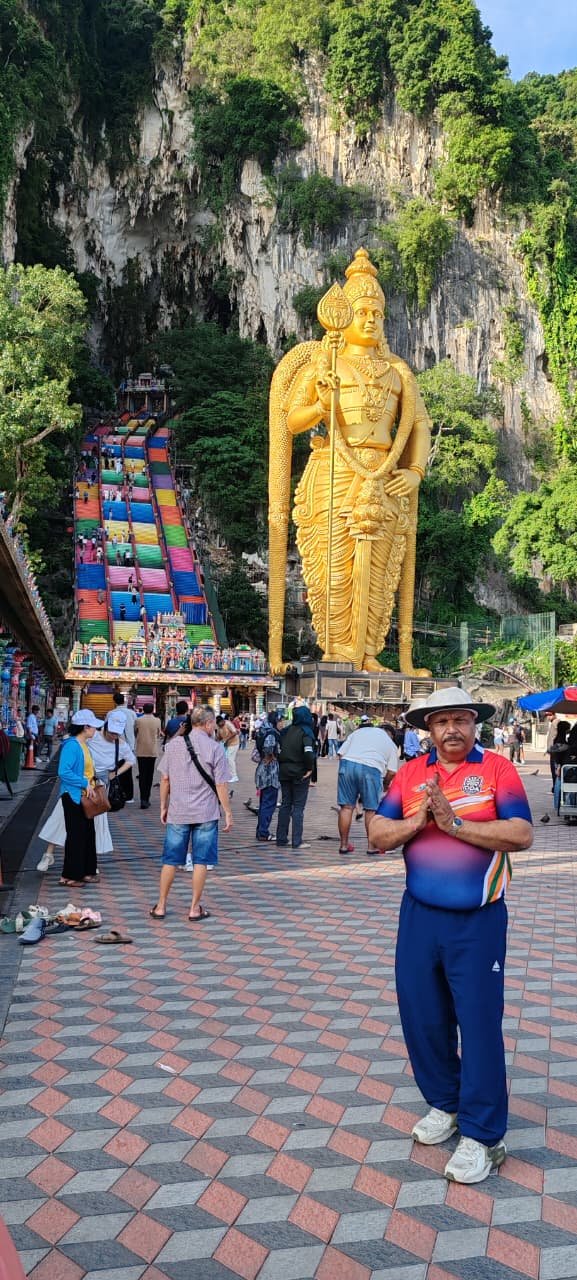
As soon as we stepped out of Batu Caves Metro Station, the first sight to the left was the gigantic statue of Lord Hanuman. Walking a little further, we witnessed the internationally renowned 47.3-meter-tall golden statue of Lord Murugan shining magnificently beneath the tropical sky. The colourful staircase leading devotees and tourists toward the sacred caves was breathtaking. The scene symbolised Malaysia’s multicultural identity—a country where temples, mosques, churches, and Gurudwaras coexist harmoniously.
A Message of Humanity
During our return journey, another touching human moment unfolded. Because of the cashless system, we were unable to buy metro tickets. At that moment, a gentleman from Pakistan named Hasan Bhai used his smart card to arrange our journey and respectfully returned the remaining balance as well. That small act seemed to erase political boundaries in an instant and reminded us that humanity is far greater than geography.
Disciplined Kuala Lumpur Wrapped in Greenery
In many ways, Kuala Lumpur reminded me of Thiruvananthapuram—with its dense greenery, humid yet pleasant weather, and calm urban rhythm. But what impressed me the most was the civic discipline. Drivers rarely used unnecessary horns. Pedestrians were given complete respect at zebra crossings. Roads were clean, scientifically planned, and almost free from chaos. Noise and air pollution were barely noticeable. The city seemed like a beautiful example of balancing modern urban planning with cultural roots. Traditional residential structures coexisted gracefully alongside towering skyscrapers.
An Emotional Farewell
Every meaningful journey eventually reaches its final chapter. Yes, before our departure on April 27, our entire team attended a farewell lunch hosted by Jassi Paji at “Desi Swad” restaurant. The warmth of Indian food and heartfelt conversations on foreign soil transformed the atmosphere from formal hospitality into a family gathering.
Later, at Kuala Lumpur International Airport, another emotional moment awaited me. K. Saigaran himself came to bid farewell to the Indian contingent. During the group photographs, he honoured me with a special shining medal in recognition of my efforts to promote darts through journalism and media. For a journalist, such moments carry emotions far greater than any award.
In return, Mahendra Singh Ji, Santosh Kumar Gupta Ji, and I presented him with a traditional Himachali cap as a symbol of Indian gratitude and friendship.
As the AirAsia flight rose into the sky toward New Delhi, we were not merely returning with medals and luggage. We were carrying stories—
stories of kindness,
stories of struggle and victory,
stories of strangers becoming family,
and stories that restore faith in humanity.
More Than Just a Travelogue
This Malaysia journey was not limited to participating in and covering an international championship. It became—a celebration of inclusive sportsmanship,
a lesson in service and humility, an exploration of multicultural harmony,
and a realisation that compassion is far greater than borders.
Representing India on an international platform was a matter of pride, but the true richness of this journey lay in its human connections—the warmth of Sikh hospitality, the generosity of strangers, the dedication of para athletes, and the quiet dignity of Malaysian society.
Malaysia no longer felt foreign to me. It began to feel familiar, affectionate, and emotionally connected. Perhaps that is why a Malaysian gentleman of Indian origin smiled and told me:
“One who has not seen Malaysia has truly not seen Asia.”
Today, as I relive those memories, I realise that journeys are not measured in kilometres. They are measured in experiences, in hearts touched, and in perspectives transformed.
And somewhere between the dartboards of Selangor, the prayers of Gurudwara Sahib, the colourful steps of Batu Caves, and the disciplined roads of Kuala Lumpur, I discovered a beautiful truth—Sometimes the finest journeys are the ones that quietly transform us from within.
And here, I conclude with one of my own couplets, while preparing for the next journey:
“Safar-e-zindagi chalti chale ja,
Manzilein khud-b-khud qayam hone lagengi…”
(Keep moving on through the journey of life, and destinations will begin to establish themselves on their own) .


Leave a Reply