

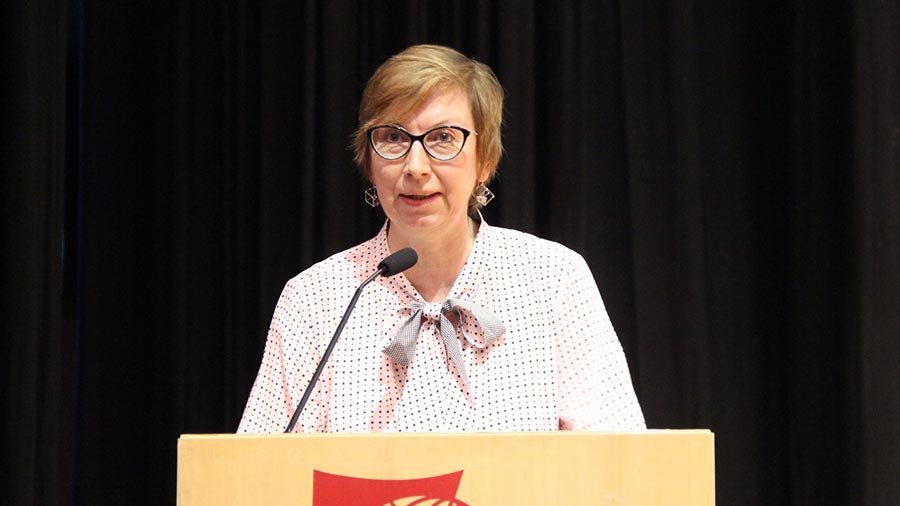
From tariff reductions and verified business information to artificial intelligence and digital innovation, Ms. Inga Skrūzmane outlined how the India–EU free trade agreement could create opportunities for businesses across both markets.
For smaller economies, international trade agreements can open doors that individual businesses might otherwise struggle to access. At the India–EU Diplomatic Dialogue organised by Diplomatist Magazine at Symbiosis International (Deemed University), Noida, on 15 October 2026, Ms Inga Skrūzmane, Chargé d’affaires at the Embassy of Latvia in India, explained how the India–EU free trade agreement could help Latvian companies expand their presence in India while creating opportunities for Indian businesses in Europe.
Describing Latvia as a small but innovative and environmentally conscious economy, Skrūzmane emphasised that the agreement’s importance lies in its potential to improve market access, strengthen commercial relationships and encourage cooperation in emerging technologies.
Tariff reductions and new market opportunities
Skrūzmane highlighted the scale of the India–EU economic relationship, noting that the two partners together represent a substantial share of global economic activity and a market of approximately two billion people.
She drew attention to the agreement’s potential to reduce or eliminate tariffs across a wide range of products. Machinery, electrical equipment, food products and chocolate were among the sectors she identified as relevant to Latvian exporters.
Beer, too, illustrated the potential commercial impact of tariff reductions. Latvia has an established brewing industry, and Skrūzmane used the example to explain how lower duties could improve the competitiveness of European products in the Indian market.
The opportunities extend in the other direction. She noted that Indian textiles, leather products, footwear, gems and jewellery, seafood, handicrafts and chemicals could benefit from improved access to European consumers. Many of these sectors are important sources of employment for small businesses across India.
For Latvia, India is a market with significant potential. Skrūzmane cited Latvian exports to India of approximately €50 million in the preceding year, identifying machinery, chemicals and timber among the country’s principal export categories to India.
Information and trust: the missing links for SMEs
Responding to a question from moderator Kent Oliver Bhupathi, CEO and co-founder of Market Theory AI, Skrūzmane identified access to reliable information as one of the most important requirements for helping smaller Indian and Latvian businesses benefit from the agreement.
She explained that distance and limited familiarity with each other’s business environments could discourage entrepreneurs from exploring opportunities. Smaller companies, in particular, may lack the resources to undertake extensive international market research or navigate unfamiliar regulatory systems.
Her proposed solution was practical: accessible, verified business information, effective points of contact and greater exchanges between commercial communities.
She also encouraged entrepreneurs to participate in trade exhibitions and establish direct business-to-business relationships. Understanding local business practices, developing personal contacts and building confidence, she argued, are essential to turning an agreement on paper into functioning commercial partnerships.
The message was relevant to both countries. Just as Latvian companies may regard India as an unfamiliar market, Indian businesses may know relatively little about Latvia and its position within the European Union.
Digital innovation as a bridge
Skrūzmane also identified digitalisation and artificial intelligence as promising areas for bilateral cooperation.
She expressed admiration for India’s Unified Payments Interface (UPI), highlighting how digital public infrastructure has become part of everyday life. She also pointed to the wider potential for collaboration in artificial intelligence, an area that presents opportunities as well as questions requiring international cooperation.
An example from the Latvian start-up ecosystem illustrated the possibilities. Skrūzmane referred to a Latvian-founded software business operating in India and serving more than 10,000 Indian enterprises with tools for workplace productivity and remote-team visibility.
The example demonstrated how a company originating in a relatively small European market could establish a presence in India and serve a substantial business community.
For Skrūzmane, this kind of exchange shows why the India–EU partnership should encompass more than traditional trade. Digital services, technological innovation and entrepreneurship can create new forms of cooperation that complement the movement of physical goods.
Building a partnership that reaches smaller businesses
Latvia’s perspective brings an important dimension to the India–EU relationship. While tariff reductions can create the conditions for trade, smaller enterprises also need information, contacts and confidence to enter new markets.
Skrūzmane’s remarks highlighted the role that embassies, trade fairs, business networks and digital partnerships can play in bridging this gap.
The broader opportunity is to ensure that the benefits of the India–EU agreement are not confined to large corporations. With the right information and commercial connections, small and medium-sized enterprises can become active participants in a partnership linking two major economic regions.


Leave a Reply